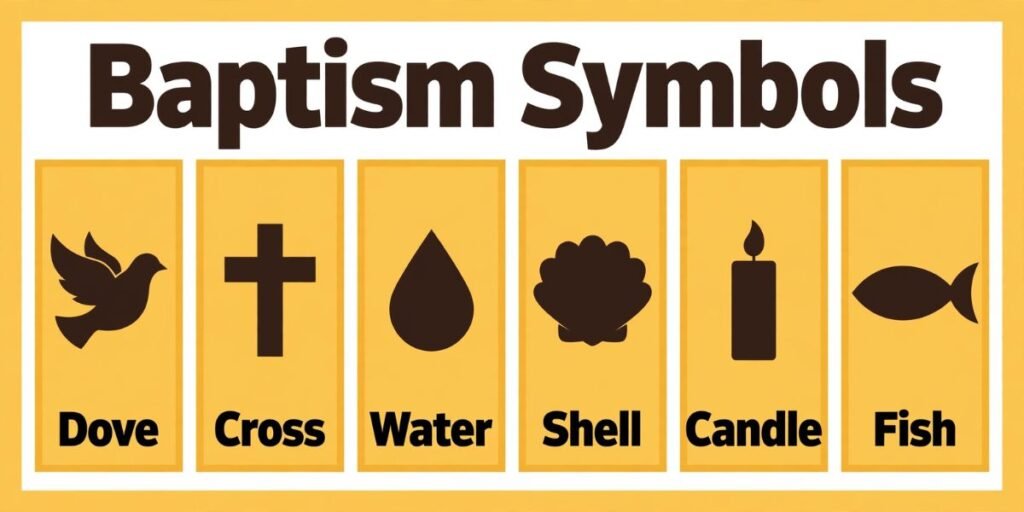
Why is baptism so important in the Christian faith? Symbols are used in the baptism to illustrate the spiritual message of this unique ceremony. Each of the water, the cross, white clothing, oil and the candles symbolizes something related to faith, new life, hope and a relationship with Jesus Christ.
Christian churches use these as various symbols, but they can assist many to grasp the meaning of baptism.Forgiveness and spiritual renewal are some symbols that remind believers.
Others refer to the light of Christ, the work of the Holy Spirit or a person’s role within the Christian community. If you are attending a baptism as a parent, godparent, family member or new believer, understanding these meanings can help you to follow the baptism better.
Water Symbol In Baptism
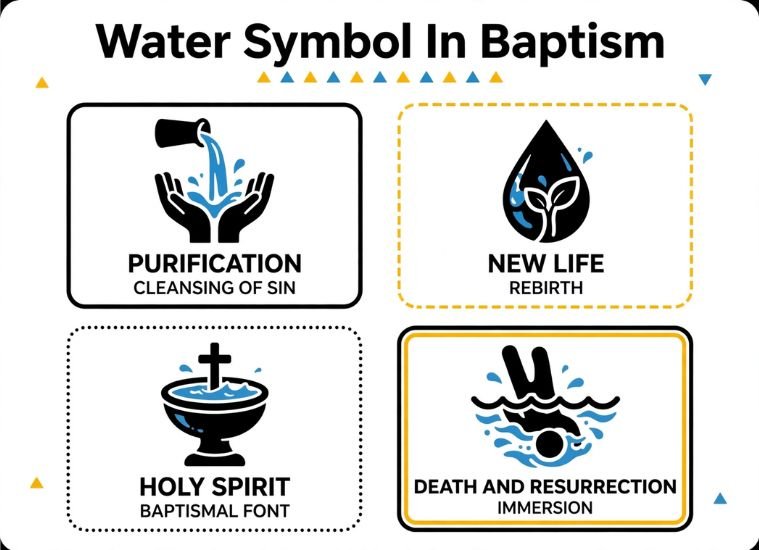
Water Symbol In Baptism represents cleansing, renewal, and the beginning of a new life in the Christian faith. During baptism, water is used as a visible sign of God’s grace and a person’s entry into the Christian community. It also recalls biblical stories in which water is connected with life, purification, and salvation.
Although baptism practices differ among churches, water remains the central symbol of this important Christian sacrament or ordinance.
In many traditions, the use of water also reflects the idea of leaving an old way of life behind and beginning a journey of faith. It reminds believers of God’s promise of spiritual renewal and the importance of growing in Christian love and obedience.
| Icon | Symbol | Meaning | Origin | Description |
| 💧 | Waters of Creation | New beginning, life from chaos | Genesis 1 (Hebrew Bible) | Water over which the Spirit moved at creation, recalled in the blessing of baptismal water. |
| 🌊 | Crossing of the Red Sea | Liberation from slavery to sin | Exodus 14 | The Israelites passing through the sea, read by early Christians as a model of passing through baptism to freedom. |
| 🛶 | Noah’s Flood | Cleansing and salvation | Genesis 6 to 9; 1 Peter 3:20-21 | Floodwaters that cleansed the earth while the ark saved the faithful, seen as a type of baptism. |
| 🏞️ | Jordan River | Christ’s own baptism | Gospels (Matthew 3, Mark 1) | The river where John baptized Jesus, the model for Christian baptism. |
| 🕊️ | Living Water | Spiritual life and the Holy Spirit | John 4 and John 7:38 | Flowing water that Jesus used to describe the Spirit’s life-giving gift. |
Learn about the mythology and historical significance behind Ares Symbols meanings and how they relate to war, courage, strength, and the Greek god Ares.
Cross Symbol In Baptism
Cross Symbol In Baptism represents the death and resurrection of Jesus Christ and the hope of salvation through him. It reminds Christians that baptism is connected with faith, forgiveness, and a new beginning in Christ. Some churches make the sign of the cross on the person’s forehead during the baptism ceremony.
This gesture expresses belonging to Christ and serves as a reminder of the Christian commitment to follow his teachings. The cross also represents the love and sacrifice Jesus showed through his life and death.
For the newly baptized person, it can serve as a lasting reminder to live with compassion, faith, and responsibility toward others.
| Icon | Symbol | Meaning | Origin | Description |
| ✝️ | Sign of the Cross | Belonging to Christ | Early Christian practice (2nd century) | Traced on the forehead of the baptized as a mark of Christ’s ownership. |
| 🏷️ | Seal of Baptism | Permanent spiritual mark | Ephesians 1:13 and early patristic writings | A sign of being sealed in the Spirit, understood in some traditions as an indelible mark. |
| ⚓ | Anchor Cross | Hope and steadfast faith | Early Christian catacomb art; Hebrews 6:19 | A cross shaped like an anchor, a disguised symbol used by persecuted Christians. |
| 🔱 | Chi-Rho | Christ’s name | Early Christianity (Constantine era) | The first two Greek letters of “Christ” combined, often carved on fonts. |
| 🌿 | Tau Cross | Salvation and marking of the faithful | Ezekiel 9:4 and Franciscan tradition | A T-shaped cross, an early Christian sign of protection. |
Explore the artistic meanings and cultural references behind Anime Symbols designs and how they connect to characters, storytelling, emotions, and Japanese animation.
White Garment Symbol In Baptism
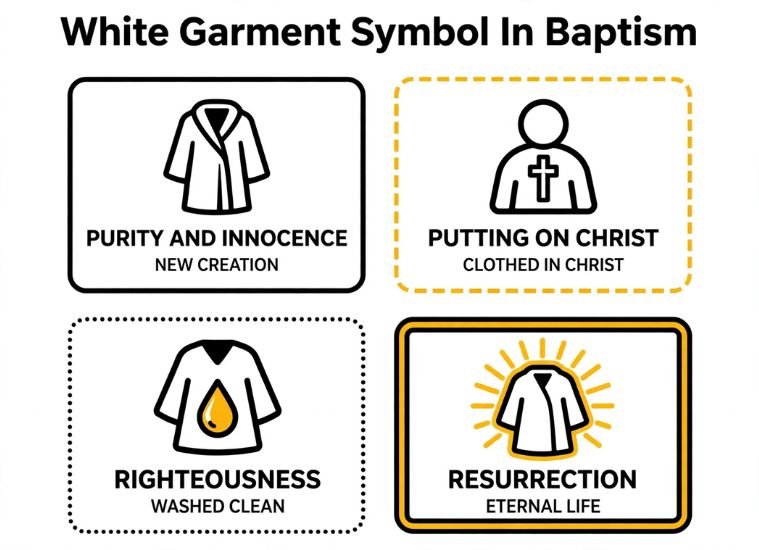
White Garment Symbol In Baptism represents purity, new life, and the spiritual transformation associated with becoming a Christian. In many baptism traditions, the person being baptized wears white clothing or receives a white garment during the ceremony. The garment serves as a visible reminder of a renewed relationship with God and a life guided by faith.
Its exact use and wording vary across Christian denominations, but the central theme is spiritual renewal. White clothing can also express the joy and hope associated with becoming part of the Christian community.
Families may preserve a baptismal garment as a special keepsake that recalls an important moment in their religious life.
| Icon | Symbol | Meaning | Origin | Description |
| 👶 | Christening Gown | Purity and new life | European Christian tradition (since the early Middle Ages) | A white gown worn by infants, often kept as a family heirloom. |
| 👘 | Chrisom Cloth | Anointed purity | Medieval English and Catholic tradition | A white cloth placed on the newly baptized after anointing. |
| 🧥 | Putting On Christ | Taking on a new identity | Galatians 3:27 | The scriptural idea behind clothing the baptized in white. |
| 👗 | Baptismal Robe of Adults | Cleansed life and commitment | Early church practice (Easter Vigil) | White robes worn by adult converts, traditionally for the week after Easter. |
| ✨ | Dominica in Albis | Week of white garments | Early church tradition | The Sunday after Easter, when the newly baptized once wore their white robes. |
Learn about card rarity levels, collectible markings, and what different Pokémon Rarity Symbols guides can tell you about Pokémon trading cards.
Candle Symbol In Baptism
Candle Symbol In Baptism represents the light of Christ and the call to live according to his teachings. In some Christian traditions, especially Catholic baptism, a lit candle is presented to the newly baptized person or their family. The flame reminds Christians that faith can guide them through difficult moments and encourage them to share kindness with others.
It also symbolizes the responsibility of the Christian community to support the person’s spiritual growth. The candle is often lit from the Easter candle in Catholic ceremonies, connecting baptism with the celebration of Christ’s resurrection.
Parents and godparents may be encouraged to help the baptized person grow in faith and reflect Christ’s light through their actions.
| Icon | Symbol | Meaning | Origin | Description |
| 🕯️ | Baptismal Candle | Christ’s light entrusted to the baptized | Catholic, Orthodox and Anglican rites | A candle lit from the Paschal candle and handed to the newly baptized or their godparents. |
| 🔥 | Paschal Candle | Risen Christ, the source of light | Early Christian Easter Vigil | A large candle blessed at Easter, from which baptismal candles are lit. |
| 🌟 | Light of the World | Christ illuminating believers | John 8:12 | The scriptural image behind the candle ceremony. |
| 🙏 | Godparent’s Flame | Shared responsibility for faith | Early church sponsorship tradition | The role of godparents in keeping the child’s light of faith alive. |
| 🌅 | Children of Light | Walking in faith | Ephesians 5:8 and 1 Thessalonians 5:5 | The call to live as people who have left darkness. |
Learn how common laboratory warning signs communicate hazards and support safer work with these Lab Safety Symbols references.
Oil Symbol In Baptism
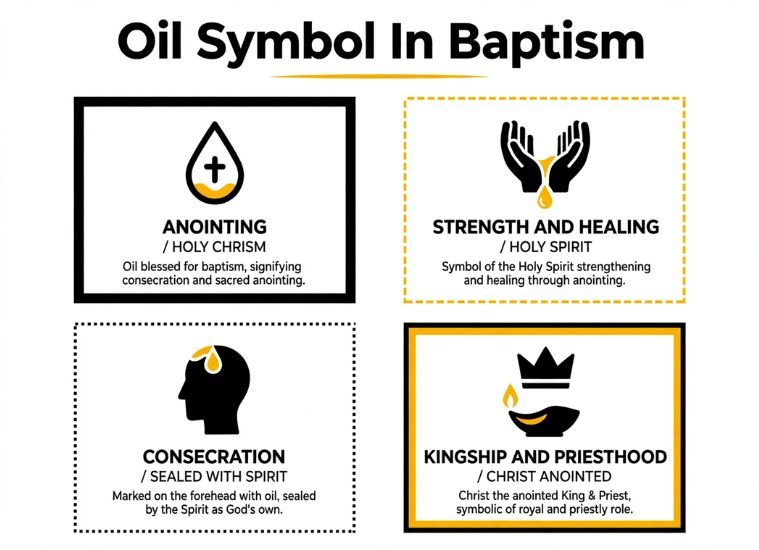
Oil Symbol In Baptism represents blessing, strengthening, and the work of the Holy Spirit in Christian life. In Catholic baptism, specific holy oils may be used during the ceremony, including the Oil of Catechumens and Sacred Chrism.
These oils have distinct roles within the rite and are not interchangeable. The use of oil differs among Christian denominations, but where it is included, it can express spiritual preparation, consecration, and belonging to God’s people.
The anointing also connects baptism with ancient biblical practices in which oil was used to mark people for special purposes. For many Christians, this symbol highlights the spiritual support and strength associated with a life of faith.
| Icon | Symbol | Meaning | Origin | Description |
| 🫒 | Chrism | Anointing with the Holy Spirit | Catholic, Orthodox and Anglican tradition | Consecrated oil of olive and balsam, used after baptism and in confirmation. |
| 🏺 | Oil of Catechumens | Strength for the journey | Early church tradition | Oil used before baptism to prepare candidates for the struggle against evil. |
| 👑 | Royal Anointing | Sharing in Christ’s role as priest, prophet and king | Old Testament (1 Samuel 16) | The practice of anointing kings, applied to all the baptized. |
| 🕊️ | Anointing of the Spirit | Gift of the Holy Spirit | 1 John 2:20 and Acts 10:38 | Oil as a sign of the Spirit’s presence and empowerment. |
| 🌿 | Olive Branch | Peace and reconciliation with God | Genesis 8 (Noah’s dove) | The tree that gives the oil, linked to peace after the flood. |
Explore the history, cultural meanings, and national traditions represented by these German Symbols traditions.
Baptismal Font Symbol
Baptismal Font Symbol represents the place where baptism takes place and serves as a reminder of spiritual cleansing and new life. In many churches, the font holds the water used during the baptism ceremony and may be designed with meaningful Christian artwork or shapes.
Its location and appearance vary according to the church’s architecture and tradition. For Christians, the font connects the physical act of baptism with the spiritual meaning of entering the community of faith. Some fonts are placed near the entrance of a church to highlight baptism as the beginning of Christian life.
Others feature designs such as crosses or eight-sided shapes, which may express particular theological ideas within the community that uses them.
| Icon | Symbol | Meaning | Origin | Description |
| ⛪ | Baptismal Font | Place of new birth | Early Christian baptisteries (3rd to 4th century) | A basin of blessed water, usually near a church entrance to mark entry into the faith. |
| 🔷 | Octagonal Font | The eighth day, new creation | Early Christian architecture (Ambrose of Milan) | An eight-sided basin pointing to Christ’s resurrection on the day after the seventh. |
| 🏛️ | Baptistery | Sacred space for initiation | Early Christian architecture (e.g., Lateran, Rome) | A separate building or chamber built for baptism. |
| 🥣 | Shell and Ewer | Pouring water in the Trinity’s name | Medieval and Renaissance church use | A scallop shell or jug used to pour water over the candidate’s head. |
| 🌊 | Immersion Pool | Burial and rising with Christ | Romans 6:3-4; Baptist and Orthodox traditions | A pool used for full-immersion baptism. |
Learn how military insignia, flags, and emblems communicate rank, service, and heritage through these Military Symbols meanings.
Dove Symbol In Baptism
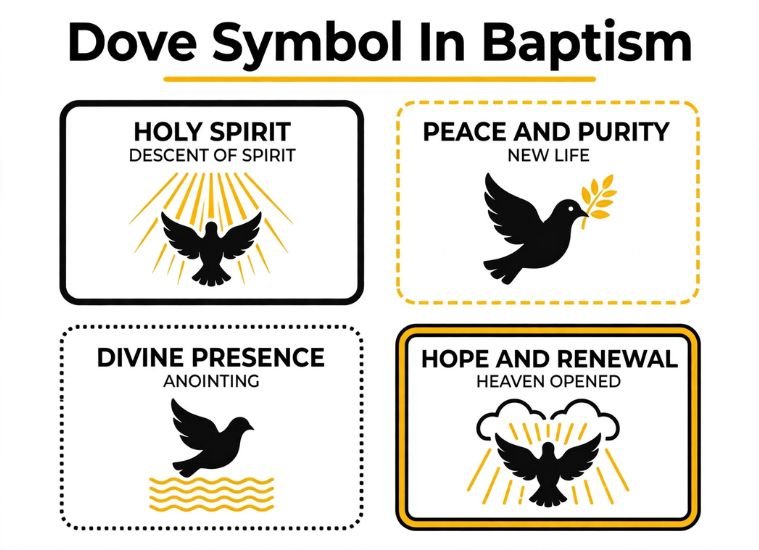
Dove Symbol In Baptism represents the Holy Spirit and is closely connected with the baptism of Jesus described in the Gospels. In these biblical accounts, the Spirit descends like a dove after Jesus is baptized, making the image an important Christian symbol.
A dove may appear in church decorations, baptismal artwork, or religious gifts. It can remind believers of God’s presence, peace, and guidance, although the dove is a symbolic image rather than a required object in baptism ceremonies.
The image also connects baptism with the biblical message that God’s Spirit guides and strengthens believers. For families, a dove on a baptism card or keepsake can express hope for the person’s spiritual journey.
| Icon | Symbol | Meaning | Origin | Description |
| 🕊️ | Dove Descending on Jesus | Presence and approval of the Holy Spirit | Gospels (Matthew 3:16, Mark 1:10) | The dove that appeared at Christ’s baptism in the Jordan, the model for the Spirit’s role in every baptism. |
| 🌿 | Dove of Noah | Peace after judgment, hope of new land | Genesis 8:8-12 | A dove returning with an olive leaf, read by early Christians as a sign of peace with God. |
| 🪟 | Dove in Stained Glass and Fonts | Spirit hovering over the water | Medieval and Gothic church art | A carved or painted dove placed above fonts and baptistery windows. |
| 🏺 | Dove Vessel (Peristerium) | Spirit sheltering the sacrament | Early Byzantine and medieval church practice | A dove-shaped container that held the reserved Eucharist, hung above altars and sometimes fonts. |
| 🔥 | Dove and Tongues of Fire | Spirit’s gifts of power and witness | Acts 2 (Pentecost) | A dove paired with flames, used to show the Spirit’s empowering of the baptized. |
Biblical Symbols And New Life
Biblical Symbols And New Life help explain how baptism connects with themes of spiritual renewal, faith, and transformation. Water is associated with cleansing, while the image of being born again points to a changed relationship with God.
The death and resurrection of Jesus also provide an important biblical foundation for understanding baptism, particularly in passages such as Romans 6:3-4.
Different Christian traditions interpret and explain these themes in their own ways, but new life remains a central idea. Other biblical images, including light and the presence of the Holy Spirit, help describe the journey of faith. Together, these themes encourage Christians to leave harmful habits behind and grow in love, forgiveness, and service to others.
| Icon | Symbol | Meaning | Origin | Description |
| 🌱 | New Creation | Old life passed away, new has come | 2 Corinthians 5:17 | The image of a believer made new in Christ, central to baptismal teaching. |
| 👶 | Born Again | Spiritual rebirth by water and Spirit | John 3:3-5 | Jesus’s words to Nicodemus, the foundation for seeing baptism as new birth. |
| ⚰️ | Buried and Raised With Christ | Dying to sin, rising to new life | Romans 6:3-4; Colossians 2:12 | The idea that going under the water mirrors burial and rising mirrors resurrection. |
| 🌳 | Tree Planted by Water | Fruitful, rooted life | Psalm 1:3 and Jeremiah 17:8 | A tree thriving by a stream, used for the flourishing faith of the baptized. |
| 🦋 | Putting Off the Old Self | Leaving the former way of life | Ephesians 4:22-24 | The call to shed the old nature and put on the new, a theme of transformation. |
Catholic Baptism Symbols And Their Meanings
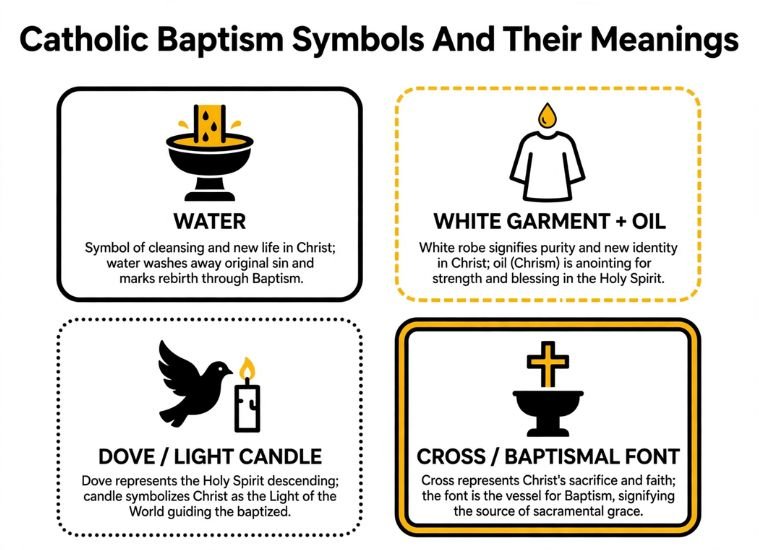
Catholic Baptism Symbols And Their Meanings include water, the sign of the cross, holy oils, a white garment, and a baptismal candle. Each element has a particular place in the Roman Catholic baptism rite and communicates an aspect of Christian faith. Water signifies baptismal cleansing and new life, while the oils express spiritual preparation and consecration.
The white garment and candle point to life in Christ and the responsibility to live by the light of faith. The ceremony also includes prayers and blessings that welcome the person into the Church and ask for God’s grace.
Parents and godparents have an important role in supporting the baptized person’s spiritual development, particularly when the baptism takes place during infancy.
| Icon | Symbol | Meaning | Origin | Description |
| 💦 | Trinitarian Formula | Baptism in the name of Father, Son and Spirit | Matthew 28:19 | The words spoken as water is poured or the candidate is immersed. |
| 🧂 | Exorcism and Prayer of Deliverance | Freedom from the power of evil | Early church rite, Rite of Baptism for Children | A prayer asking God to protect the candidate from sin and darkness. |
| 👂 | Ephphatha Rite | Ears opened to hear, lips to proclaim | Mark 7:34 | A gesture where the minister touches the ears and mouth of the baptized. |
| 📖 | Godparents | Sponsors of the child’s faith | Early Christian sponsorship | Chosen adults who present the child and promise to support their faith. |
| 🔔 | Renewal of Baptismal Promises | Rejecting sin, professing faith | Roman Catholic liturgy (Easter Vigil) | Parents and godparents state the faith in which the child is baptized. |
Orthodox Christian Baptism Symbols
Orthodox Christian Baptism Symbols reflect the tradition’s emphasis on new life in Christ, participation in the Church, and the gift of the Holy Spirit.
Water is central to the baptism service, which commonly involves the threefold immersion of the person being baptized. Holy oil, white clothing, candles, and other ritual actions also carry spiritual significance within the service. Details may vary among Eastern Orthodox jurisdictions, but baptism is generally understood as part of entering the life of the Church.
In the Orthodox tradition, baptism is commonly followed by chrismation, through which the newly baptized person is anointed with holy chrism. The service also includes prayers and actions that express a turning away from evil and a commitment to Christ.
| Icon | Symbol | Meaning | Origin | Description |
| 🛁 | Triple Immersion | Death, burial and resurrection; the Trinity | Eastern Orthodox tradition | The candidate is fully immersed three times. |
| 🧿 | Renunciation of Satan | Turning away from evil | Early Eastern liturgy | The candidate faces west and rejects the devil, then turns east to profess Christ. |
| 📿 | Baptismal Cross | Lifelong sign of faith | Orthodox practice | A small cross blessed and hung around the neck, worn for life. |
| 🧴 | Myron Anointing (Chrismation) | Seal of the gift of the Holy Spirit | Eastern Orthodox tradition | Oil anointing on the forehead, eyes, ears, lips, chest, hands and feet right after baptism. |
| ✂️ | Cutting of Hair | Offering of self to God | Orthodox practice | A small lock of hair is cut as a first offering. |
Protestant Baptism Symbols And Traditions
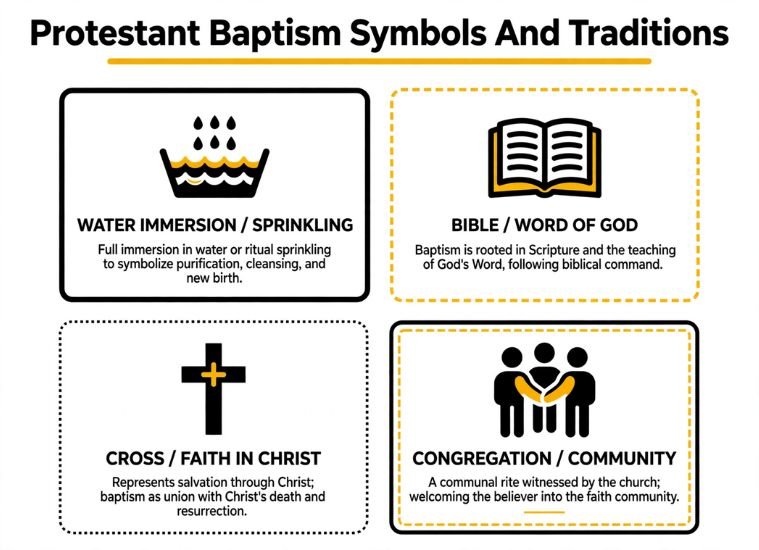
Protestant Baptism Symbols And Traditions vary considerably because Protestant churches differ in their beliefs and practices. Many use water to express faith in Christ, cleansing, and new life, while some also include a cross, white clothing, or candles.
Some communities baptize infants, whereas others baptize people who personally profess their faith; methods may include immersion, pouring, or sprinkling.
Understanding a particular church’s tradition helps explain the meaning it gives to baptism and the symbols used during the service. In many Protestant communities, the ceremony includes readings from the Bible, prayer, and a public statement of faith.
The congregation may also welcome the newly baptized person and offer encouragement as they continue their Christian journey.
| Icon | Symbol | Meaning | Origin | Description |
| 📜 | Believer’s Baptism | Public profession of personal faith | Anabaptist and Baptist tradition (16th and 17th centuries) | Baptism given only to those who confess faith for themselves. |
| 🏊 | Full Immersion | Burial with Christ and rising to new life | Baptist, Pentecostal and many evangelical churches | The believer is lowered fully under water in a pool or river. |
| 🏠 | Infant Baptism and the Covenant | Child included in God’s promises | Reformed, Lutheran and Methodist tradition | Baptism of infants, seen as a sign of God’s grace given before understanding. |
| 🤝 | Church Membership and Testimony | Joining the local congregation | Evangelical Protestant practice | Baptism paired with a spoken testimony and welcome into the church. |
| 📘 | Ordinance, Not Sacrament | Obedient symbol of grace already received | Baptist and many evangelical statements of faith | The view that baptism illustrates salvation rather than conveying it. |
Frequently Asked Questions About Baptism Symbols
What are the main symbols of baptism?
Water, the cross, a white garment, oil, and a candle are common baptism symbols in several Christian traditions. Not every church uses all of them.
What does water symbolize in baptism?
Water commonly represents cleansing, new life, and spiritual renewal. Many Christians also connect it with Jesus’ death and resurrection.
Why is white clothing used in baptism?
White clothing often represents purity, new life in Christ, and a new Christian identity. Its use varies between churches.
What does the baptism candle represent?
The candle commonly represents the light of Christ and the call to live according to Christian faith. In some traditions, it is lit from the Paschal Candle.