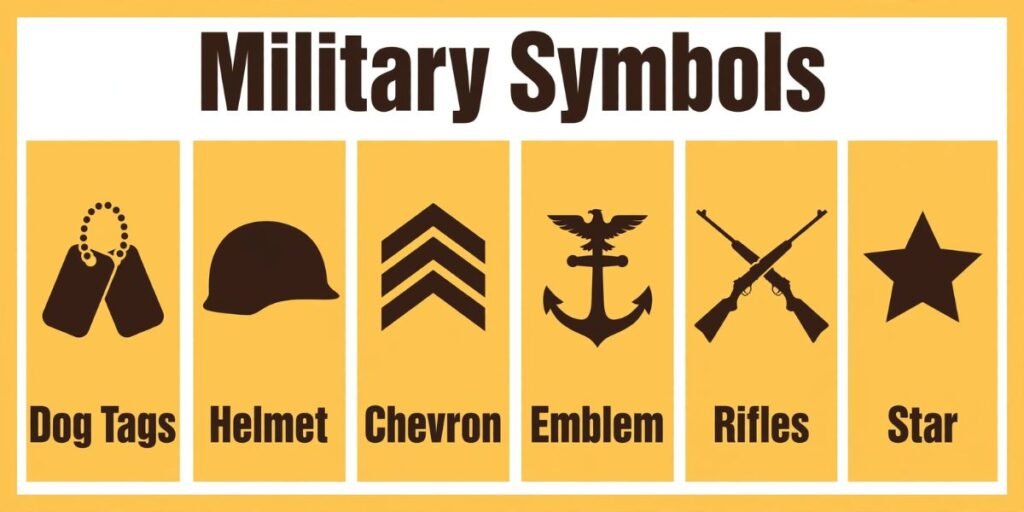
What is it about military symbols that people are able to recognize them even without the use of words? Military symbols are used to create information, identity, history and purpose in clear visual designs.
These may be used on maps, uniforms, flags, medals, badges, vehicles, documents and on displays of units. Symbols assist military personnel in understanding positions, movements or operational information. NATO’s APP-06 offers a common approach to the graphical codes of the military set for command, control, mapping and other related uses.
Heraldry includes other military symbols, including patches, coats of arms, badges, flags and seals. These designs can depict a unit’s identity, history, mission, traditions, achievements, etc.
In this guide, you will find out about common military symbols, what they represent and how they can be used. Symbols may have different meanings in different countries, different services, systems and contexts.
What Are Military Symbols?
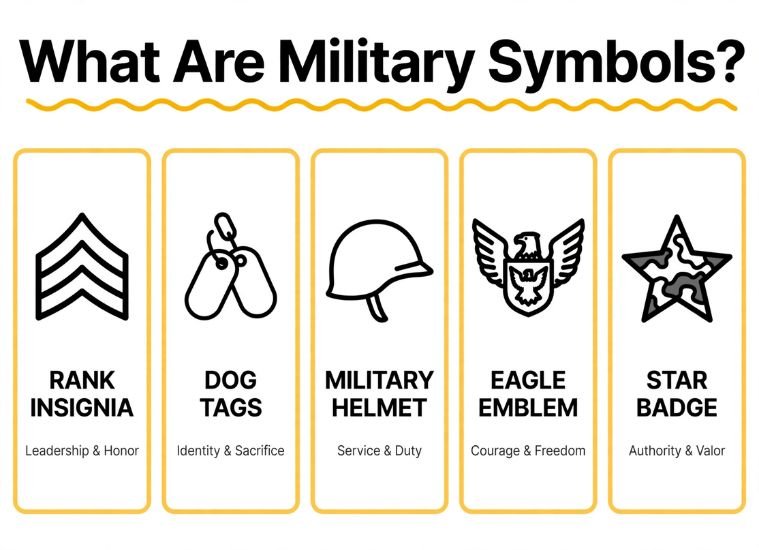
Military symbols are visual signs, designs, or objects used by armed forces to communicate identity, authority, affiliation, achievement, or tradition. They can appear on uniforms, vehicles, flags, buildings, official documents, medals, and military equipment.
Common examples include:
- Military insignia
- Unit emblems
- Rank insignia
- Military flags
- Service branch symbols
- Medals and decorations
- Regiment and squadron badges
- Military crests
- Shields and heraldic designs
- Stars, eagles, anchors, swords, and wings
Some symbols are primarily practical, helping identify a person’s rank or unit. Others have a ceremonial or historical purpose and preserve traditions that have developed over many years.
Explore the meanings and cultural significance behind Symbols For Family traditions and how they represent love, connection, unity, and belonging.
Military Symbols And Their Meanings
Military symbols can serve several different purposes.Some communicate operational information, while others identify people, units, awards, or organizations.
Their meaning depends heavily on the system and context.NATO operational symbology, for example, uses standardized graphical elements to support a common visual language.
| Symbol | Meaning | Description |
| Shield | Protection | Commonly used in military heraldry to represent defense and identity. |
| Sword | Military Power | Often represents readiness, authority, or armed service. |
| Eagle | Leadership | Frequently used to express strength, vigilance, or national identity. |
| Star | Achievement | Can represent rank, service, achievement, or national identity depending on context. |
| Laurel | Honor | Often associated with achievement, courage, and victory in military heraldry. |
| Torch | Liberty | Can represent freedom, knowledge, or guidance. |
| Anchor | Naval Service | Commonly associated with maritime forces and naval identity. |
| Wings | Aviation | Often connected with flight and military aviation. |
| Crossed Swords | Readiness | Can represent military strength and preparedness. |
| Globe | Worldwide Mission | Can represent operations or responsibilities across regions. |
| Cannon | Artillery | Represents artillery heritage or military firepower. |
| Lightning Bolt | Speed | May suggest rapid action or communications in specific insignia. |
| Arrow | Direction | Can represent movement, purpose, or forward action. |
| Helmet | Military Service | Represents soldiers, protection, and military tradition. |
| Flag | Identity | Represents a nation, service, organization, or unit. |
| Medal | Recognition | Represents an official award or decoration. |
| Ribbon | Service | Often carries information about military awards. |
| Badge | Qualification | Identifies an earned qualification or official role. |
| Patch | Unit Identity | Can identify a military organization or headquarters. |
| Crest | Heritage | Forms part of some official heraldic designs. |
Explore the meanings and cultural significance behind Symbols Of Freedom expressions and how they represent independence, liberty, courage, and personal choice.
Military Symbols For Unit Identity
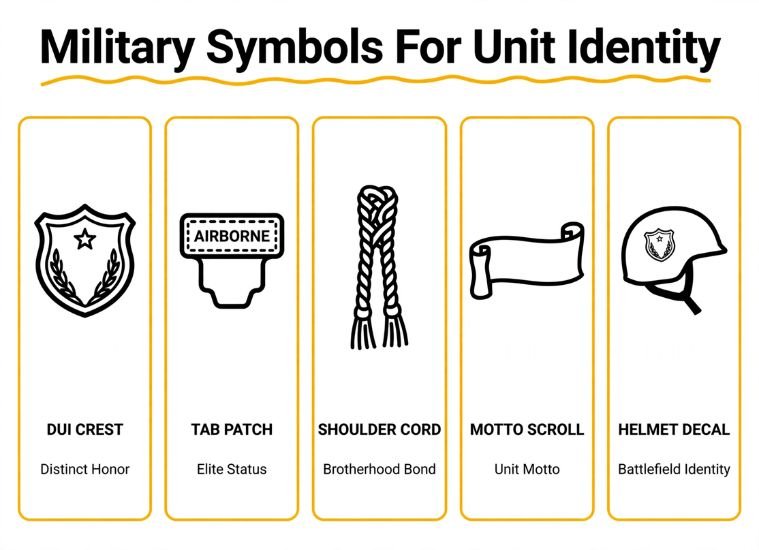
Military organizations use insignia to create a recognizable visual identity.A unit’s design may include shapes, animals, colors, objects, mottos, or historical references.U.S.
Army sources explain that heraldic items can reflect a unit’s history, traditions, ideals, mission, and accomplishments.The exact design and authorized use depend on the military organization and its regulations.
| Symbol | Meaning | Description |
| Shoulder Sleeve Insignia | Unit Identity | Identifies the primary headquarters to which an Army soldier is assigned. |
| Distinctive Unit Insignia | Organization | A metal device associated with an authorized Army unit. |
| Unit Crest | Heritage | Represents the identity and history of a military organization. |
| Regimental Insignia | Tradition | Connects a unit with its organizational history. |
| Unit Patch | Assignment | Provides visual identification of a military organization. |
| Unit Flag | Identity | Displays an organization’s approved visual identity. |
| Guidon | Unit Marker | A small flag used to identify certain military units. |
| Coat Of Arms | Heritage | A heraldic design associated with an organization. |
| Organizational Seal | Authority | Identifies an official military organization. |
| Unit Tab | Designation | Can identify a particular unit or mission. |
| Shoulder Tab | Identification | Provides additional organizational identification on some uniforms. |
| Beret Flash | Unit Identity | A colored insignia associated with certain Army organizations. |
| Organizational Device | Identity | Represents an approved military organization or function. |
| Regimental Crest | Heritage | Connects an organization to its history and traditions. |
| Service Emblem | Branch Identity | Represents a military service or organization. |
Explore the meanings and personal significance behind Symbols That Represent Me ideas and how they can reflect identity, personality, values, and individuality.
Military Symbols For Ranks And Leadership
Rank symbols help show a person’s position within a military hierarchy.The specific shapes and insignia vary between countries and military services.Stars, bars, stripes, chevrons, and other devices can carry rank information.
They should not be interpreted without knowing the relevant country’s uniform system.
| Symbol | Meaning | Description |
| Chevron | Rank | Used in various military systems to indicate enlisted grades. |
| Bar | Rank | Bars appear in several military rank systems. |
| Star | Senior Rank | Stars can indicate certain officer ranks in some forces. |
| Eagle Device | Senior Leadership | Used in some military rank systems and insignia. |
| Oak Leaf | Rank | Appears in some U.S. military officer rank insignia. |
| Diamond | Rank | Used as a rank device in some military systems. |
| Crown | Rank | Used in some national military rank traditions. |
| Pip | Rank | Small devices used in certain rank systems. |
| Stripe | Rank | Stripes can identify military grade or service level. |
| Shoulder Board | Rank | A uniform area that may display rank insignia. |
| Collar Insignia | Rank | Certain forces use collar devices to indicate rank or branch. |
| Epaulet | Rank | A shoulder feature that can carry rank insignia. |
| Rank Star | Officer Grade | A star may indicate officer grade in some systems. |
| Warrant Officer Device | Status | Identifies warrant officer rank in applicable systems. |
| Command Insignia | Authority | Can identify a command role or position. |
Explore the meanings and cultural significance behind Symbols Of Strength meanings and how they represent courage, resilience, power, and inner fortitude.
Military Symbols For Medals And Awards
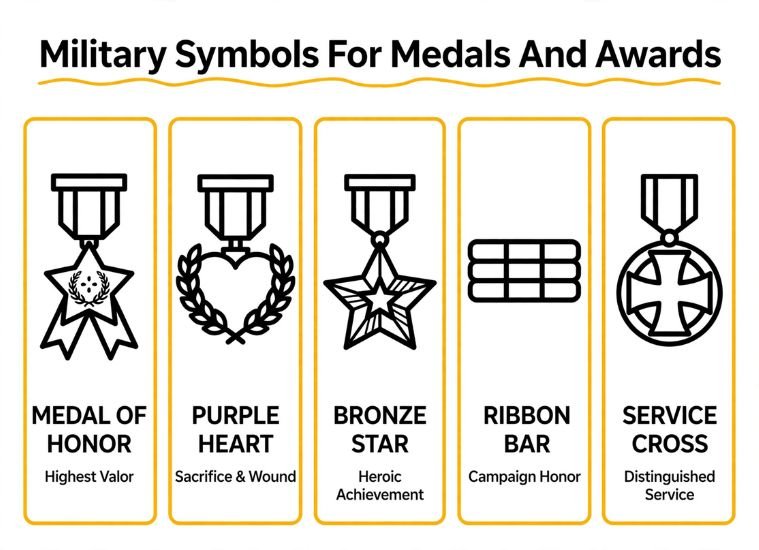
Military awards use symbols, ribbons, medals, and devices to record recognition or service.Their designs can contain stars, crosses, eagles, laurel branches, shields, or other elements.
The meaning is specific to the award and issuing authority.For example, the U.S. Army states that service stars can indicate participation in a named campaign or an additional award on certain medals and ribbons.
| Symbol | Meaning | Description |
| Medal Star | Recognition | Can form part of an award design. |
| Service Star | Campaign Service | Used on specified U.S. awards for campaign or service recognition. |
| Bronze Star Device | Award Device | A specific device used within U.S. military awards. |
| Silver Star Device | Award Device | A silver star can replace five bronze service stars in specified cases. |
| Laurel Wreath | Achievement | Often associated with honor and accomplishment. |
| Ribbon Bar | Service Record | Displays award ribbons according to service rules. |
| Cross Medal | Honor | Used by some military decorations. |
| Eagle Medal | Service | Can incorporate national or military symbolism. |
| Shield Medal | Defense | May represent service connected with defense. |
| Sword Medal | Military Merit | Can represent military service or achievement. |
| Star Ribbon | Recognition | Uses a star as part of an award design. |
| Campaign Ribbon | Campaign Service | Represents qualifying participation in a designated campaign. |
| Unit Award Ribbon | Unit Recognition | Can represent recognition awarded to an organization. |
| Valor Decoration | Courage | Used for awards recognizing specified acts of bravery. |
| Service Decoration | Service | Recognizes qualifying military service. |
Explore the meanings and religious significance behind Catholic Symbols traditions and how they represent faith, worship, devotion, and Christian beliefs.
Military Symbols For Branches Of Service
Military branches often have their own emblems, colors, traditions, and identifying devices.These symbols help distinguish one service or professional community from another.
The exact designs vary by nation.A symbol that has one meaning in one military may have a different role elsewhere.
| Symbol | Associated Area | Description |
| Anchor | Navy | Strongly associated with maritime service. |
| Wings | Air Force | Represents flight and aviation. |
| Crossed Cannons | Artillery | Commonly associated with artillery traditions. |
| Crossed Rifles | Infantry | Used in some military infantry insignia. |
| Tank | Armored Forces | Represents armored warfare and vehicles. |
| Missile | Missile Forces | Represents missile-related military capabilities. |
| Propeller | Aviation | Can represent aviation heritage. |
| Ship | Naval Forces | Represents maritime operations. |
| Submarine | Undersea Forces | Identifies submarine-related service or heritage. |
| Parachute | Airborne Forces | Represents airborne operations. |
| Medical Caduceus | Medical Service | Used in some military medical insignia. |
| Signal Bolt | Communications | Can represent military communications. |
| Engineer Castle | Engineers | The castle is strongly associated with U.S. Army engineers. |
| Quartermaster Key | Logistics | Can represent logistics and supply traditions. |
| Military Police Insignia | Security | Identifies military police traditions or organizations. |
Explore the meanings and visual details behind Star Wars Symbols themes and how they connect to characters, factions, stories, and the wider galaxy.
Military Symbols On Maps
Military map symbols are different from decorative military emblems.They are designed to communicate information about military units, equipment, activities, and control measures.
NATO APP-06 provides a standardized framework for graphical military symbology and is intended for electronic displays as well as manual applications and mapping.Because these symbols can be system-specific, their meaning should be checked against the relevant map legend or standard.
| Symbol Type | Meaning | Description |
| Unit Symbol | Military Unit | Shows the presence or type of a military organization. |
| Equipment Symbol | Equipment | Represents specified military equipment. |
| Installation Symbol | Facility | Identifies a military facility or installation. |
| Command Symbol | Command | Indicates command-related information. |
| Movement Arrow | Movement | Shows a specified movement or direction. |
| Boundary Line | Area Limit | Marks a defined operational or organizational boundary. |
| Control Measure | Coordination | Helps display operational control information. |
| Point Symbol | Location | Identifies a particular position or point. |
| Line Symbol | Route | Represents a route, boundary, or other linear feature. |
| Area Symbol | Zone | Identifies a defined geographic area. |
| Headquarters Symbol | Headquarters | Identifies a command or headquarters location. |
| Observation Symbol | Observation | Can indicate an observation-related position. |
| Supply Symbol | Logistics | Can represent a logistics-related location or activity. |
| Medical Symbol | Medical Support | Identifies certain medical facilities or resources. |
| Communications Symbol | Communications | Can represent communications-related information. |
Military Symbols For Flags And Colors
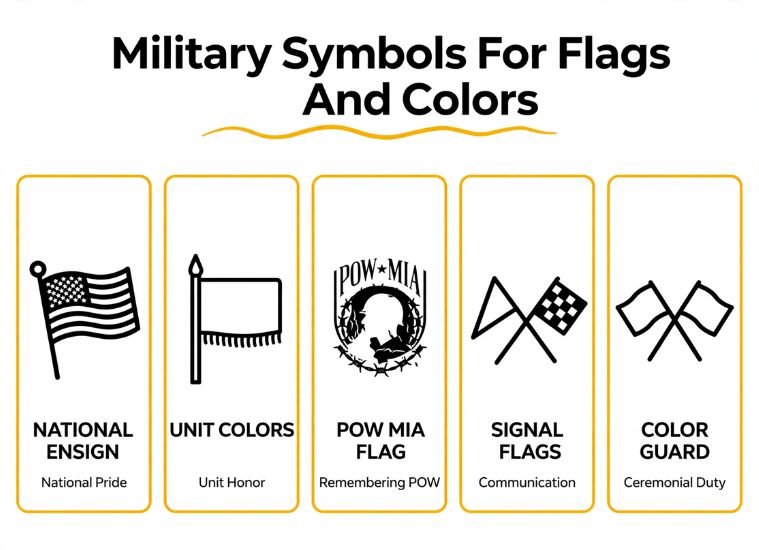
Flags and colors have long been important forms of military identification.They can identify nations, services, units, commands, and ceremonial organizations.
Military flag systems are governed by specific rules, so colors should not be given one universal meaning.The U.S. Army’s heraldic program includes organizational flags, guidons, and streamers among its official heraldic areas.
| Symbol | Meaning | Description |
| National Flag | National Identity | Represents a country and its armed forces when officially used. |
| Service Flag | Branch Identity | Identifies a military service. |
| Unit Flag | Organization | Identifies a particular military organization. |
| Guidon | Unit Identity | Used as a military organizational marker. |
| Streamer | Honor | Can record a unit’s authorized campaign or service honors. |
| Command Flag | Authority | Identifies a command or command position. |
| Ceremonial Color | Tradition | Used in formal military ceremonies. |
| Standard | Identity | Can serve as an organizational or national marker. |
| Pennant | Identification | A smaller flag used for specific purposes. |
| Flagstaff | Display | Supports an official flag or color. |
Military Symbols And Heraldry
Military heraldry gives organizations a visual language for history and identity.The U.S. Army’s Institute of Heraldry explains that military insignia developed partly from the need for clear identification and continues to support official heraldic design.
Official heraldic items can include coats of arms, medals, flags, streamers, seals, badges, and organizational insignia.
| Symbol | Meaning | Description |
| Coat Of Arms | Identity | A formal heraldic design associated with an organization. |
| Escutcheon | Heraldic Shield | The shield-shaped field used in many coats of arms. |
| Crest | Heraldry | A component placed above a heraldic shield. |
| Motto Scroll | Values | Displays words associated with an organization’s ideals. |
| Heraldic Eagle | National Identity | Can represent national authority or service. |
| Heraldic Lion | Courage | Often used to convey strength or bravery. |
| Laurel Wreath | Achievement | Commonly associated with accomplishment. |
| Sword | Military Service | Can represent readiness or military authority. |
| Shield | Defense | Represents protection and security. |
| Colors | Identity | Colors can carry specific meanings within an official design. |
Military Symbols For Courage
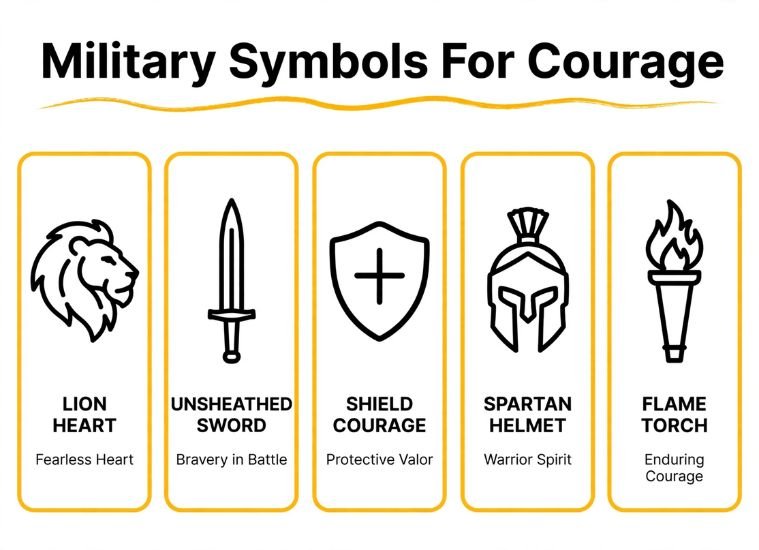
Military Symbols For Courage often represent bravery, determination, and the willingness to face danger.Many of these images come from military traditions, heraldry, badges, and warrior culture.
They can also represent personal courage rather than an official military designation.These symbols work well for tattoos, artwork, memorials, and military-inspired designs.
| Symbol | Meaning | Description |
| Lion | Courage | Represents bravery and fearless action. |
| Eagle | Valor | Often associated with strength and boldness. |
| Sword | Bravery | Represents readiness to face danger. |
| Shield | Protection | Shows courage while defending others. |
| Spartan Helmet | Warrior Courage | Represents a determined fighting spirit. |
| Bear | Strength | Suggests physical and mental bravery. |
| Wolf | Fearlessness | Represents loyalty and courage under pressure. |
| Tiger | Ferocity | Reflects boldness and determination. |
| Falcon | Focus | Represents courage guided by precision. |
| Raven | Resolve | Can represent endurance through difficult times. |
| Bull | Determination | Shows persistence and fearless strength. |
| Stag | Noble Courage | Represents strength with dignity. |
| Ram | Boldness | Suggests forceful determination. |
| Boar | Ferocity | Represents an unwillingness to retreat. |
| Dragon | Power | Represents formidable courage. |
| Phoenix | Resilience | Shows the ability to rise after hardship. |
| Arrow | Forward Action | Represents moving ahead despite danger. |
| Spear | Warrior Spirit | Suggests directness and bravery. |
| Axe | Strength | Represents decisive action. |
| Mace | Combat Power | Reflects traditional warrior strength. |
| Thunderbolt | Force | Represents sudden and powerful action. |
| Mountain | Endurance | Shows courage that remains steady. |
| Fire | Fighting Spirit | Represents passion and determination. |
| Sun | Confidence | Suggests strength and renewed hope. |
| Star | Aspiration | Represents a high standard of service. |
| Wings | Fearless Freedom | Suggest movement beyond limitations. |
| Crossed Swords | Warrior Valor | Represents readiness and martial courage. |
| Gauntlet | Combat Readiness | Suggests strength prepared for action. |
| Fortress | Defiance | Represents standing firm against threats. |
| War Drum | Rallying Courage | Represents unity before difficult action. |
Military Symbols For Honor
Military Symbols For Honor are often connected with duty, respect, service, and achievement.Honor has a strong place in military traditions and ceremonial practices.
Objects such as medals, flags, swords, and wreaths can carry ideas of respect and distinction.The exact meaning can vary between countries, services, units, and historical periods.
| Symbol | Meaning | Description |
| Laurel Wreath | Honor | Traditionally associated with achievement and distinction. |
| Medal | Recognition | Represents acknowledged service or achievement. |
| Flag | National Honor | Represents loyalty to a nation or organization. |
| Sword | Duty | Can represent responsibility and service. |
| Shield | Defense | Represents protecting people or principles. |
| Crown | Authority | Suggests rank, leadership, or distinction. |
| Star | Achievement | Can represent distinction or high accomplishment. |
| Eagle Crest | Prestige | Represents authority and national identity. |
| Banner | Allegiance | Represents loyalty to a group or cause. |
| Wreath | Remembrance | Can honor service and sacrifice. |
| Bugle | Ceremony | Associated with military calls and formal occasions. |
| Drum | Tradition | Represents ceremonial military heritage. |
| Ceremonial Sword | Leadership | Can signify command and formal responsibility. |
| Medal Ribbon | Service | Represents an awarded decoration. |
| Insignia | Identity | Helps identify a military organization or role. |
| Badge | Qualification | Can indicate training, skill, or status. |
| Crest | Heritage | Represents an organization’s history and identity. |
| Shield Emblem | Service | Combines identity with protection. |
| Torch | Duty | Represents knowledge, guidance, or service. |
| Column | Stability | Suggests strength and order. |
| Oak Leaf | Strength | Traditionally associated with endurance and honor. |
| Olive Branch | Peace | Represents peace after conflict. |
| Cross | Sacrifice | May represent faith, service, or remembrance. |
| Angel | Protection | Can represent guardianship and remembrance. |
| Bell | Remembrance | May mark ceremonial or memorial occasions. |
| Scroll | History | Represents recorded service and heritage. |
| Shield and Sword | Duty | Combines defense with readiness. |
| Eagle and Shield | Service | Represents national identity and defense. |
| Star and Wreath | Distinction | Combines achievement with honor. |
| Memorial Stone | Respect | Represents lasting remembrance of service. |
Military Symbols For Strength
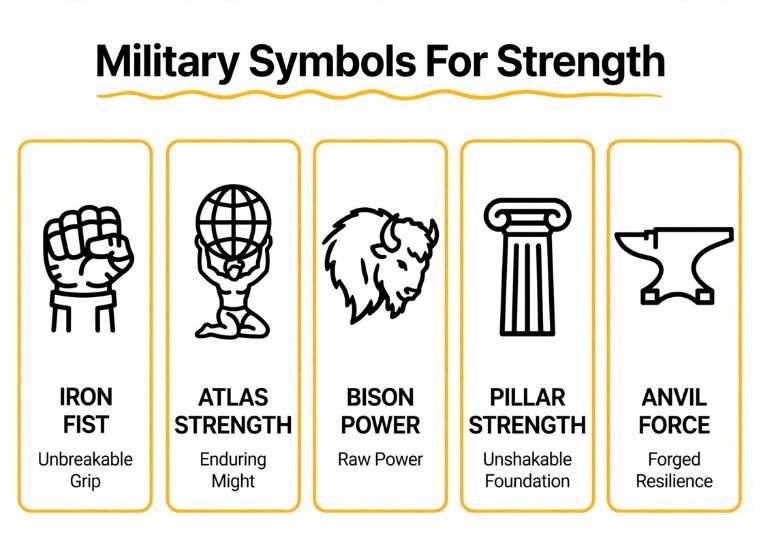
Military Symbols For Strength represent physical power, endurance, resilience, and determination.Some are drawn from animals, weapons, natural forces, and traditional heraldry.
They are commonly used in military-inspired artwork and unit designs.Their meaning can be personal unless they are part of an official emblem or insignia.
| Symbol | Meaning | Description |
| Iron Fist | Power | Represents force and determination. |
| Tank | Armored Strength | Represents protected military power. |
| Cannon | Firepower | Represents heavy combat capability. |
| Anchor | Stability | Suggests strength and steadiness. |
| Hammer | Force | Represents powerful action. |
| Anvil | Endurance | Shows strength built through hardship. |
| Oak Tree | Resilience | Represents lasting strength. |
| Mountain | Stability | Suggests strength that withstands pressure. |
| Bear Paw | Power | Represents physical strength. |
| Elephant | Endurance | Suggests great size and resilience. |
| Rhino | Toughness | Represents strong defense. |
| Bison | Resilience | Reflects endurance and natural power. |
| Bull | Force | Represents determination and strength. |
| Gorilla | Physical Power | Suggests formidable strength. |
| Hammer and Anvil | Hardiness | Represents strength developed through work. |
| Fortress | Defense | Represents strong protection. |
| Castle | Security | Suggests durable defense. |
| Wall | Protection | Represents a strong barrier. |
| Armor | Defense | Represents protection against threats. |
| Helmet | Readiness | Suggests protection and preparedness. |
| Gauntlet | Combat Strength | Represents a protected fighting hand. |
| Mace | Power | Represents traditional martial force. |
| Spear | Offensive Strength | Represents direct action. |
| Axe | Force | Suggests decisive strength. |
| Lightning | Energy | Represents sudden power. |
| Thunder | Force | Suggests overwhelming energy. |
| Fire | Power | Represents intense energy and drive. |
| Steel | Toughness | Represents durability and resilience. |
| Chain | Unity | Represents strength through connection. |
| Iron Shield | Defense | Combines durability with protection. |
Military Symbols For Protection
Military Symbols For Protection commonly represent defense, security, guardianship, and preparedness.Shields, armor, fortifications, and protective animals are frequent examples.
Some symbols have formal meanings in specific military organizations, while others are general military imagery.These symbols can also be used to represent protecting family, country, teammates, or personal values.
| Symbol | Meaning | Description |
| Shield | Protection | Represents defense against danger. |
| Armor | Security | Represents physical protection. |
| Helmet | Safety | Suggests readiness and protection. |
| Fortress | Defense | Represents a secure stronghold. |
| Castle | Security | Suggests protected territory. |
| Wall | Barrier | Represents a defensive boundary. |
| Watchtower | Vigilance | Represents observing potential threats. |
| Sentinel | Guarding | Represents someone watching over others. |
| Guardian Eagle | Protection | Combines watchfulness with strength. |
| Bear | Guardianship | Can represent protective strength. |
| Wolf | Pack Protection | Represents loyalty and group defense. |
| Lion | Defensive Courage | Suggests protection through strength. |
| Shepherd’s Staff | Guidance | Represents care and guardianship. |
| Anchor | Stability | Suggests dependable protection. |
| Gate | Security | Represents controlled access. |
| Key | Security | Represents protected access. |
| Lock | Safety | Represents keeping something secure. |
| Watchtower Bell | Warning | Suggests alerting others to danger. |
| Searchlight | Vigilance | Represents watching for threats. |
| Periscope | Observation | Represents concealed surveillance. |
| Bunker | Shelter | Represents protection from attack. |
| Sandbag | Defense | Represents a practical defensive barrier. |
| Barbed Wire | Perimeter | Represents restricted or protected areas. |
| Minefield Marker | Hazard Awareness | Indicates an area requiring caution. |
| Radar Screen | Detection | Represents monitoring for threats. |
| Patrol Vehicle | Security | Represents active protection. |
| Guard Tower | Watchfulness | Represents continuous observation. |
| Crossed Shields | Collective Defense | Represents protection through unity. |
| Shield and Helmet | Military Defense | Combines personal protection with readiness. |
| Fortified Gate | Secure Entry | Represents controlled and protected access. |
Military Symbols For Victory
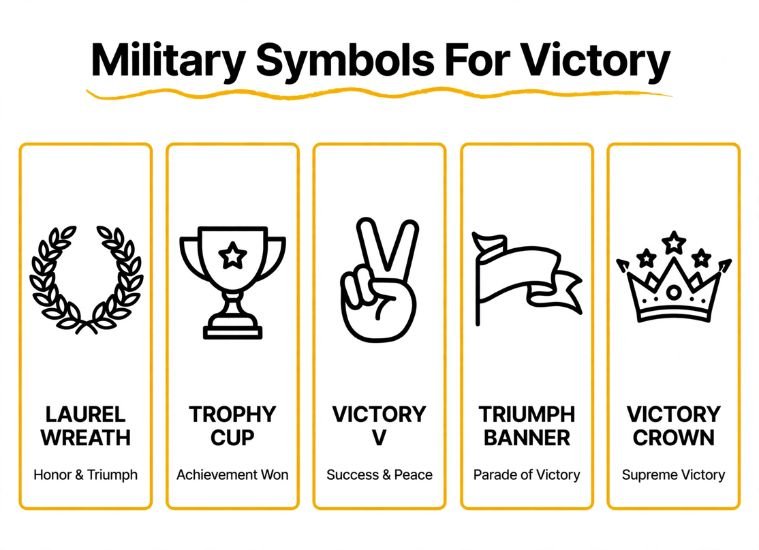
Military Symbols For Victory often represent achievement, success, survival, or the completion of a difficult mission.Laurel wreaths, banners, stars, and raised weapons have long appeared in military and ceremonial imagery.
Some symbols are historical or cultural rather than official military insignia.Their meaning should therefore be considered in the context where the symbol is used.
| Symbol | Meaning | Description |
| Laurel Wreath | Victory | Traditionally connected with triumph and achievement. |
| Victory Banner | Triumph | Represents success after conflict. |
| Raised Sword | Victory | Can represent successful military action. |
| Star | Achievement | Represents distinction or accomplishment. |
| Eagle | Triumph | Can represent strength and victory. |
| Crown | Success | Suggests achievement and high status. |
| Trophy | Achievement | Represents a successful outcome. |
| Medal | Recognition | Represents officially recognized achievement. |
| Flag on Summit | Conquest | Represents reaching an important goal. |
| Torch | Progress | Represents moving forward after success. |
| Phoenix | Renewal | Represents recovery after hardship. |
| Sunrise | New Beginning | Suggests a positive outcome after struggle. |
| Wreath and Star | Distinction | Combines honor with achievement. |
| Crossed Swords | Martial Triumph | Represents combat readiness and victory imagery. |
| Shield and Laurel | Honored Victory | Combines defense with achievement. |
| Eagle and Banner | National Triumph | Combines national imagery with success. |
| Victory Bell | Celebration | Represents marking an important success. |
| Drum | Celebration | Can represent ceremonial victory. |
| Trumpet | Announcement | Represents proclaiming an achievement. |
| Arrow Upward | Progress | Represents movement toward success. |
| Mountain Peak | Achievement | Represents reaching a difficult goal. |
| Summit Flag | Success | Shows accomplishment after a challenging journey. |
| Lightning Bolt | Decisive Action | Represents rapid and powerful success. |
| Firebrand | Determination | Represents continuing strength after conflict. |
| Oak Leaf | Achievement | Can represent endurance and distinction. |
| Golden Shield | Honored Defense | Represents successful protection. |
| Champion’s Wreath | Triumph | Represents ceremonial victory. |
| Victory Palm | Triumph | Traditional imagery associated with victory. |
| Triumphal Arch | Commemoration | Represents public recognition of victory. |
| Rising Eagle | Advancement | Represents upward movement and achievement. |
How Military Symbols Are Used
Military symbols are not all used for the same purpose.An operational map symbol may communicate information to personnel, while a unit patch may identify an organization.
A medal may record recognition, and a coat of arms may preserve organizational history.Understanding the context is therefore essential when interpreting a military symbol.
NATO notes that standardized military symbology supports a common visual language, particularly when personnel from different nations need to understand the same operational display.
Military Animal Symbols
Animals are frequently used in military emblems because they can communicate qualities associated with strength, courage, vigilance, speed, or loyalty.
Common examples include:
- Eagles: strength, authority, vigilance, and freedom
- Lions: courage, leadership, and strength
- Wolves: loyalty, cooperation, and resilience
- Bears: strength and endurance
- Horses: mobility, speed, and tradition
- Falcons: speed, precision, and vigilance
These meanings are not universal. The symbolism of an animal depends on the specific military tradition, country, unit, and historical period.
Conclusion
What are the different uses of military symbols in the various aspects of military life? Their ability lies in the ability to represent and make sense of complex ideas through visualization. A patch can represent an organization and a map symbol can represent a unit or place.
A medal may document service or achievement, a coat of arms may document a units history and traditions. In addition to these, military symbols may feature carefully selected shields, swords, stars, eagles, anchors, wings, flags, badges, ribbons and more. Not all of them may have a universal meaning; context is important.
One example of common visual rules that can be used to help communicate between military users are NATO’s standardized symbology.
Another example is the official heraldic programs, that use designs to identify organizations and to keep their history alive. Before assigning meaning to any military symbol, research the country, service, organization and purpose of the symbol.
Frequently Asked Questions About Military Symbols
Q1: What do Military Symbols represent?
A2: They can represent different branches, unit types, ranks, vehicles, weapons systems, command structures, or operational functions.
Q2: Where are Military Symbols used?
A3: Military Symbols can appear on maps, uniforms, flags, insignia, documents, equipment, historical materials, and military communication systems.
Q3: How can I identify Military Symbols?
A4: Look at the symbol’s shape, markings, colors, letters, and surrounding context, then compare it with the relevant military symbol system or reference guide.