How can the planets teach us about science, history and human beliefs? For centuries, people have been drawing the planet symbols to depict planets. These symbols relate space to ancient narratives, to astrology and cultural traditions. Each planet carries a name and history, and a number of people also associate an idea or quality with each planet.
For instance, in astrology Mercury is connected with communication, and Venus is connected with love and beauty. The meanings are derived from traditional beliefs and not scientific evidence.In modern astrology, the planet symbols are used in horoscope charts, books, educational texts, and in art.
But this can vary from one subject to another. Astronomy is the observation and evidence study of planets, and astrology assigns symbolic meanings to planets, which are related to human life. This distinction is important to readers’ learning about planets without blending fact and belief.
This guide offers an understanding of planet meanings, their history, widespread applications, and easy tips on how to remember planet meanings. It also has answers to some frequently asked questions by anyone beginning to learn about planetary symbols.
Why Planet Symbols Remain Popular
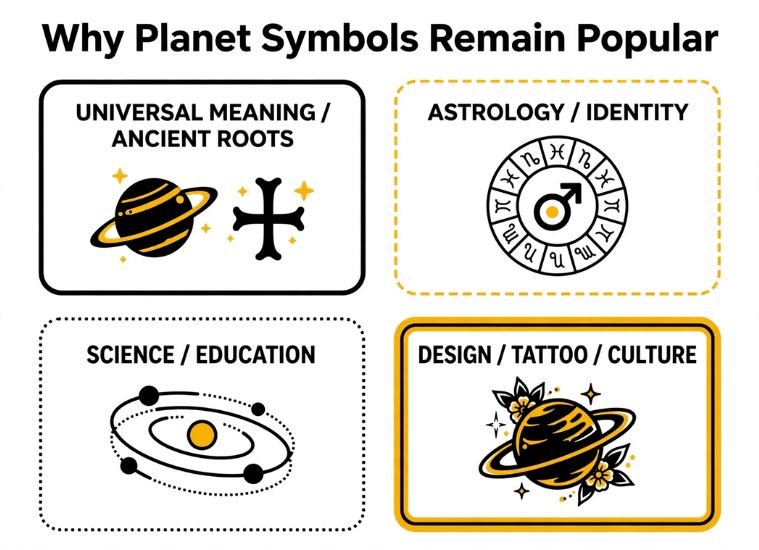
Planetary glyphs remain popular because they combine simple shapes with recognizable associations. Their compact designs work well in educational diagrams, astrology charts, tattoos, pendants, posters, and minimalist artwork.
People may choose a planet symbol because they appreciate its mythology, identify with its traditional astrological meaning, or simply enjoy its visual design. For example, Venus may represent love, Mars may express courage, and Saturn may suggest discipline.
Planet symbols can also be used together to create a solar system design or represent an interest in space, astronomy, and the natural world.
Learn how water, light, and other meaningful elements represent faith and spiritual renewal through these Baptism Symbols traditions.
What Are Planet Symbols?
Planet symbols are small graphic signs, often called planetary glyphs, that represent planets and other important celestial bodies. They provide a simple visual way to identify the Sun, Moon, Mercury, Venus, Earth, Mars, Jupiter, Saturn, Uranus, Neptune, and Pluto.
Many traditional planetary symbols combine three basic shapes: a circle, a crescent, and a cross. In common symbolic interpretations, the circle represents spirit or wholeness, the crescent represents receptivity or the mind, and the cross represents material life. These interpretations belong to symbolic and astrological traditions rather than established scientific definitions.
NASA documents the historical use of planetary symbols in both astronomy and astrology, although modern scientific publications generally favor written names over these glyphs.
Understand how laboratory warning signs identify potential hazards and support safe practices with these Lab Safety Symbols explanations.
Planet Symbols And Their Meanings
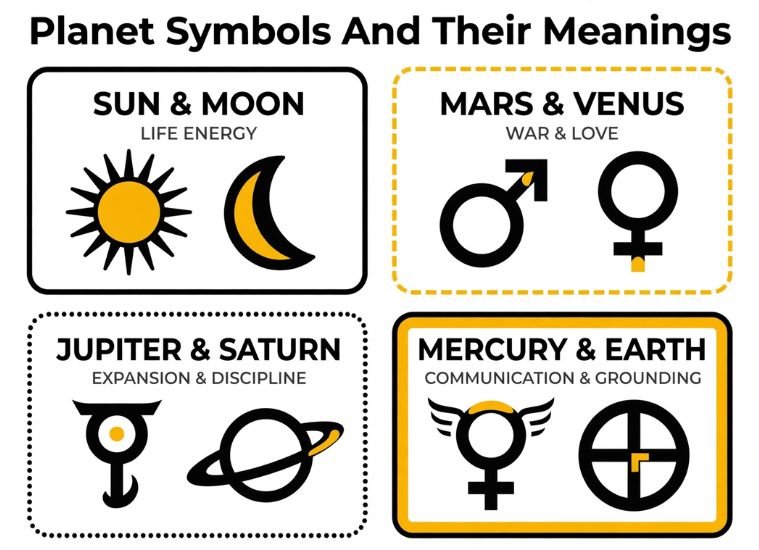
Planet symbols are simple signs used to represent planets in astrology, astronomy, and historical traditions. Each symbol has its own design and background, often connected to ancient beliefs, mythology, or early astronomical practices.
In astrology, these signs are associated with different parts of human experience, while in science they help identify celestial bodies in diagrams and educational materials.
Learning about planet symbols and their meanings can help you understand how people have represented the planets across different cultures and periods. Their continued use also shows how ancient traditions have influenced modern symbolic language.
| Icon | Symbol | Meaning | Origin | Description |
| ☀️ | Sun (☉) | Identity, vitality, life force | Ancient Greek and Egyptian astronomy | A circle with a central dot, used in astrology as the “luminary” of the self. |
| 🌙 | Moon (☽) | Emotions, instinct, cycles | Ancient Mesopotamian and Greek astronomy | A crescent shape representing the inner world and the rhythm of change. |
| 🌍 | Earth (🜨) | Grounding, the physical world | Ancient astronomy and alchemy | A circle divided by a cross, standing for the four directions and elements. |
| 🔑 | Chiron (⚷) | The wounded healer, teaching through pain | Modern astrology (after its 1977 discovery) | A key-like glyph with a circle at its base, linked to the centaur healer of Greek myth. |
| 🌾 | Ceres (⚳) | Nurturing, harvest, cycles of loss and return | Modern astrology (after its 1801 discovery) | A sickle-shaped glyph named for the Roman grain goddess. |
Explore the cultural heritage, historic emblems, and national traditions connected with these German Symbols meanings.
Mercury Symbol
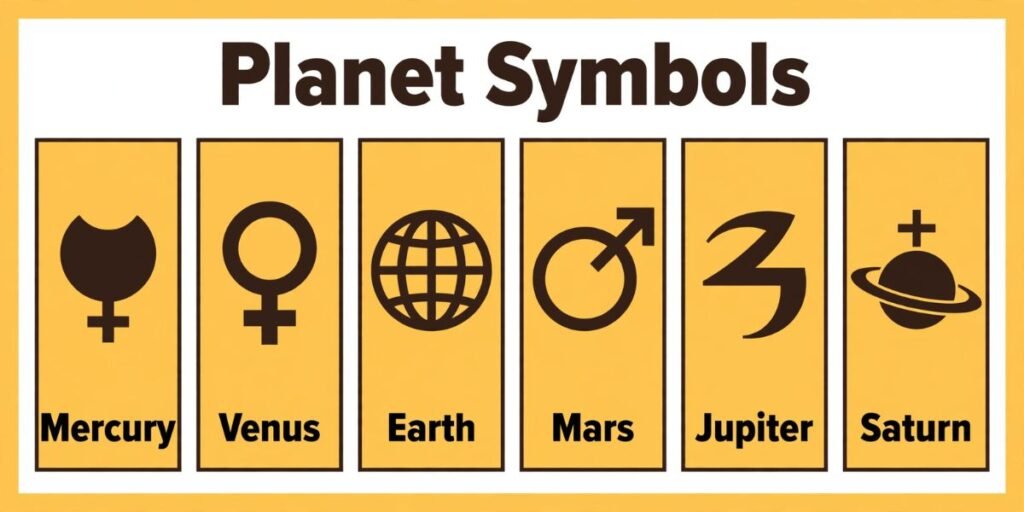
The Mercury symbol is represented by a circle above a cross, with a crescent shape at the top. In astrology, Mercury is associated with communication, learning, reasoning, and the exchange of ideas.
Its name comes from the Roman messenger god Mercury, who was linked to travel, trade, and messages. The symbol has historical connections to alchemical traditions, where Mercury also referred to the substance known as quicksilver.
In modern astrology charts, this sign identifies Mercury and its interpreted influence on thinking and communication. Its distinctive design makes it one of the most recognizable planetary symbols.
| Icon | Symbol | Meaning | Origin | Description |
| 📨 | Mercury Glyph (☿) | Mind, communication, reasoning | Greek and Byzantine manuscripts | A circle with horns above a cross, derived from the caduceus of the messenger god. |
| 🪖 | Winged Helmet | Swift thought | Roman myth (Mercury) and Greek myth (Hermes) | A helmet with wings, worn by the god of messages and travel. |
| 👟 | Winged Sandals (Talaria) | Speed and movement between worlds | Greek myth (Hermes) | Golden sandals that let the messenger god cross land, sea and sky. |
| 🔄 | Retrograde Symbol (℞) | Review, delay, reflection | Medieval Latin abbreviation, adopted in astrology | A mark showing a planet that appears to move backward in the sky. |
| 🌡️ | Quicksilver | Fluidity, adaptability | Alchemical tradition | The liquid metal also called mercury, linked to the planet for its restless movement. |
Explore meaningful signs of love, unity, and belonging through these Symbols For Family connections that celebrate the bonds between loved ones.
Venus Symbol
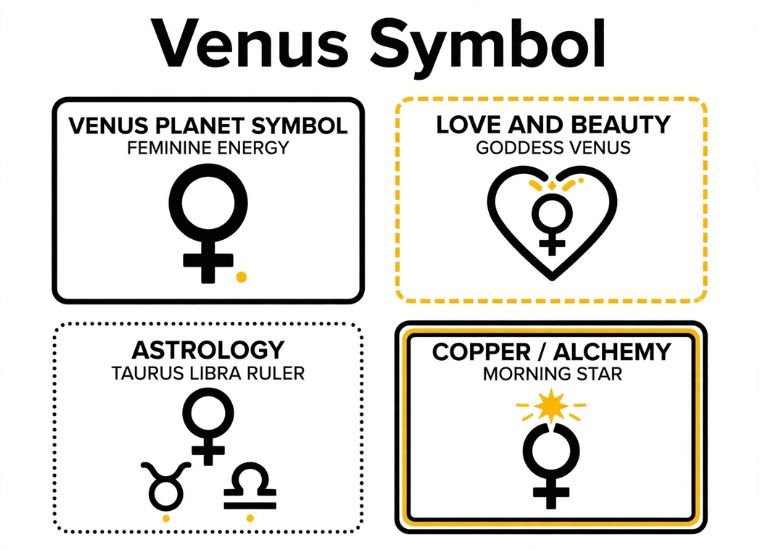
The Venus symbol consists of a circle placed above a small cross. It is commonly associated with love, beauty, relationships, harmony, and attraction in astrology.
The symbol is also widely used to represent the female sex, a convention influenced by its connection to the Roman goddess Venus. In ancient mythology, Venus was linked to love and beauty, while the Greek counterpart was Aphrodite.
Astrologers interpret Venus according to its placement in a birth chart, especially when discussing affection, personal values, and aesthetic preferences. Outside astrology, the sign remains a familiar symbol in biology, culture, and popular communication.
| Icon | Symbol | Meaning | Origin | Description |
| 💖 | Venus Glyph (♀) | Love, beauty, harmony, values | Greek and Byzantine manuscripts | A circle above a cross, often read as the goddess’s hand mirror. |
| 🪞 | Hand Mirror | Beauty and self-image | Roman art and myth | A mirror carried by the goddess of love, the popular reading of the glyph. |
| ⭐ | Pentagram of Venus | Cycle of attraction and return | Ancient Babylonian and later astronomical observation | The five-petaled pattern traced by Venus’s orbit as seen from Earth over eight years. |
| 🌅 | Morning and Evening Star | Dual nature of love | Ancient Greek (Phosphorus and Hesperus) | Venus shines before sunrise and after sunset, so it was once seen as two stars. |
| 🥉 | Copper | Attraction, conductivity of feeling | Alchemical tradition | The metal linked to Venus, long used in mirrors and jewelry. |
Learn how birds, flags, and other powerful emblems express independence and personal liberty through these Symbols Of Freedom expressions.
Mars Symbol
The Mars symbol features a circle with an arrow pointing diagonally outward. In astrology, it is associated with energy, action, courage, ambition, and the drive to pursue goals.
The symbol is connected to Mars, the Roman god of war, whose Greek counterpart was Ares. Its arrow-like design has also become a widely recognized symbol of the male sex.
In astrological interpretations, Mars is often considered when examining motivation, competition, and how someone responds to challenges. In astronomy and planetary science, the same symbol may appear in historical references, although scientific writing generally uses the planet’s name or abbreviation.
| Icon | Symbol | Meaning | Origin | Description |
| 🔴 | Mars Glyph (♂) | Drive, courage, assertion | Greek and Byzantine manuscripts | A circle with an arrow pointing up and to the right. |
| 🛡️ | Shield and Spear | Defense and attack | Roman myth (Mars) | The common reading of the glyph, showing the god of war’s arms. |
| 🏹 | Red Planet | Passion, anger, energy | Ancient Egyptian and Greek observation | The reddish color of Mars led ancient cultures to link it to blood and war. |
| ⚔️ | Iron | Strength, force | Alchemical tradition | The metal tied to Mars, used in weapons and tools. |
| 🐏 | Aries and Scorpio Rulership | Initiative and intensity | Traditional and modern astrology | Mars rules Aries traditionally and shared rulership of Scorpio in older systems. |
Find meaningful ways to express your personality, values, and life story through these Symbols That Represent Me ideas.
Jupiter Symbol
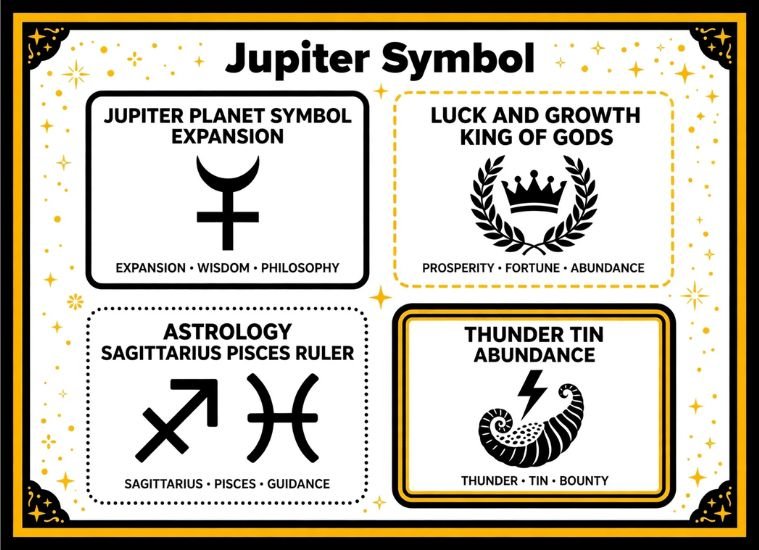
The Jupiter symbol is often drawn as a stylized character resembling a curved number four, though its traditional forms vary. In astrology, Jupiter is linked with growth, knowledge, optimism, opportunity, and expansion. It takes its name from the chief Roman god Jupiter, who was associated with authority, protection, and the sky.
The Greek equivalent is Zeus, a powerful figure in ancient mythology. Astrologers interpret Jupiter’s placement as part of a chart’s broader themes of learning, beliefs, and personal development.
Historically, the symbol also appeared in alchemy and early astronomical manuscripts, reflecting the close relationship between planetary observation and traditional symbolic systems.
| Icon | Symbol | Meaning | Origin | Description |
| 🪐 | Jupiter Glyph (♃) | Growth, luck, wisdom | Greek manuscripts | A curved shape with a cross, often explained as a stylized form of Zeus’s initial. |
| ⚡ | Thunderbolt | Authority, divine power | Greek myth (Zeus) and Roman myth (Jupiter) | The weapon of the king of the gods. |
| 🦅 | Eagle | Vision, sovereignty | Roman myth and military symbolism | The bird sacred to Jupiter, carried on Roman standards. |
| 🌀 | Great Red Spot | Long-lived storm, scale | Astronomical observation (17th century) | A giant storm on Jupiter that has lasted for centuries. |
| 🏹 | Sagittarius and Pisces Rulership | Exploration and faith | Traditional astrology | Signs governed by Jupiter, linked to travel, belief and expansion. |
Saturn Symbol
The Saturn symbol is usually shown as a cross above a curved shape, often interpreted as a stylized sickle. In astrology, Saturn represents structure, responsibility, limits, discipline, and long-term effort.
Its name comes from the Roman god Saturn, who was associated with agriculture and the passage of time; the Greek figure Cronus is often compared with him. Astrologers commonly connect Saturn with patience, maturity, and the lessons gained through difficult experiences.
The symbol has also appeared in historical alchemical texts and early astronomical records. Its traditional appearance remains largely recognizable in contemporary astrology charts and educational references.
| Icon | Symbol | Meaning | Origin | Description |
| ⏳ | Saturn Glyph (♄) | Discipline, limits, time | Greek and Byzantine manuscripts | A cross above a curved stroke, often read as a scythe. |
| 🌾 | Scythe | Harvest, endings | Roman myth (Saturn) and Greek myth (Cronus) | The tool tied to the god of time and the harvest. |
| 🕰️ | Hourglass | Passage of time, patience | Medieval European art | A common image of Father Time, linked to the planet. |
| 💍 | Rings of Saturn | Boundaries, structure | Astronomical observation (Galileo, 1610; Huygens, 1655) | The visible rings that make the planet recognizable. |
| ⚫ | Lead | Weight, endurance | Alchemical tradition | The heavy metal associated with Saturn’s slow movement. |
Uranus Symbol
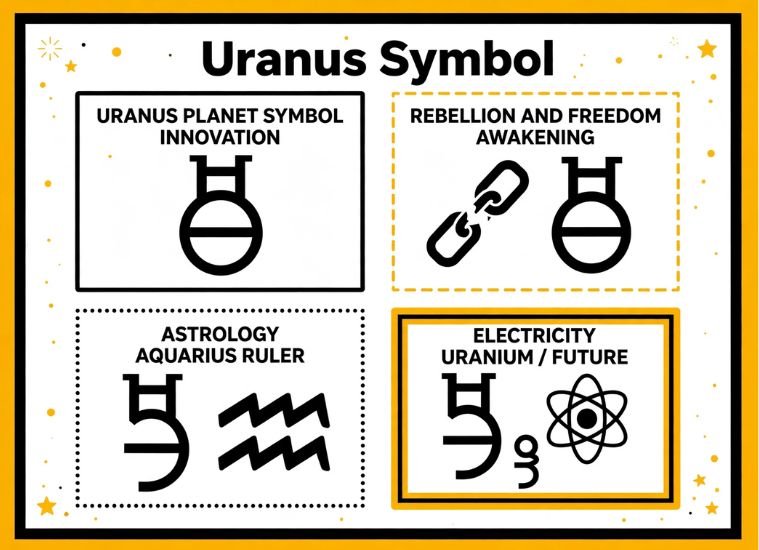
The Uranus symbol has more than one commonly used form. One version combines a circle and cross with side-facing shapes, while another resembles a central circle with lines extending upward and outward. The planet was named after Uranus, the ancient Greek personification of the sky.
In modern astrology, Uranus is associated with originality, independence, innovation, and unexpected change. Its discovery in 1781 marked an important moment in astronomy because it expanded the known planetary system beyond Saturn.
The different symbol designs reflect the planet’s relatively recent place in modern astronomical history and the development of conventions for representing newly identified celestial bodies.
| Icon | Symbol | Meaning | Origin | Description |
| 🌐 | Uranus Glyph (♅) | Innovation, awakening, change | Astronomy; named after William Herschel (1781) | An H topped with a globe, honoring its discoverer. |
| 🔱 | Astrological Glyph (⛢) | Revolution and invention | Modern astrology (Paul Choisnard, 20th century) | A variant with a circle and cross design, preferred in many astrology charts. |
| 🔭 | Herschel’s Discovery | Breaking the old order | 1781 astronomical discovery | The first planet found with a telescope, which expanded the known solar system. |
| 🌪️ | Lightning Flash | Sudden insight | Modern astrological association | A bolt used to show Uranus’s sudden, disruptive changes. |
| 🔄 | Sideways Rotation | Unconventional path | Astronomical observation | The planet spins on its side, tilted about 98 degrees. |
Neptune Symbol
The Neptune symbol resembles a trident, a three-pronged object associated with the Roman sea god Neptune. Its Greek counterpart is Poseidon, who was also connected with the sea and earthquakes.
In astrology, Neptune is associated with imagination, dreams, spirituality, idealism, and uncertainty. Astrologers may use its placement to explore themes involving creativity, intuition, and the difference between reality and fantasy.
The planet was identified in 1846 through mathematical predictions and astronomical observation, making its discovery an important achievement in planetary science. Its recognizable trident design connects modern planetary symbolism with classical mythology.
| Icon | Symbol | Meaning | Origin | Description |
| 🔱 | Neptune Glyph (♆) | Dreams, intuition, illusion | Astronomy (after its 1846 discovery) | A trident-shaped glyph tied to the sea god. |
| 🌊 | Trident | Command of the sea and the unseen | Roman myth (Neptune) and Greek myth (Poseidon) | The three-pronged spear carried by the ruler of the ocean. |
| 🌫️ | Mist and Fog | Blurred boundaries, imagination | Modern astrological association | A haze used to represent illusion and mystery. |
| 🐟 | Pisces Rulership | Compassion and spiritual sensitivity | Modern astrology | Neptune is the modern ruler of Pisces. |
| 🔵 | Deep Blue | Depth, serenity | Astronomical observation | The color of Neptune, linked to the ocean and dreamlike states. |
Pluto Symbol
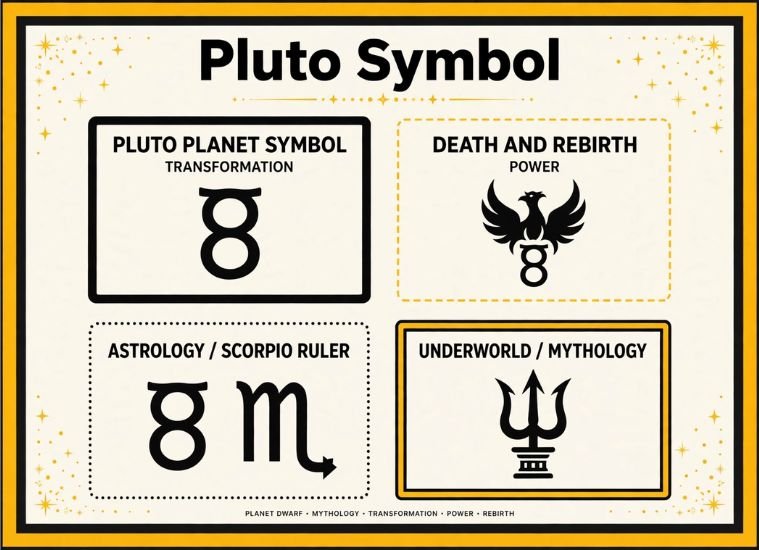
The Pluto symbol has appeared in several forms, including a monogram combining the letters P and L and a symbol resembling a circle, crescent, and cross.
The monogram is associated with the astronomer Percival Lowell, whose initials inspired the name, while other designs reflect traditional planetary symbolism. Pluto was named after the Roman god of the underworld, whose Greek counterpart was Hades.
In astrology, Pluto is commonly linked with transformation, power, hidden matters, and renewal. Astronomically, Pluto was classified as the ninth planet after its discovery in 1930 but was reclassified as a dwarf planet by the International Astronomical Union in 2006. Its symbols continue to appear in astrology, historical astronomy, and educational resources.
| Icon | Symbol | Meaning | Origin | Description |
| 🌑 | Pluto Glyph (♇) | Transformation, power, rebirth | Astronomy (after its 1930 discovery) | A PL monogram honoring Percival Lowell, with the letters joined as a symbol. |
| 🔮 | Orb and Bident (⯓) | Death, regeneration | Modern astrology | A circle with a bident and crossbar, favored by many astrologers. |
| 🔱 | Bident of Hades | Rule of the underworld | Greek and Roman myth (Hades, Pluto) | A two-pronged spear linked to the god of the dead. |
| 🐕 | Cerberus | Guardian of thresholds | Greek myth | The three-headed hound at the gates of the underworld. |
| 🦂 | Scorpio Rulership | Depth, intensity, secrets | Modern astrology | The sign that Pluto governs in modern systems. |
Planet Symbols In Astrology Charts
Planet symbols in astrology charts help readers identify the planets and understand how astrologers interpret their positions in relation to the zodiac signs and houses.
Each symbol represents a celestial body associated with particular themes, such as communication for Mercury or discipline for Saturn. The chart’s layout shows where these bodies appeared in the sky at a specific time and location. Astrologers combine the symbols with aspects and other chart details to develop their interpretations.
Although astrology has cultural and historical importance, its claims about personality and future events are not established as scientific facts.
| Icon | Symbol | Meaning | Origin | Description |
| 🤝 | Conjunction (☌) | Blending of energies | Hellenistic astrology | Two planets close together, shown as a small circle with a line. |
| ↔️ | Opposition (☍) | Tension and balance | Hellenistic astrology | Two planets about 180° apart, drawn as two circles joined by a line. |
| 🔺 | Trine (△) | Ease and flow | Hellenistic astrology | A triangle marking planets about 120° apart. |
| ⬜ | Square (□) | Friction and growth | Hellenistic astrology | A square marking planets about 90° apart. |
| ✳️ | Sextile (⚹) | Opportunity and cooperation | Hellenistic astrology | A six-pointed star marking planets about 60° apart. |
Planet Symbols In Astronomy and Science
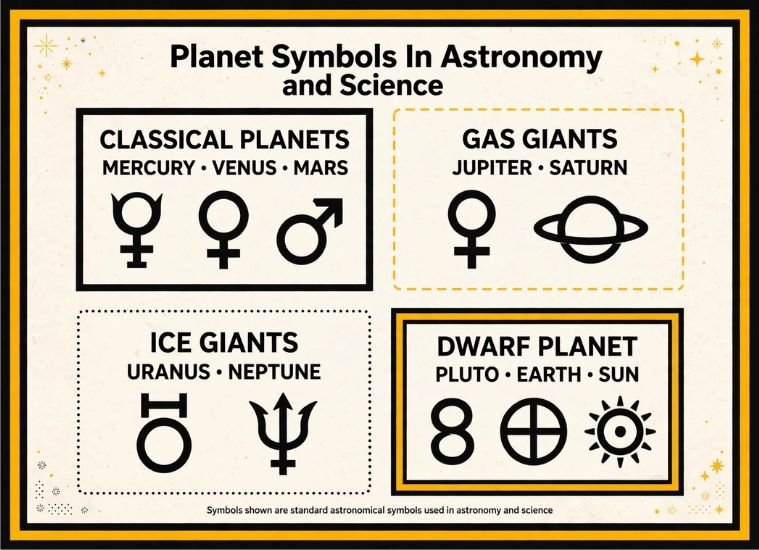
In astronomy and science, planet symbols have been used in diagrams, calendars, manuscripts, and historical scientific writing. These signs offered a compact way to identify celestial bodies before modern scientific notation became standardized.
Today, astronomers generally use planet names, abbreviations, and technical designations in research and data systems rather than relying on traditional astrological glyphs.
However, planetary symbols remain useful in educational illustrations and discussions of the history of astronomy. They also show how early observers combined the study of the night sky with the artistic and cultural traditions of their time.
| Icon | Symbol | Meaning | Origin | Description |
| 📏 | Astronomical Unit (AU) | Standard measure of distance in the solar system | International Astronomical Union (fixed at 149,597,870,700 m in 2012) | Roughly the average distance from Earth to the Sun, used to map planetary orbits. |
| 📐 | Kepler’s Laws of Planetary Motion | Orbits are ellipses with predictable speeds | Johannes Kepler (1609 and 1619) | Three laws showing that planets move in ellipses and move faster nearer the Sun. |
| 📉 | Transit Method | Detecting planets by dimming starlight | Modern astronomy (used by Kepler and TESS missions) | A small dip in a star’s brightness when a planet crosses its face, used to find exoplanets. |
| 🌑 | Dwarf Planet Class | Round bodies that have not cleared their orbit | IAU planet definition (2006) | The category created when Pluto was reclassified, which also includes Ceres and Eris. |
| 🤍 | Eris Glyph (⯰) | Discord, defiance of convention | Proposed by Denis Moskowitz and adopted in astrological use after Eris’s 2005 discovery | A hand holding a ring of fire. It is a modern astrological glyph, not an official astronomical symbol. |
Ancient Planet Symbols And Their Origins
Ancient planet symbols developed through a long history of sky observation, mythology, and the study of natural substances. Many familiar forms became more standardized in medieval European manuscripts, drawing on earlier Greek, Roman, and Near Eastern traditions.
Planets were often connected with deities, and their symbols also appeared in alchemy, where celestial bodies were linked with particular metals.
These associations were part of historical belief systems rather than modern scientific explanations. Studying the origins of planetary symbols helps explain how astronomy, religion, mythology, and early chemistry influenced one another. It also reveals why some symbols have several historical versions.
| Icon | Symbol | Meaning | Origin | Description |
| 🌠 | Wandering Stars (Planetai) | Lights that move against the fixed stars | Ancient Greek astronomy | The Greek word planetes means “wanderer,” which is the root of our word “planet.” |
| 🏺 | Dingir Star Sign (𒀭) | Divinity, sky god | Sumerian and Babylonian cuneiform | A star-shaped sign placed before the names of gods, including those linked to planets. |
| 📜 | Mul.Apin Tablets | Early catalog of stars and planets | Babylonian astronomy (compiled around the 7th century BCE) | Clay tablets listing constellations, planetary movements and seasonal risings. |
| 🔢 | Chaldean Order | Sequence of the seven classical planets by apparent speed | Babylonian and Hellenistic astronomy | The ordering Saturn, Jupiter, Mars, Sun, Venus, Mercury, Moon, from slowest to fastest. |
| 🏜️ | Egyptian Decan Stars | Time measured by rising stars | Ancient Egypt (star clocks on coffin lids) | Thirty-six star groups whose rising marked ten-day periods and the hours of night. |
Planet Symbols In Roman And Greek Mythology
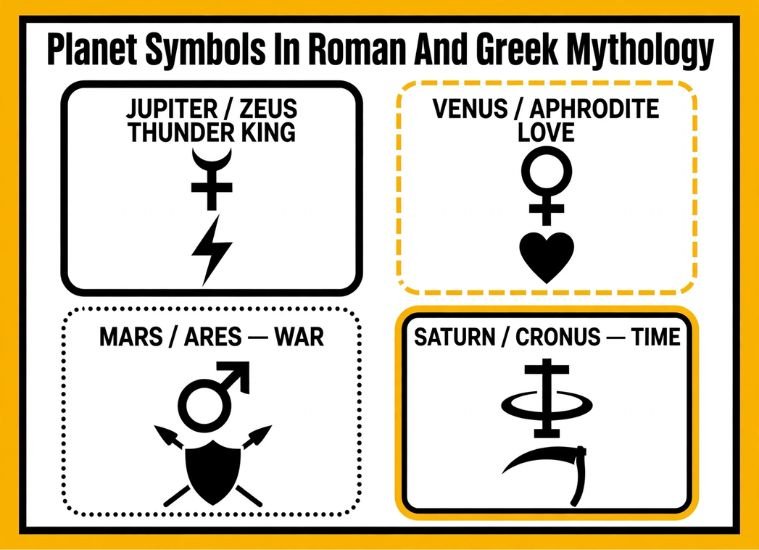
Planet symbols have strong connections to Roman and Greek mythology because several planets were named after important gods. Mercury corresponds broadly to Hermes, Venus to Aphrodite, Mars to Ares, Jupiter to Zeus, and Saturn to Cronus, although the traditions surrounding these figures are not identical.
Uranus and Neptune also draw on Greek and Roman divine figures associated with the sky and sea. Pluto takes its name from the Roman god of the underworld, closely related to the Greek Hades.
These mythological associations influenced how later cultures interpreted planetary symbolism, especially in astrology and art. The symbols themselves developed over time and should not all be treated as direct copies of ancient mythological images.
| Icon | Symbol | Meaning | Origin | Description |
| ⚕️ | Caduceus of Hermes | Messages, commerce, safe passage | Greek myth (Hermes) and Roman myth (Mercury) | A winged staff entwined with two serpents, carried by the messenger god. |
| 🎀 | Girdle of Aphrodite (Cestus) | Irresistible charm and desire | Homer’s Iliad | An embroidered belt that made its wearer alluring, tied to the goddess of love. |
| 🐺 | Wolf of Mars | Protection and martial courage | Roman myth (Romulus and Remus) | The animal sacred to Mars, said to have nursed the founders of Rome. |
| 🌳 | Oak of Zeus | Divine voice and authority | Greek oracle at Dodona | A sacred oak whose rustling leaves were interpreted as the will of Zeus. |
| 🎉 | Saturnalia | Role reversal, abundance, freedom | Roman festival of Saturn (December) | A week of feasting and gift-giving honoring the god of agriculture and the Golden Age. |
Planet Symbols And Their Historical Meanings
The historical meanings of planet symbols reflect the changing relationship between astronomy, mythology, and alchemy. In older European traditions, planetary signs could represent both a celestial body and a particular metal, such as Mercury for quicksilver or Saturn for lead.
Their designs were copied and adapted in manuscripts, scientific illustrations, and astrological texts. Over time, printing and the development of standardized typefaces helped establish more familiar versions of these symbols.
Their meanings therefore depend on the period and context in which they were used. Understanding this history makes it easier to distinguish traditional symbolism from the way planets are described in modern science.
| Icon | Symbol | Meaning | Origin | Description |
| 📅 | Planetary Days of the Week | Each day ruled by a classical planet | Hellenistic astrology, later Roman | The reason Sunday, Monday and Saturday carry the names of the Sun, Moon and Saturn. |
| 🎶 | Music of the Spheres | Cosmic harmony in planetary motion | Pythagorean philosophy (6th century BCE) | The idea that planets produce an inaudible music through mathematical proportions. |
| ⭕ | Epicycle | Planets moving in small loops | Ptolemy’s Almagest (2nd century CE) | A circle on a larger circle, used to explain apparent backward motion in an Earth-centered model. |
| 📖 | Enuma Anu Enlil | Omens read from the heavens | Babylonian omen series (compiled in the second millennium BCE) | A large collection of tablets interpreting planetary and lunar events as signs for kings. |
| ⏰ | Planetary Hours | Each hour ruled by a planet | Hellenistic and medieval astrology | A system dividing day and night into twelve hours each, assigned in Chaldean order. |
Traditional Planet Symbols And Modern Interpretations
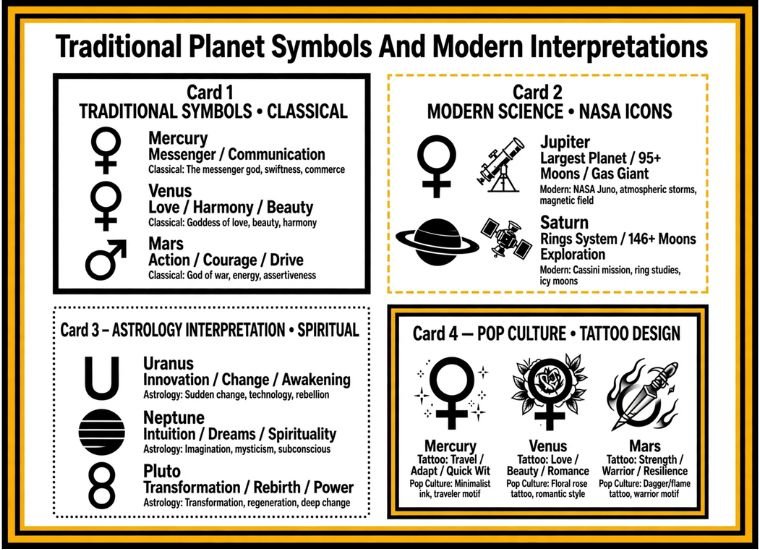
Traditional planet symbols continue to appear in modern astrology, historical studies, art, and popular culture. Their familiar designs provide a visual connection to centuries of astronomical observation and mythological storytelling.
Contemporary astrologers attach interpretations to each planet, while historians study how the symbols changed and spread across different cultures. Scientists, by contrast, use evidence-based models and standardized terminology to describe planetary properties and motion.
The same symbol may therefore carry different meanings depending on its setting. Recognizing these differences helps readers appreciate planetary symbols as part of cultural history without confusing astrological interpretations with scientific findings.
| Icon | Symbol | Meaning | Origin | Description |
| 🏠 | Domicile Rulership | A planet at its strongest in its own sign | Hellenistic and medieval astrology | The pairing of each classical planet with the signs it governs, such as the Sun with Leo. |
| 👑 | Exaltation | Honored position of a planet | Hellenistic astrology (Babylonian roots) | A zodiac sign where a planet is considered especially dignified, such as the Sun in Aries. |
| ☀️ | Planetary Sect | Day and night planet groups | Hellenistic astrology (Ptolemy, Vettius Valens) | A division of planets into diurnal and nocturnal teams, affecting how helpful they are in a chart. |
| 🃏 | Golden Dawn Tarot Correspondences | Planets linked to tarot cards | Hermetic Order of the Golden Dawn (late 19th century) | A system matching planets to major arcana, such as the Sun card and the Tower with Mars. |
| 🔭 | Heliocentric Model | The Sun at the center of the solar system | Nicolaus Copernicus (1543) | The view that replaced Earth-centered cosmology and reshaped how planets are understood. |
Why Are Planet Symbols Important?
Planet symbols have helped people record and discuss celestial bodies for many generations. They connect the study of the sky with history, mythology, and cultural beliefs.
In astrology, these symbols make birth charts easier to read and understand. In astronomy, planet names and scientific terms are more common in modern research. Knowing their purpose helps readers avoid confusing symbolic beliefs with scientific facts.
- They help explain historical astronomy and astrology.
- They connect planets with stories from ancient mythology.
- They make astrological charts easier to understand.
- They show how ideas about planets have changed over time.
How Are Planet Symbols Used Today?
Planet symbols have different uses depending on the subject and setting. Astrology uses traditional planetary signs in birth charts and horoscope readings.
Historical books may use them to explain older ways of recording celestial bodies. Modern astronomy usually identifies planets by name and uses scientific notation when needed. Planetary symbols may also appear in educational materials, artwork, jewelry, and popular culture.
- Astrology charts and horoscope guides.
- Historical astronomy books and old star charts.
- Educational resources about the solar system.
- Artwork and designs inspired by planets.
- Cultural and mythological discussions.
Why Should You Learn the Difference Between Astronomy and Astrology?
Astronomy is a science that studies planets, stars, moons, and other objects in space. It uses observation, mathematics, and evidence to explain how the universe works.
Astrology is a belief system that connects celestial bodies with human experiences and events. Both subjects have influenced human history, but they use different methods and make different kinds of claims. Understanding the difference helps you read planet-related content with greater care.
- Astronomy studies measurable features of planets.
- Astrology interprets planets through traditional meanings.
- Scientific claims require evidence and testing.
- Astrological meanings can vary across cultures and systems.
- Keep facts and personal beliefs clearly separated.
Conclusion: Planet Symbols
So why bother to learn about planet symbols? They link the knowledge of the solar system to history and mythology and to cultural beliefs.
Every planet is different, from the quickest orbit around the sun of Mercury, to the rings of Saturn and the winds of Neptune. These facts enable us to learn about the true objects in space.
The names of planets also have tales from ancient civilizations. In astrology, every single planet is connected with a concept like love, communication, courage or responsibility. It’s interesting to learn these meanings, but they don’t necessarily provide scientific evidence of how planets affect human lives.
Frequently Asked Questions About Planet Symbols
What does Mercury represent in astrology?
Mercury is commonly linked with communication, learning, reasoning, and writing. These meanings come from astrological tradition rather than scientific evidence.
Why is Venus connected with love?
Venus is connected with love and beauty because of its association with the Roman goddess Venus. Astrology carries this mythological link into its traditional interpretation of the planet.
Which planet is known as the Red Planet?
Mars is known as the Red Planet because iron-rich dust on its surface gives it a reddish appearance.