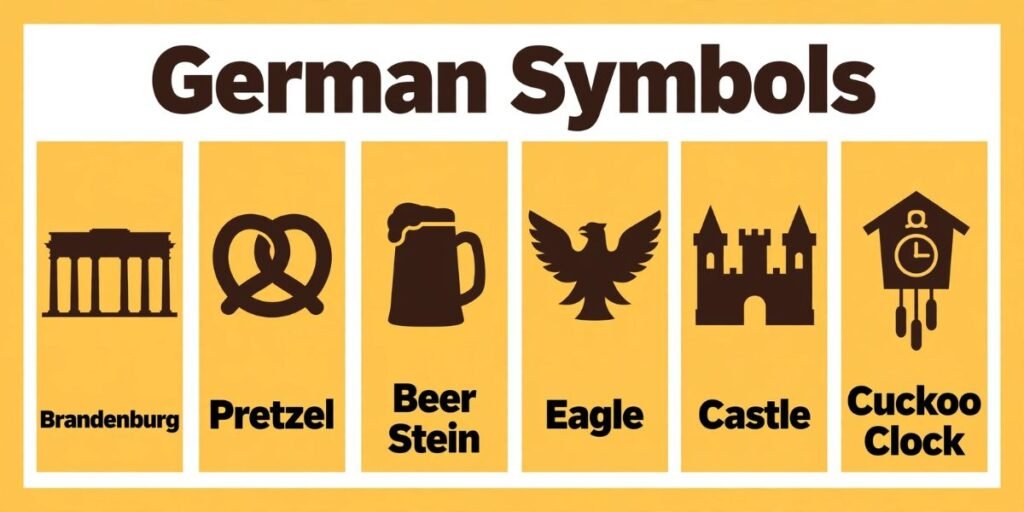
What symbols do you think of for Germany and what do they say about Germany? German symbols are not just flags, buildings, animals and traditional objects. They embody a nation and its movement and its cultures and its changing borders and its political history and its art and its traditions and its sense of national unity. The black, red and gold flag and the federal eagle are official symbols in modern Germany.
Others like the Brandenburg Gate, the Berlin Bear, the oak tree, the pretzel, the Christmas tree and the traditional clothing are cultural images related to German life. Also the meanings are context-dependent in terms of time, place and environment. By explaining these symbols, readers will gain a better understanding of German history and identity without making Germany into a stereotype.
This guide describes symbols and their meanings, as well as their history and cultural applications, in Germany. These examples provide simple-to-follow context for anyone today, not just for those interested in German heritage, learning about the past, creating artwork, or simply being curious.
How German Symbols Are Used Today
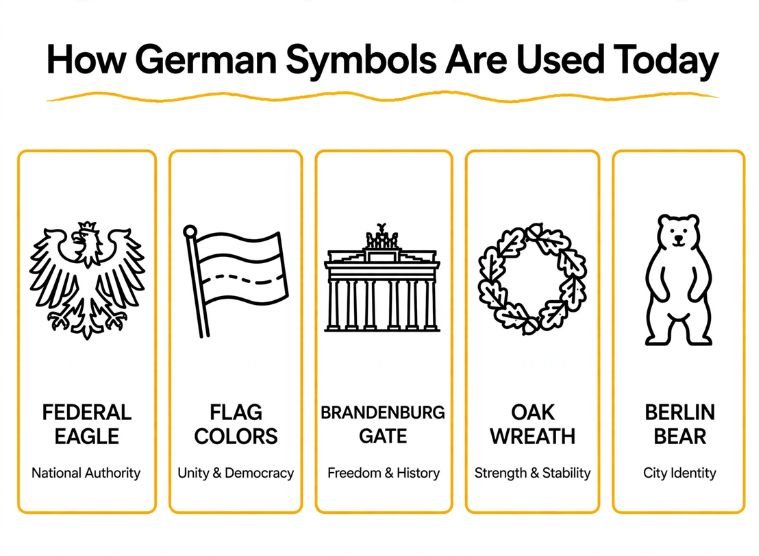
German symbols are everywhere, they can still be seen in the national holidays, public institutions, sport, education, architecture, as well as cultural festivals.
The German flag is often flown at international events and at national occasions. The official state institutions are recognized by the federal eagle and the national anthem is used for formal ceremonies.
Other symbols are used in a more personal or regional manner. An oak leaf could be included to commemorate an oak tree, a Christmas tree could be used as a symbol of family traditions, and a city’s coat of arms can symbolize a local pride.
German symbols can also be found on jewelry, body art, clothes, art and decorations. It is useful to do some research before selecting a design to see if it is a modern democratic value or a regional, religious or historical tradition.
This distinction serves to help people value German heritage, while not neglecting experiences and events that have formed the meaning.
Learn about the meanings and historical significance behind Military Symbols emblems and how they represent service, honor, courage, and duty.
German Symbols And Their Meanings
German symbols and their meanings can reflect the country’s history, culture, traditions, and national identity. Learning the background of each symbol can provide useful context for understanding how it is used and what it represents.
| Symbol | Meaning | Origin | Description |
| Bundesflagge | National identity | Modern Germany | The federal flag is Germany’s main national symbol and consists of three horizontal bands of black, red, and gold. |
| Schwarz-Rot-Gold | Unity and freedom | German national movement | Black, red, and gold became closely connected with German unity and civic freedom, especially during the 19th-century national movement. |
| Bundesadler | State and sovereignty | Holy Roman Empire and later Germany | The federal eagle is Germany’s official heraldic eagle and has deep historical roots in German state symbolism. |
| Nationalhymne | National identity | 19th-century Germany | The current German national anthem uses the third stanza of the Deutschlandlied, officially adopted for ceremonial use after World War II. |
| Brandenburger Tor | Unity and history | Berlin, 18th century | Berlin’s Brandenburg Gate became a major national landmark and later an important symbol of German division and reunification. |
| Eisernes Kreuz | Military tradition | Prussia, 1813 | The Iron Cross originated as a Prussian military decoration and later became a prominent German military symbol. |
| Bundeswappen | State authority | Modern Germany | Germany’s federal coat of arms displays the black eagle on a golden shield. |
| Reichsadler | Historical German statehood | Medieval and imperial traditions | Reichsadler means Imperial Eagle and refers to various historical forms of the German eagle used by earlier German states. |
| Germania | Nation and national identity | 19th-century German art | Germania is a personification of Germany that became especially prominent during the 19th-century national movement. |
| German Oak | Strength and endurance | German cultural tradition | The oak has long been associated with strength, longevity, and German national culture. |
| Oak Leaves | Strength and achievement | German heraldic tradition | Oak leaves appear in German medals, military decorations, and heraldic designs as signs of strength and honor. |
| Iron Cross Medal | Courage and service | Prussia | The decoration was created in 1813 and became one of the best-known German military honors. |
| Hambach Flag | Unity and liberty | Hambach Festival, 1832 | Black-red-gold flags became powerful symbols of the German movement for national unity and political freedom. |
| Paulskirche | Democracy | Frankfurt, 19th century | Frankfurt’s St. Paul’s Church hosted the first freely elected German national assembly in 1848. |
| Frankfurt Parliament | Constitutional democracy | German Revolution of 1848 | The parliament represented an important early attempt to establish a united German constitutional state. |
| German Unity Day | Reunification | 3 October 1990 | German Unity Day commemorates the reunification of Germany and is the country’s national day. |
| Reichstag Building | Parliamentary democracy | Berlin, 19th century | The historic Reichstag became the seat of the German Bundestag after reunification and represents parliamentary government. |
| Bundestag | Democratic representation | Federal Republic of Germany | The German Bundestag is the country’s federal parliament and represents citizens at the national level. |
| Bundesrat | Federal cooperation | Federal Republic of Germany | The Bundesrat represents Germany’s federal states in the national legislative process. |
| Basic Law | Democracy and rights | 1949 | Germany’s constitution, called the Basic Law, establishes the country’s democratic and constitutional framework. |
| Federal Seal | Official authority | German federal government | The federal seal is used in official contexts and incorporates Germany’s state eagle. |
| Federal President’s Standard | Head of state | Federal Germany | This official flag represents the office of the German Federal President. |
| Federal Government Eagle | Government authority | Modern federal symbolism | Variations of the eagle are used by German federal institutions and government bodies. |
| German State Eagle | Sovereignty | Historical German heraldry | The eagle has been a major German state emblem for centuries and continues to represent the federal state. |
| German National Colors | Shared identity | 19th-century national movement | Black, red, and gold became associated with the political aspirations of unity and freedom. |
| Lützow Uniform Colors | Historical nationalism | Wars of Liberation | Black uniforms with red details and gold buttons worn by the Lützow Freikorps later became associated with the origins of black-red-gold symbolism. |
| Jena Student Flag | National movement | Jena, 1815 | The flag of the Jena student fraternity helped popularize the black-red-gold color combination. |
| Hambach Cockade | Unity and freedom | Hambach Festival | Black-red-gold cockades were worn by participants in the 1832 Hambach Festival. |
| Constitutional Eagle | Republican government | Weimar Republic | The eagle continued as Germany’s state animal after the monarchy ended and became part of republican state symbolism. |
| German National Identity Card Eagle | Official identity | Modern Germany | The federal eagle appears on official German state documents and represents national authority. |
Learn about the meanings and cultural significance behind Symbols For Family connections and how they represent love, unity, loyalty, and lasting family bonds.
German Flag Symbols
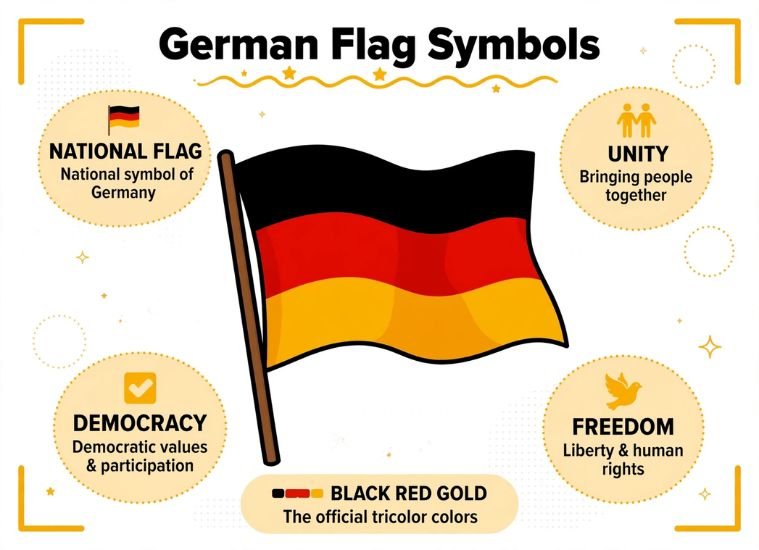
German flag symbols are closely connected with the colors and design of Germany’s national flag. Black, red, and gold have historical associations with German political movements and national identity.
| Symbol | Meaning | Origin | Description |
| Black Stripe | Historical struggle | German national movement | The black band is one part of the national color combination whose history became connected with the movement for German unity and freedom. |
| Red Stripe | Historical sacrifice and movement | German national movement | Red forms the middle band and is part of the historic black-red-gold combination. |
| Gold Stripe | Freedom and national aspiration | German national movement | Gold completes the tricolor and is closely associated with the historical unity-and-freedom tradition. |
| Black-Red-Gold Tricolor | Unity and freedom | 19th-century Germany | The three colors together became a major symbol of the German national movement and were adopted as federal colors in 1949. |
| Horizontal Bands | Equality of national colors | Modern German flag | The three equally arranged horizontal bands form the standard design of Germany’s federal flag. |
| Flag of Unity | Reunification | 1990 | The black-red-gold flag became the flag of reunified Germany when the Basic Law took effect in the eastern states on 3 October 1990. |
| Hambach Tricolor | Political freedom | 1832 | Black-red-gold flags were prominently displayed at the Hambach Festival, making the colors important symbols of political demands. |
| 1848 Tricolor | National unity | German Revolution of 1848 | Black-red-gold became strongly associated with the revolutionary movement and German constitutional aspirations. |
| 1848 Federal Colors | German political unity | German Confederation | In March 1848, black-red-gold was declared the colors of the German Confederation. |
| Paulskirche Tricolor | Constitutional government | Frankfurt, 1848 | The colors were associated with the Frankfurt Parliament and its effort to create a united constitutional Germany. |
| Weimar Flag | Republican democracy | 1919 | Black-red-gold became the national colors of the Weimar Republic in 1919. |
| Republican Cockade | Democratic identity | Weimar Republic | Black-red-gold cockades represented support for the republican system during the Weimar period. |
| Reich Colors | National identity | Weimar Constitution | The 1919 constitution formally designated black, red, and gold as Reich colors. |
| Gösch | Historical compromise | Weimar Republic | The small black-red-gold section added to certain commercial flags reflected the complicated flag compromise of the period. |
| East German Tricolor | State identity | German Democratic Republic | East Germany initially used black-red-gold but later added its state emblem to distinguish its flag. |
| Hammer and Compass | Labor and technical professions | GDR | The hammer and compass formed part of the East German state emblem placed on the flag from 1959. |
| Wheat Wreath | Agriculture | GDR | The wreath of grain surrounded the GDR emblem and represented agricultural workers. |
| GDR Flag Emblem | Socialist state | East Germany | The emblem combined a hammer, compass, and grain wreath within the black-red-gold flag. |
| Federal Flag Without Emblem | Federal identity | Federal Republic | Unlike the former GDR flag, the present German federal flag has no central emblem. |
| Flag at Reichstag | Parliamentary democracy | Modern Germany | The national flag displayed at the Reichstag connects the tricolor with Germany’s democratic parliament. |
| National Flag at Bundestag | Democratic representation | Modern Germany | Black-red-gold flags are prominently displayed around the German parliament. |
| Flag of German Unity Monument | Reunification | Modern Berlin | The national colors used around unity-related sites recall the reunification of Germany. |
| Vertical Federal Flag | National identity | Modern Germany | Germany also uses a vertical version of the black-red-gold design for certain display situations. |
| Service Flag of the Federation | State authority | Federal Germany | This official variation incorporates the federal coat of arms and is used by federal authorities. |
| Federal Service Flag Eagle | Government authority | Modern Germany | The eagle distinguishes the service flag from the plain civilian federal flag. |
| Flagpole Tricolor | Public identity | Modern Germany | The German tricolor is commonly displayed on public buildings, ceremonies, and national occasions. |
| National Color Cockade | Patriotism | German national movement | Small black-red-gold circular badges historically served as wearable expressions of national identity. |
| Sports Tricolor | National pride | Modern Germany | The colors are widely displayed by German supporters at international sporting events. |
| Unity Flag | Reunification | 1990 | Black-red-gold became a particularly strong visual expression of national reunification after 1990. |
| Constitutional Tricolor | Democratic order | Federal Republic | The federal flag represents the constitutional order of modern Germany. |
Learn about the meanings and cultural significance behind Symbols Of Freedom expressions and how they represent independence, liberty, courage, and personal choice.
German Symbols Of Unity
German symbols of unity can represent togetherness, shared identity, and important moments in German history. They may include national colors, landmarks, traditions, and other cultural references.
| Symbol | Meaning | Origin | Description |
| Brandenburg Gate | German reunification | Berlin | The gate became a powerful symbol of German unity after the Berlin Wall fell and the gate reopened in December 1989. |
| German Unity Monument | National reunification | Modern Germany | Monuments dedicated to German unity commemorate the restoration of a united German state. |
| Unity Day | Reunification | 3 October 1990 | The national holiday marks the formal reunification of Germany. |
| Unity Flag | National togetherness | 1990 | The black-red-gold flag became a highly visible symbol of the reunited country. |
| Berlin Wall | Division and reunification | Berlin, 1961–1989 | Although originally a symbol of division, the Wall’s fall transformed it into a powerful reminder of German reunification. |
| Fall of the Berlin Wall | Freedom and unity | 9 November 1989 | The opening of the Wall became a decisive event on the path to German reunification. |
| Checkpoint Charlie | Former division | Berlin | The former crossing point became an internationally recognized symbol of Cold War division and later reunification. |
| Reichstag | Unified democracy | Berlin | The Reichstag became a central symbol of parliamentary Germany after reunification. |
| Dome of the Reichstag | Democratic transparency | Modern Berlin | The glass dome represents openness and has become a major symbol of modern German democracy. |
| Paulskirche | Early national unity | Frankfurt, 1848 | The church hosted the Frankfurt Parliament, an early attempt to create a unified constitutional Germany. |
| Hambach Festival | National unity | 1832 | The festival brought together supporters of political rights and German national unity. |
| Black-Red-Gold Cockade | National solidarity | 19th-century Germany | The cockade was worn as a compact visual expression of the German unity movement. |
| Jena Student Fraternity Flag | National movement | 1815 | The student movement helped spread black-red-gold symbolism across German-speaking territories. |
| Frankfurt National Assembly | Political unity | 1848 | The assembly represented an effort to establish a national parliament for a united Germany. |
| Constitution of 1849 | Constitutional unity | Frankfurt | The proposed constitution sought to establish a united German constitutional state. |
| German Confederation | German cooperation | 1815 | The German Confederation linked numerous German states after the Napoleonic period. |
| North German Confederation | Political integration | 1867 | The confederation represented an important stage in the political unification of northern German states. |
| German Empire | National unification | 1871 | The proclamation of the German Empire marked the political unification of most German states under Prussian leadership. |
| Versailles Proclamation | Imperial unification | 1871 | The proclamation at Versailles became associated with the establishment of the German Empire. |
| German Customs Union | Economic unity | 19th-century Germany | The Zollverein reduced internal trade barriers and encouraged economic integration among German states. |
| Zollverein | Economic cooperation | 1834 | The customs union helped connect many German states economically before political unification. |
| Reunification Treaty | Legal unity | 1990 | The treaty between the Federal Republic and GDR provided the legal framework for German reunification. |
| Two-Plus-Four Treaty | International settlement | 1990 | The treaty settled key external aspects of German reunification and restored full sovereignty. |
| October 3 | National unity | 1990 | The date Germany became formally reunified and is celebrated annually as German Unity Day. |
| Unity Bell | Commemoration | Modern German remembrance culture | Bells used in unity commemorations can represent the end of division and a shared national future. |
| Unity Oak | Shared national future | Modern commemorative tradition | Oak trees planted to commemorate unity represent endurance, growth, and a lasting national connection. |
| Reunification Memorials | Shared history | Post-1990 Germany | Memorials across Germany preserve the memory of division, peaceful protest, and reunification. |
| German National Anthem | Shared identity | Modern Germany | The anthem provides a common ceremonial expression of national identity. |
| Federal Eagle | Common state | Modern Germany | The federal eagle serves as a shared state emblem for the reunited Federal Republic. |
| Federal Republic | Political unity | 1949 and reunified Germany | The Federal Republic represents the constitutional state that became the political framework for reunified Germany in 1990. |
Learn about the meanings and cultural significance behind Protection Symbols designs and how they represent safety, spiritual defense, security, and positive energy.
German Eagle Symbols
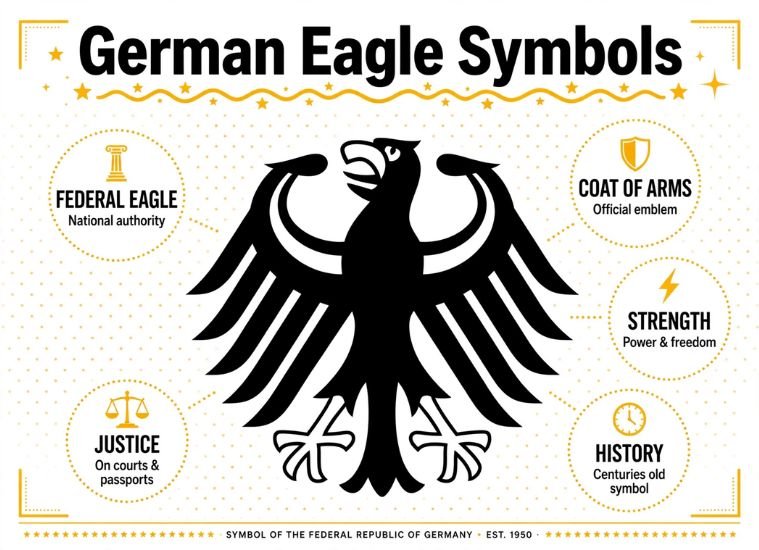
German eagle symbols have a long history in German heraldry and political imagery. The eagle has been used in different forms over time and is strongly associated with German state and national identity.
| Symbol | Meaning | Origin | Description |
| Bundesadler | Federal sovereignty | Federal Republic | The Bundesadler is the official federal eagle and appears in Germany’s contemporary state symbolism. |
| Reichsadler | Imperial authority | Holy Roman Empire | The Imperial Eagle refers to historical forms of the German state eagle used by the Empire. |
| Doppeladler | Imperial power | Holy Roman Empire | The double-headed eagle represented the emperor and became an important imperial emblem. |
| Königsadler | Royal authority | Medieval German kingdom | The single-headed royal eagle was used as a sign of the king’s authority. |
| Kaiseradler | Imperial sovereignty | German Empire | The imperial eagle represented the German emperor and the Imperial state. |
| Weimar Reichsadler | Republican state | Weimar Republic | After the monarchy ended, the eagle was retained but stripped of imperial symbols and adapted for republican government. |
| Bundeswappen Eagle | Constitutional authority | Modern Germany | The black eagle on the golden shield forms the central image of Germany’s federal coat of arms. |
| Federal Eagle in Bundestag | Parliament | Modern Germany | A federal eagle is displayed prominently within the German Bundestag. |
| Federal Eagle on Documents | Official authority | Federal Germany | Eagle imagery appears on various official government documents and state materials. |
| Eagle on German Passport | National identity | Modern Germany | The federal eagle appears on the cover of the German passport as an official national emblem. |
| Eagle on Identity Documents | State identification | Modern Germany | Variations of federal eagle imagery are used on German official identification materials. |
| Eagle on Coins | Sovereignty | German monetary tradition | The German eagle has appeared on German coins across different political periods. |
| Eagle on Euro Coins | National identity | Modern Germany | German euro coins feature the federal eagle on selected denominations. |
| Eagle on Bundestag Seal | Parliamentary authority | Modern Germany | Eagle imagery is incorporated into official parliamentary symbolism. |
| Eagle on Federal Court Emblems | Judicial authority | Modern Germany | Federal institutions may use eagle imagery as part of official seals and heraldic designs. |
| Eagle on Bundesrat | Federal government | Modern Germany | Eagle symbolism appears in official federal institutional imagery. |
| Eagle on Presidential Standard | Head of state | Federal Germany | The Federal President’s official standard incorporates the federal eagle. |
| Eagle Shield | Sovereignty | German heraldry | The eagle displayed on a shield is a traditional heraldic representation of German state authority. |
| Black Federal Eagle | National statehood | Modern Germany | The black eagle is the defining animal figure in Germany’s federal coat of arms. |
| Golden Shield Eagle | Federal emblem | Modern Germany | The eagle is placed on a gold-colored shield in the federal coat of arms. |
| Uncrowned Eagle | Republican government | Post-monarchical Germany | The modern federal eagle has no crown, reflecting the country’s republican form of government. |
| Single-Headed Federal Eagle | Modern sovereignty | Federal Germany | The head faces one direction and distinguishes the contemporary federal eagle from historic double-headed forms. |
| Imperial Double Eagle | Empire | Medieval and imperial Germany | Two heads represented imperial authority in historical German heraldry. |
| Prussian Eagle | Prussian statehood | Kingdom of Prussia | The black eagle was a central symbol of Prussia and appeared in its coats of arms. |
| Brandenburg Eagle | Brandenburg identity | Brandenburg | The red eagle of Brandenburg is a separate regional heraldic symbol from the black federal eagle. |
| Holy Roman Eagle | Imperial authority | Holy Roman Empire | The eagle served as an important emblem of the medieval and early modern Empire. |
| Hohenstaufen Eagle | Imperial dynasty | Medieval Germany | Eagle imagery appeared in the heraldry of the Hohenstaufen rulers. |
| German Imperial Eagle Seal | State legitimacy | Imperial Germany | Imperial seals used eagle imagery to authenticate official authority. |
| Reichstag Eagle | National parliament | Historical Germany | Eagle symbolism was associated with the German parliament and later remained part of parliamentary visual culture. |
| Federal Heraldic Eagle | Democratic state | Modern Germany | The federal eagle continues the long German heraldic tradition while representing today’s constitutional state. |
Learn about the meanings and festive traditions behind Christmas Symbols traditions and how they represent joy, hope, generosity, and the spirit of the holiday season.
German Symbols Of Freedom
German symbols of freedom can be connected with ideas of liberty, democracy, rights, and political change. Some gained particular importance through Germany’s modern history and movements for democratic participation.
| Symbol | Meaning | Origin | Description |
| Black-Red-Gold Flag | Freedom and unity | German national movement | The tricolor became a major symbol of the movement for national unity and civic freedom. |
| Hambach Flag | Political liberty | 1832 | Flags carried at the Hambach Festival represented demands for political rights, unity, and freedom. |
| Hambach Festival | Civil liberties | 1832 | The festival became one of the most important events in the early German democratic and national movement. |
| Paulskirche | Constitutional freedom | Frankfurt, 1848 | The Frankfurt Parliament met here while working toward a democratic constitution for a united Germany. |
| Frankfurt Parliament | Representative government | 1848 | The assembly represented an early effort to establish a German parliament based on popular representation. |
| German Revolution of 1848 | Political rights | German states | The revolution brought demands for constitutional government, civil liberties, and national unity. |
| Freedom Movement Cockade | Civic liberty | 19th-century Germany | Black-red-gold cockades served as wearable signs of support for the unity and freedom movement. |
| Lützow Colors | Liberation | Wars of Liberation | The colors were later connected with the Lützow Freikorps and the struggle against Napoleonic rule. |
| Freedom Banner | Public expression | German democratic movements | Banners using black-red-gold became visual expressions of demands for political participation and rights. |
| Constitution of 1849 | Constitutional rights | Frankfurt | The Frankfurt Constitution attempted to establish a united Germany based on constitutional government. |
| Basic Law | Fundamental rights | 1949 | Germany’s Basic Law establishes fundamental rights and the constitutional principles of the Federal Republic. |
| Article 1 Basic Law | Human dignity | 1949 | Article 1 places human dignity at the center of Germany’s constitutional order. |
| Article 5 Basic Law | Freedom of expression | 1949 | The Basic Law protects freedom of expression, subject to constitutional limits. |
| Article 8 Basic Law | Freedom of assembly | 1949 | Citizens have constitutional protection for peaceful assembly. |
| Article 4 Basic Law | Freedom of belief | 1949 | The constitution protects freedom of faith and conscience. |
| Article 2 Basic Law | Personal liberty | 1949 | The provision protects personal freedom within Germany’s constitutional framework. |
| Berlin Wall | From division to freedom | 1961–1989 | The Wall originally represented restricted movement and political division, but its fall turned it into a symbol of freedom. |
| Berlin Wall Fall | Freedom of movement | 1989 | The opening of the Wall became one of the strongest visual moments associated with the end of Cold War division in Germany. |
| Bornholmer Straße Crossing | Peaceful opening | Berlin, 1989 | The border crossing became famous because guards opened the checkpoint on the night the Wall fell. |
| Checkpoint Charlie | Divided Berlin | Cold War | The former checkpoint became a symbol of confrontation between East and West and later of the city’s reunification. |
| Brandenburg Gate Reopening | Freedom and unity | 1989 | The gate reopened to public passage after decades of division, becoming an important freedom symbol. |
| Monday Demonstrations | Peaceful protest | East Germany, 1989 | Peaceful demonstrations, especially in Leipzig, became central to the pressure for political reform and freedom. |
| Leipzig Nikolaikirche | Peaceful civic action | Leipzig | The church became closely associated with the peaceful protest movement of 1989. |
| Peaceful Revolution | Democratic change | East Germany, 1989 | The term describes the largely peaceful civic movement that helped bring down the East German political system. |
| Freedom Bell | Liberty | Berlin | Berlin’s Freedom Bell was established as a symbol of freedom and opposition to dictatorship. |
| Liberty Bell Inscription | Democratic ideals | Berlin | The bell and its associated inscription express commitment to freedom and democratic government. |
| Reichstag Glass Dome | Transparency | Modern Berlin | The transparent dome is commonly associated with openness and public visibility in democratic government. |
| Federal Constitutional Court | Rule of law | Karlsruhe | The court safeguards constitutional principles and fundamental rights within Germany’s legal system. |
| Federal Constitutional Eagle | Constitutional authority | Modern Germany | Eagle imagery used by federal constitutional institutions represents the authority of the constitutional state. |
| German Human Rights Memorials | Civil liberties | Modern Germany | Memorials throughout Germany preserve the memory of those who struggled for rights, democracy, and freedom. |
Learn about the personal meanings behind Symbols That Represent Me choices and how they can reflect your identity, personality, values, and individuality.
German Symbols Of Berlin
German symbols of Berlin can represent the city’s history, architecture, culture, and modern identity. Famous landmarks, public spaces, and local imagery can all help express what makes Berlin distinctive.
| Symbol | Meaning | Origin | Description |
| Berlin Bear | City identity | Medieval Berlin | The bear has been associated with Berlin for centuries and appears prominently in the city’s coat of arms. |
| Berliner Bär Coat of Arms | Municipal identity | Berlin | The standing black bear on a white shield is Berlin’s best-known heraldic symbol. |
| Brandenburg Gate | Berlin and unity | 18th-century Berlin | The neoclassical gate is Berlin’s most internationally recognized landmark and became a symbol of reunification. |
| Berlin TV Tower | Modern Berlin | East Berlin, 1960s | The Fernsehturm is one of Berlin’s defining landmarks and represents the city’s modern skyline. |
| Berlin Wall | Division and memory | 1961–1989 | The Wall divided East and West Berlin and remains a central symbol of the city’s 20th-century history. |
| East Side Gallery | Freedom and art | Berlin | A preserved section of the Wall covered with murals represents artistic expression and the memory of division. |
| Victory Column | Historical military victory | 19th-century Berlin | The Siegessäule commemorates Prussian military victories and has become a distinctive Berlin landmark. |
| Reichstag Building | Parliament | Berlin | The historic parliamentary building now serves as the home of the German Bundestag. |
| Reichstag Dome | Transparency | Modern Berlin | The glass dome is a major architectural attraction and a symbol of modern parliamentary openness. |
| Museum Island | Culture and heritage | Berlin | Museum Island is a UNESCO World Heritage site containing major museums and collections. |
| Berlin Cathedral | Religious heritage | Berlin | The cathedral is one of the city’s most recognizable historic buildings along Museum Island. |
| Berlin Palace Facade | Historical reconstruction | Berlin | The reconstructed exterior of the Berlin Palace forms part of the Humboldt Forum complex. |
| Humboldt Forum | Culture and knowledge | Modern Berlin | The Humboldt Forum occupies the reconstructed palace site and serves as a major cultural institution. |
| Charlottenburg Palace | Prussian heritage | Berlin | The palace represents Berlin’s royal and Prussian architectural history. |
| Berlin Cathedral Dome | Historic skyline | Berlin | Its large dome is a prominent feature of Berlin’s central skyline. |
| Neptune Fountain | Urban heritage | Berlin | The historic fountain near the Rotes Rathaus is a recognizable piece of Berlin’s public art. |
| Red City Hall | Civic government | Berlin | The Rotes Rathaus is the official seat of Berlin’s governing mayor and Senate. |
| Berlin State Flag | Regional identity | Berlin | Berlin’s state flag features the city bear and is used to represent the federal state. |
| Alexanderplatz World Clock | Global city | East Berlin | The Weltzeituhr is a famous meeting point and landmark on Alexanderplatz. |
| Fernsehturm Sphere | Modern architecture | East Berlin | The spherical structure beneath the TV tower’s antenna makes it instantly recognizable. |
| Ampelmann | Berlin culture | East Germany | The distinctive East German pedestrian traffic-light figure became a popular symbol of Berlin after reunification. |
| Ampelfrau | Berlin identity | East Germany | The female traffic-light figure is a playful part of Berlin’s visual culture and pedestrian signage. |
| Trabbi | East Berlin history | East Germany | The Trabant car became an iconic representation of everyday life in the former East Germany. |
| Berlin U-Bahn | Urban movement | Berlin, 1902 | Berlin’s underground railway is an important part of the city’s transportation identity. |
| Berlin S-Bahn | City connection | Berlin, 19th–20th century | The suburban railway connects Berlin’s central districts with surrounding areas and is part of the city’s identity. |
| Oberbaum Bridge | East-West connection | Berlin | The historic bridge crosses the Spree and became a significant connection between former East and West Berlin. |
| Berlin Wall Memorial | Historical memory | Bernauer Straße | The memorial preserves sections of the former Wall and documents the history of Berlin’s division. |
| Checkpoint Charlie Booth | Cold War memory | Berlin | The replica guardhouse marks one of the city’s most famous former Allied checkpoints. |
| Holocaust Memorial | Remembrance | Berlin | The Memorial to the Murdered Jews of Europe commemorates Jewish victims of the Holocaust. |
| Berlin Airlift Monument | Postwar freedom | Berlin | The Luftbrückendenkmal commemorates the Berlin Airlift and the supply of West Berlin during the blockade. |
German Symbols Of Nature
German symbols of nature can draw from forests, flowers, animals, mountains, rivers, and other elements of the country’s landscape. They often reflect Germany’s connection with its natural environment and cultural traditions.
| Symbol | Meaning | Origin | Description |
| Black Forest | Wilderness and tradition | Baden-Württemberg | The Schwarzwald is one of Germany’s best-known natural landscapes, famous for dense forests, mountains, and traditional culture. |
| Rhine River | Life and connection | Central Europe | The Rhine has shaped German trade, settlement, folklore, and landscape for centuries. |
| Danube River | Continuity and heritage | Central Europe | The Danube begins in Germany’s Black Forest region and connects the country with much of Central and Eastern Europe. |
| Alps | Grandeur and endurance | Southern Germany | The Bavarian Alps represent dramatic mountain scenery and are closely linked with southern German identity. |
| Wadden Sea | Coastal nature | North Sea coast | Germany’s Wadden Sea contains tidal flats, salt marshes, and rich coastal ecosystems. |
| Baltic Sea | Maritime heritage | Northern Germany | Germany’s Baltic coast is associated with beaches, fishing communities, islands, and maritime traditions. |
| North Sea | Coastal strength | Northern Germany | The North Sea has influenced German coastal culture, shipping, fishing, and settlement patterns. |
| Oak Tree | Strength and longevity | German and European tradition | The oak has long held cultural importance in Germany and appears frequently in German art, medals, and monuments. |
| Beech Tree | Forest heritage | Central Europe | European beech is one of Germany’s characteristic native trees and forms extensive natural forests. |
| Linden Tree | Community and peace | German village tradition | Linden trees were traditionally planted near village centers and meeting places and became associated with community life. |
| Spruce Tree | Mountain forests | Central Europe | Spruce is widespread in German forests and has become strongly associated with mountainous landscapes. |
| Pine Tree | Resilience | Northern and central Germany | Scots pine is common in German landscapes and thrives in several sandy and dry regions. |
| Fir Tree | Woodland life | Central Europe | Fir trees are native to parts of Germany and are associated with evergreen forests and mountain landscapes. |
| Edelweiss | Alpine beauty | European Alps | Although more strongly associated with the Alps generally than Germany alone, edelweiss is familiar in Bavarian alpine culture. |
| Cornflower | Natural beauty | Central Europe | The cornflower grows in European landscapes and became a recognizable floral image in German cultural history. |
| Heather | Woodland landscape | Northern Europe | Heather-covered landscapes occur in parts of northern Germany, especially the Lüneburg Heath. |
| Dandelion | Wild nature | Europe | The dandelion is common across Germany and represents the everyday beauty of meadows and open landscapes. |
| Oak Leaf | Endurance | German cultural tradition | Oak leaves are frequently used in German decorative and commemorative designs because of the tree’s cultural importance. |
| Acorn | Growth | European woodland tradition | Acorns represent the reproductive cycle of the oak and can suggest future growth and continuity. |
| Bee | Biodiversity | European nature | Bees are important pollinators and have become widely used in environmental imagery connected with healthy ecosystems. |
| Red Fox | Adaptability | German wildlife | The red fox is widespread in Germany and is a familiar animal of forests, countryside, and urban areas. |
| European Roe Deer | Woodland life | Central Europe | Roe deer are widespread in German forests and agricultural landscapes and are common in German wildlife imagery. |
| Red Deer | Wildness | Central Europe | Red deer inhabit German forests and mountain regions and are associated with wilderness and natural strength. |
| White Stork | Seasonal renewal | German countryside | The white stork is a familiar bird in German rural landscapes and is especially associated with nesting in villages and wetlands. |
| Blackbird | Song and nature | Europe | The blackbird is one of Germany’s common garden and woodland birds and is familiar for its distinctive song. |
| European Hare | Open countryside | German farmland | Hares are traditional inhabitants of German fields and meadows and are part of the country’s rural wildlife. |
| Wild Boar | Forest strength | German forests | Wild boar are widespread in Germany and have become a recognizable symbol of untamed woodland nature. |
| Wolpertinger | Alpine folklore | Bavaria | The Wolpertinger is a mythical creature from Bavarian folklore, usually depicted as a fantastical mixture of several animals. |
| Black Forest Cuckoo | Forest heritage | Black Forest | The cuckoo is closely associated with the Black Forest’s famous cuckoo clocks and its surrounding woodland culture. |
| German Heather Landscape | Rural beauty | Lüneburg Heath | The purple-flowering heathlands of northern Germany are a distinctive natural landscape and cultural image. |
German Symbols Of Strength
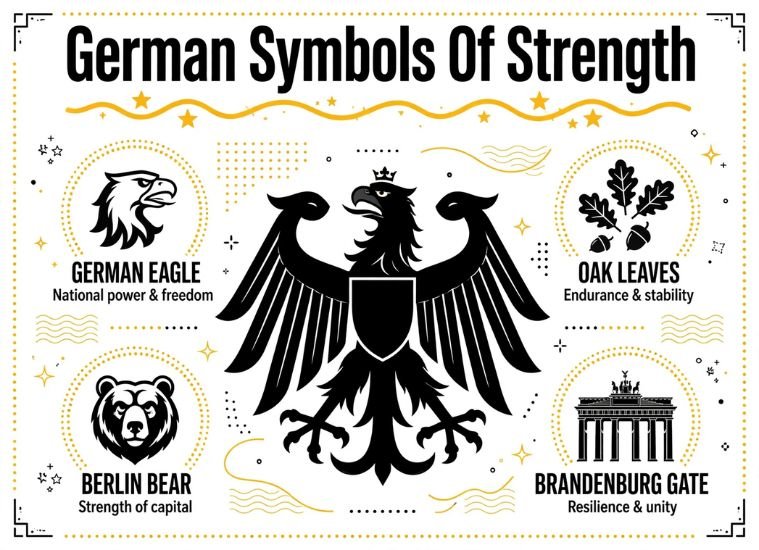
German symbols of strength can represent courage, resilience, endurance, and determination. Historical emblems, animals, and traditional imagery may carry these ideas in different contexts.
| Symbol | Meaning | Origin | Description |
| German Oak | Endurance | German cultural tradition | The oak became an important German symbol of strength, longevity, and resilience. |
| German Eagle | Power and sovereignty | German heraldry | The eagle has been a major German state emblem for centuries and represents authority and sovereignty. |
| Iron Cross | Courage | Prussia | Established in 1813, the Iron Cross was originally a Prussian military decoration and later became a prominent German military symbol. |
| Brandenburg Eagle | Regional power | Brandenburg | The red eagle of Brandenburg is a historic heraldic emblem representing the state and its long political tradition. |
| Prussian Eagle | Authority | Kingdom of Prussia | The black eagle was a major emblem of Prussia and appeared in its coats of arms and royal insignia. |
| German Lion | Courage | Medieval European heraldry | Lions appear in numerous German regional coats of arms and traditionally represent bravery and strength. |
| Bavarian Lion | Sovereignty | Bavaria | The golden lion appears in Bavarian heraldry and represents the historical identity of the Bavarian state. |
| Saxon Horse | State identity | Saxony | The white horse of Lower Saxony represents the region’s historic Saxon identity and appears on its coat of arms. |
| Black Horse of Westphalia | Regional strength | Westphalia | The white horse on a red field is a major symbol of Westphalia and its historic political identity. |
| Bear of Berlin | Civic strength | Berlin | Berlin’s heraldic bear represents the city and appears on its official coat of arms. |
| Hamburg Castle | Civic authority | Hamburg | Hamburg’s coat of arms features a castle, representing the city’s historic status and identity. |
| Frankfurt Eagle | Civic authority | Frankfurt | Frankfurt’s coat of arms uses a red eagle as a historic municipal emblem. |
| Lübeck Eagle | Historic power | Lübeck | Lübeck’s heraldic traditions incorporate an eagle connected with the city’s historical status. |
| Bremen Key | Authority and independence | Bremen | The key is Bremen’s best-known heraldic symbol and refers to Saint Peter and the city’s historic identity. |
| Nuremberg Eagle | Imperial heritage | Nuremberg | Nuremberg’s traditional heraldry includes the imperial eagle and reflects the city’s historical importance within the Empire. |
| Silesian Eagle | Regional heritage | Silesia | The eagle is a longstanding heraldic symbol of Silesia and appears in various historical and modern regional emblems. |
| Hessian Lion | Courage | Hesse | The striped lion is a prominent symbol in Hessian heraldry and represents the historic state of Hesse. |
| Thuringian Lion | Sovereignty | Thuringia | The red-and-white striped lion is a major heraldic symbol of Thuringia. |
| Palatine Lion | Regional authority | Palatinate | The golden lion is connected with the historic Electoral Palatinate and remains important in regional heraldry. |
| Franconian Rake | Regional identity | Franconia | The red-and-white rake is one of the strongest visual symbols of Franconia. |
| Mecklenburg Bull Head | Regional heritage | Mecklenburg | The bull’s head is a traditional heraldic element associated with Mecklenburg. |
| Pomeranian Griffin | Courage and heritage | Pomerania | The griffin is a major historic emblem of Pomerania and appears in regional coats of arms. |
| Württemberg Stag | Strength and tradition | Württemberg | The black stag antlers are a distinctive symbol of Württemberg and appear in the state’s historic heraldry. |
| Baden Griffin | Regional power | Baden | The griffin appears in Baden’s historic heraldic traditions and represents the region’s historical identity. |
| Saarland Lion | Regional authority | Saarland | The lion is incorporated into the Saarland coat of arms alongside symbols representing its historic territories. |
| Meissen Lion | Dynastic power | Saxony | The Meissen lion is associated with the historic Margraviate of Meissen and Saxon heraldic tradition. |
| Hohenstaufen Lion | Dynastic strength | Medieval Germany | The Hohenstaufen dynasty used heraldic imagery including lions during its medieval rule. |
| Germanic Wolf | Endurance and independence | Germanic folklore | Wolves appear in Germanic mythology and folklore and are commonly interpreted as images of strength and independence. |
| Stag | Masculine strength | German and European folklore | The stag appears in European hunting traditions, folklore, and art as a powerful woodland animal. |
| Hammer | Labor and strength | German industrial symbolism | The hammer became a common symbol of physical work, craftsmanship, and industrial labor. |
German Symbols Of Traditional Culture
German symbols of traditional culture can reflect customs, festivals, clothing, crafts, food, music, and regional heritage. Because Germany has many distinct regions, cultural symbols can vary considerably from one area to another.
| Symbol | Meaning | Origin | Description |
| Dirndl | Alpine heritage | Bavaria and Austria | The dirndl is a traditional women’s garment strongly associated with Bavarian and Alpine culture. |
| Lederhosen | Bavarian tradition | Bavaria and Alpine regions | Leather breeches became closely associated with Bavarian rural and festive clothing. |
| Trachtenhut | Regional identity | German-speaking Alpine regions | Traditional hats vary by region and form part of German and Bavarian folk dress. |
| Cuckoo Clock | Black Forest craftsmanship | Black Forest | The cuckoo clock became internationally associated with traditional Black Forest craftsmanship. |
| Beer Stein | Hospitality | German-speaking Europe | Decorative handled beer mugs are strongly associated with German beer culture and traditional dining. |
| Pretzel | Food tradition | Southern Germany | The Brezel is especially associated with Bavaria and Swabia and is one of Germany’s best-known baked foods. |
| Gingerbread Heart | Festivals and affection | German folk culture | Decorated gingerbread hearts are especially associated with fairs, Christmas markets, and Bavarian festivals. |
| Maypole | Community celebration | Central European tradition | Maypoles are erected during spring festivals in many German communities and represent local celebration. |
| Christmas Pyramid | Christmas tradition | Erzgebirge | The wooden Weihnachtspyramide is a distinctive Christmas craft from the Ore Mountains. |
| Nutcracker | Christmas craftsmanship | Erzgebirge | Wooden nutcrackers became a famous traditional craft of the Ore Mountains in eastern Germany. |
| Schwibbogen | Christmas light | Erzgebirge | The arched candle decoration is a traditional Christmas craft associated with mining communities in the Ore Mountains. |
| Smoker Figure | Christmas tradition | Erzgebirge | Wooden incense smokers, often shaped like people or tradesmen, are traditional Erzgebirge decorations. |
| Easter Fountain | Spring celebration | Franconia | Decorated fountains are a distinctive Easter custom in parts of Bavaria, especially Franconia. |
| Oktoberfest Costume | Festival identity | Munich | Traditional clothing such as dirndls and lederhosen became closely associated with Munich’s Oktoberfest. |
| Maibaum | Village identity | Bavaria and southern Germany | Decorated maypoles are raised in towns and villages during spring celebrations. |
| Erzgebirge Woodcraft | Craftsmanship | Saxony | The Ore Mountains are famous for detailed wooden Christmas decorations and folk-art traditions. |
| Bollenhut | Black Forest identity | Baden-Württemberg | The distinctive pom-pom hat is associated with traditional women’s dress in parts of the Black Forest. |
| Black Forest Dress | Regional heritage | Baden-Württemberg | Traditional costumes from the Black Forest vary by locality and include distinctive hats, skirts, and bodices. |
| Krampus Figure | Alpine winter folklore | Bavaria and Alpine regions | Krampus traditions occur in parts of southern German and Alpine culture, particularly around early December. |
| St. Nicholas Figure | Generosity and tradition | European Christian culture | Nikolaus traditions are widespread in Germany, with children traditionally receiving small gifts around 6 December. |
| Easter Bunny | Easter celebration | German-speaking Europe | The Easter hare became a familiar German Easter tradition and later spread widely internationally. |
| Easter Eggs | Renewal | German and European tradition | Decorated eggs are central to German Easter customs and represent spring, renewal, and celebration. |
| Christmas Market | Community and celebration | German-speaking Europe | Weihnachtsmärkte are a major part of German winter culture, combining crafts, food, lights, and seasonal traditions. |
| Advent Wreath | Advent season | German tradition | The Advent wreath is strongly associated with German Protestant tradition and marks the weeks leading to Christmas. |
| Advent Calendar | Christmas anticipation | German tradition | The Advent calendar developed in German-speaking culture as a way to count down the days before Christmas. |
| Maypole Ribbons | Community | Southern Germany | Colorful ribbons decorating maypoles are part of village festivals and seasonal celebrations. |
| Volksfest Wheel | Local celebration | German festival culture | Ferris wheels and fairground rides are common features of German Volksfeste and public celebrations. |
| Accordion | Folk music | Central European folk culture | The accordion became an important instrument in German folk, dance, and festival music. |
| Alphorn | Alpine music | Alpine regions | The long wooden horn is traditionally associated with mountain regions and remains part of Bavarian and Alpine musical culture. |
| German Folk Embroidery | Craft tradition | Regional Germany | Decorative embroidery appears on traditional clothing and household textiles across different German regions. |
German Pretzel Symbol
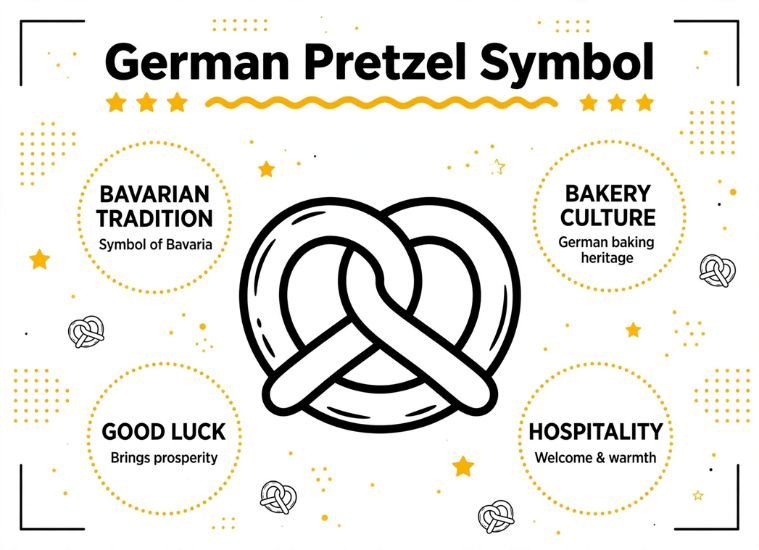
The German pretzel symbol is closely connected with traditional baking and food culture. Pretzels, known as Brezeln in German, are especially associated with southern German traditions and are commonly seen at festivals and gatherings.
| Symbol | Meaning | Origin | Description |
| Classic Brezel | German baking tradition | Southern Germany | The familiar twisted pretzel is one of Germany’s most recognizable traditional baked foods. |
| Bavarian Pretzel | Bavarian identity | Bavaria | Bavarian pretzels are commonly served with beer, sausages, cheese, and other regional foods. |
| Swabian Pretzel | Regional food heritage | Swabia | Swabian pretzels traditionally have a distinctive shape with thinner arms and a thicker central section. |
| Pretzel Knot | Craftsmanship | German baking tradition | The interwoven form demonstrates the characteristic shaping technique used to create the Brezel. |
| Pretzel Twist | Tradition | Southern Germany | The crossed and twisted design gives the pretzel its instantly recognizable appearance. |
| Pretzel Loop | Continuity | Traditional baking | The open loops of the pretzel form are often used decoratively in German food imagery. |
| Salted Pretzel | Hospitality | German bakery culture | Coarse salt is a classic topping and contributes to the traditional appearance and flavor of German pretzels. |
| Laugenbrezel | Traditional baking | Germany | A Laugenbrezel receives its characteristic dark brown surface from treatment with alkaline solution before baking. |
| Brezel With Butter | Bavarian snack culture | Bavaria | Butter-filled or butter-served pretzels are especially popular in Bavarian food culture. |
| Pretzel Basket | Hospitality | German dining culture | Baskets of fresh pretzels are common in traditional restaurants, beer halls, and festive settings. |
| Pretzel and Beer | Social gathering | Bavaria | The pairing has become an internationally recognized image of Bavarian social and festival culture. |
| Pretzel and Weisswurst | Bavarian cuisine | Bavaria | Pretzels are traditionally served alongside white sausage as part of a well-known Bavarian meal. |
| Pretzel Stand | Street food | German cities and festivals | Pretzel stands are common at railway stations, markets, festivals, and public events. |
| Pretzel Baker | Craftsmanship | German bakery tradition | The pretzel represents the skills of traditional German bakers and bakery apprentices. |
| Pretzel Sign | Bakery identity | German commercial tradition | Bakeries often use pretzel imagery on signs and logos to indicate baked goods. |
| Pretzel Logo | Food heritage | Modern German design | The pretzel shape is widely used in restaurant, bakery, and food branding. |
| Mini Pretzel | Celebration | German festival culture | Small pretzels are served at parties, markets, and gatherings as convenient snacks. |
| Pretzel Necklace | Festival culture | Modern Bavarian fashion | Pretzel-shaped jewelry is sometimes worn at Oktoberfest and other Bavarian-themed celebrations. |
| Pretzel Ornament | Food heritage | Modern German decorative culture | Pretzel-shaped ornaments are used in kitchens, restaurants, and festival decorations. |
| Pretzel Cookie | Sweet tradition | Modern German baking | Sweet versions use the classic pretzel form while adapting it to dessert-style baking. |
| Pretzel Wreath | Hospitality | Modern decorative use | Multiple pretzels can be arranged into wreath shapes for festive food displays. |
| Pretzel Heart | Affection | German fair culture | Heart-shaped gingerbread is more traditional, but pretzel-heart designs are used in modern German-themed decoration. |
| Pretzel and Cheese | Bavarian snack culture | Southern Germany | Soft pretzels paired with cheese reflect the casual food traditions of southern Germany. |
| Pretzel Board | Shared food | Modern dining | Pretzels arranged on serving boards are used for communal meals and German-themed gatherings. |
| Pretzel Basket Sign | Bakery tradition | German commercial culture | A pretzel illustration on a storefront or sign quickly communicates bakery and snack traditions. |
| Brezel Embroidery | Folk decoration | German regional costume | Pretzel motifs sometimes appear in decorative textiles, aprons, and festival clothing. |
| Brezel Woodcarving | Craftsmanship | German folk art | Pretzel shapes can be carved into wooden signs, kitchen objects, and decorative pieces. |
| Brezel Ceramic | Kitchen tradition | German craft | Pretzel motifs appear on mugs, plates, serving dishes, and other German-themed ceramics. |
| Brezel Festival Emblem | Celebration | Modern festival culture | Pretzel imagery is commonly incorporated into logos and decorations for food festivals and Bavarian events. |
| Brezel Tattoo | Regional pride | Modern body art | A pretzel tattoo can represent German heritage, Bavarian culture, food traditions, or affection for German festivals. |
German Christmas Symbols
German Christmas symbols are connected with holiday traditions, decorations, markets, and seasonal customs. Christmas trees, Advent traditions, candles, stars, and wooden decorations are among the imagery associated with German Christmas culture.
| Symbol | Meaning | Origin | Description |
| Christmas Tree | Christmas celebration | German-speaking Europe | The decorated Christmas tree became strongly established in German-speaking lands before spreading internationally. |
| Advent Wreath | Preparation | German Protestant tradition | Four candles mark the Sundays of Advent and create a gradual countdown toward Christmas. |
| Advent Calendar | Anticipation | Germany | Advent calendars developed in German-speaking culture and became a worldwide Christmas tradition. |
| Christmas Pyramid | Light and celebration | Erzgebirge | Wooden pyramids with rotating figures are a distinctive Christmas craft from the Ore Mountains. |
| Nutcracker | Christmas folklore | Erzgebirge | Wooden nutcracker figures became a signature craft of the Ore Mountains and are now famous worldwide. |
| Schwibbogen | Light | Erzgebirge | Candle arches traditionally display scenes connected with mining and Christmas life in the Ore Mountains. |
| Räuchermann | Festive tradition | Erzgebirge | These wooden smoker figures release incense and often depict traditional occupations or characters. |
| Christmas Angel | Protection and joy | Erzgebirge | Wooden angels are among the best-known Christmas decorations produced by Ore Mountain artisans. |
| Christmas Star | Light and guidance | German Christmas tradition | Paper stars are popular German Christmas decorations and are especially common in windows and homes. |
| Herrnhut Star | Christmas light | Herrnhut, Saxony | The distinctive many-pointed Herrnhut Star originated in the Moravian tradition and became a famous German Christmas decoration. |
| Christmas Market | Community | German-speaking Europe | German Weihnachtsmärkte combine seasonal foods, crafts, decorations, and public celebration. |
| Lebkuchen | Festive sweetness | German-speaking Europe | German gingerbread is a traditional Christmas food with many regional varieties. |
| Stollen | Christmas abundance | Saxony | Christstollen is a traditional German Christmas bread strongly associated with Dresden and Saxony. |
| Dresdner Christstollen | Christmas tradition | Dresden | The Dresden version of Stollen is a protected regional specialty with a long history. |
| Plätzchen | Home baking | German-speaking Europe | Small Christmas cookies are traditionally baked at home during Advent and Christmas. |
| Spekulatius | Seasonal baking | German-speaking regions | Spiced biscuits are popular during Advent and Christmas, particularly in western and northern Germany. |
| Pfefferkuchen | Christmas baking | German tradition | Pepper cakes and spiced gingerbread are traditional seasonal sweets in several German regions. |
| Marzipan | Festive confectionery | European tradition | Marzipan is widely used in German Christmas sweets, especially in northern Germany and Lübeck. |
| Christmas Goose | Festive meal | German tradition | Roast goose has long been associated with major festive meals in Germany. |
| St. Nicholas | Gift-giving | German Christian tradition | Nikolaus visits are traditionally associated with 6 December and small gifts for children. |
| Knecht Ruprecht | Traditional companion | German folklore | Knecht Ruprecht appears in some German St. Nicholas traditions as a companion to Saint Nicholas. |
| Christkind | Christmas gift-giver | German-speaking Europe | The Christkind became an important Christmas gift-giving figure in German-speaking regions. |
| Weihnachtsmann | Santa figure | German Christmas culture | The Weihnachtsmann is the German Christmas gift-giving figure broadly comparable to Santa Claus. |
| Christmas Angel Ornament | Blessing | German folk craft | Angels are common decorations on Christmas trees, pyramids, and windows. |
| Wooden Nutcracker Soldier | Festive protection | Erzgebirge | Soldier-shaped nutcrackers are particularly recognizable examples of German wooden Christmas craft. |
| Candle Arch | Winter light | Erzgebirge | Schwibbögen illuminate windows during the dark winter season and have become a hallmark of German Christmas decoration. |
| Christmas Incense Smoker | Fragrance and tradition | Erzgebirge | Wooden smoker figures burn incense and are traditionally displayed during Advent and Christmas. |
| Straw Star | Simplicity and tradition | German Christmas craft | Handmade straw stars are traditional tree and window decorations. |
| Christmas Caroling | Community | German Christian tradition | Singing Christmas songs is an important part of Advent and Christmas celebrations across Germany. |
| Christmas Village Scene | Nativity and tradition | German Christmas culture | Small Christmas villages and nativity displays are common seasonal decorations in German homes and markets. |
German Symbols In Heraldry
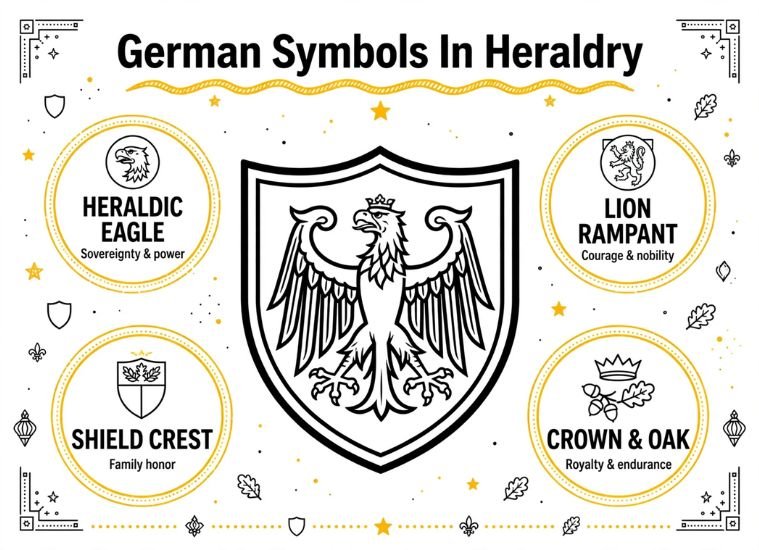
German symbols in heraldry include coats of arms, shields, animals, crowns, colors, and other traditional elements. Regional and historical heraldic designs can provide insight into the identity of cities, states, and families.
| Symbol | Meaning | Origin | Description |
| Federal Eagle | National sovereignty | Federal Germany | The black eagle on a golden shield is the central heraldic symbol of the Federal Republic. |
| Brandenburg Eagle | Brandenburg identity | Brandenburg | A red eagle on a silver field represents the German state of Brandenburg. |
| Bavarian Lozenge | Bavarian identity | Bavaria | The blue-and-white lozenges are among the most recognizable elements of Bavarian heraldry. |
| Bavarian Lions | Regional territories | Bavaria | Golden lions appear alongside the lozenges in Bavaria’s state arms and represent historical territories. |
| Saxon Arms | Saxon identity | Saxony | The green-and-white striped field with the crossed crown-shaped design is central to Saxon heraldry. |
| Saxon Horse | Saxon heritage | Lower Saxony | The white Saxon steed is the principal symbol of Lower Saxony. |
| Hessian Lion | Hesse | Hesse | The red-and-white striped lion is the principal heraldic animal of Hesse. |
| Thuringian Lion | Thuringia | Thuringia | The red-and-white striped lion is a central element of the Thuringian coat of arms. |
| Württemberg Stag Antlers | Württemberg | Württemberg | Three black stag antlers form a distinctive historical symbol of Württemberg. |
| Baden Griffin | Baden | Baden | The griffin is part of the historical heraldic tradition of Baden. |
| Bremen Key | Bremen | Bremen | The silver key represents Saint Peter and is Bremen’s principal heraldic emblem. |
| Hamburg Castle | Hamburg | Hamburg | The castle on Hamburg’s coat of arms represents the city’s historic identity. |
| Berlin Bear | Berlin | Berlin | The black bear is the city’s principal heraldic animal. |
| Frankfurt Eagle | Frankfurt | Frankfurt am Main | The red eagle is the traditional coat-of-arms figure of Frankfurt. |
| Palatine Lion | Palatinate | Historical Palatinate | The golden lion is associated with the former Electoral Palatinate. |
| Franconian Rake | Franconia | Franconia | The red-and-white rake is a distinctive symbol of the Franconian region. |
| Pomeranian Griffin | Pomerania | Pomerania | The griffin is one of the oldest and most recognizable symbols of Pomerania. |
| Mecklenburg Bull Head | Mecklenburg | Mecklenburg | The bull’s head is a traditional heraldic symbol of Mecklenburg. |
| Saarland Lion | Saarland | Saarland | A silver lion forms part of the Saarland coat of arms and reflects historical territorial traditions. |
| Nassau Lion | Nassau | Historical Nassau | The blue-and-gold lion is associated with the House of Nassau and regional heraldry. |
| Hohenzollern Shield | Dynasty | Hohenzollern | The quartered black-and-white shield is associated with the Hohenzollern dynasty. |
| Hohenlohe Leopard | Dynasty and region | Hohenlohe | Leopard imagery appears in the arms of the historic Hohenlohe territories. |
| Lippe Rose | Lippe | Lippe | The rose is the central symbol of the former state of Lippe and remains important in regional heraldry. |
| Oldenburg Cross | Oldenburg | Oldenburg | The blue cross and heraldic elements represent the historic House and territory of Oldenburg. |
| Holstein Nettle Leaf | Holstein | Holstein | The silver nettle leaf is a characteristic heraldic symbol of Holstein. |
| Lüneburg Lion | Lüneburg | Lower Saxony | The lion is part of the complex heraldic tradition of the former Duchy of Lüneburg. |
| Wettin Lion | Dynastic heritage | Saxon dynasties | Lion imagery appears in the heraldry associated with the Wettin dynasty. |
| Guelph Lion | Dynastic identity | House of Welf | The lion became associated with the House of Welf and related German territories. |
| Imperial Eagle | Imperial authority | Holy Roman Empire | The double-headed eagle represented the emperor and became a defining feature of imperial heraldry. |
| Black Eagle of Prussia | Prussian state | Kingdom of Prussia | The black eagle became the principal heraldic animal of Prussia and influenced later German state symbolism. |
German Symbols For Tattoos And Art
German symbols for tattoos and art can draw from national colors, historical imagery, traditional designs, nature, and cultural motifs. Before using a historical symbol, it is important to understand its context and modern associations.
| Symbol | Meaning | Origin | Description |
| German Eagle Tattoo | Strength and identity | German heraldry | A stylized federal eagle can create a bold tattoo representing German national or cultural identity. |
| Black-Red-Gold Stripes | Unity and freedom | German national movement | Three clean horizontal bands make a simple design based on Germany’s national colors. |
| Brandenburg Gate | Berlin and unity | Berlin | Its classical columns create a recognizable architectural tattoo connected with Berlin and reunification. |
| Berlin Bear | Berlin pride | Berlin heraldry | The bear is an instantly recognizable city symbol that works well in minimalist or traditional tattoo styles. |
| Pretzel | German food culture | Southern Germany | A Brezel tattoo can represent German heritage, Bavarian culture, or an appreciation for German cuisine. |
| Cuckoo Clock | Black Forest heritage | Baden-Württemberg | A cuckoo clock design represents traditional craftsmanship and the cultural image of the Black Forest. |
| Lederhosen | Bavarian culture | Bavaria | A stylized pair of lederhosen can represent Bavarian heritage and traditional dress. |
| Dirndl Bodice | Folk tradition | Bavaria and Alpine regions | The distinctive silhouette of a dirndl makes an easily recognizable cultural-art motif. |
| Oak Leaf Crown | Strength | German cultural tradition | Oak leaves can be arranged into a wreath or crown to create an artwork representing endurance. |
| Iron Cross Design | Military history | Prussia | The Iron Cross is visually distinctive but has military associations, so its historical context should be considered carefully. |
| German Oak Tree | Endurance | German tradition | A full oak tree makes a strong nature-based design connected with longevity and resilience. |
| Brandenburg Eagle | Regional heritage | Brandenburg | The red eagle provides a striking tattoo option for someone connected with Brandenburg. |
| Bavarian Lozenge Pattern | Bavaria | Bavarian heraldry | Blue-and-white diamonds create a recognizable regional pattern for backgrounds, bands, or decorative artwork. |
| Bremen Key | Bremen identity | Bremen heraldry | The key is a compact symbol that can work well as a small tattoo or emblem. |
| Frankfurt Eagle | Frankfurt heritage | Frankfurt heraldry | The red eagle provides a distinctive city-specific design for people connected with Frankfurt. |
| Hessian Lion | Hesse pride | Hessian heraldry | The striped lion creates a strong heraldic image representing the state of Hesse. |
| Thuringian Lion | Thuringian identity | Thuringia | The red-and-white lion offers a traditional regional motif for artwork and commemorative designs. |
| Württemberg Stag Antlers | Regional heritage | Württemberg | Three black stag antlers form a clean geometric motif suitable for heraldic art. |
| Pomeranian Griffin | Heritage and courage | Pomerania | The griffin combines eagle and lion features and produces a dramatic traditional design. |
| Lippe Rose | Regional identity | Lippe | The five-petaled rose provides a softer heraldic design with strong regional associations. |
| Franconian Rake | Franconian heritage | Franconia | The red-and-white rake is visually distinctive and works particularly well in heraldic artwork. |
| Holstein Nettle Leaf | Holstein identity | Holstein heraldry | The stylized nettle leaf provides a simple regional motif with historical heraldic roots. |
| Mecklenburg Bull Head | Regional strength | Mecklenburg | The bull’s head creates a bold traditional emblem connected with Mecklenburg. |
| Nassau Lion | Dynastic heritage | Nassau | The blue-and-gold lion can be used in historical German-themed artwork. |
| Hohenzollern Shield | Dynastic history | Hohenzollern | The black-and-white quartered shield provides a geometric heraldic design. |
| Christmas Pyramid | German craftsmanship | Erzgebirge | A miniature pyramid design can represent German Christmas traditions and Ore Mountain woodworking. |
| Schwibbogen | Winter tradition | Erzgebirge | The curved candle arch creates a distinctive decorative image associated with German Christmas culture. |
| Nutcracker Figure | Christmas heritage | Erzgebirge | A wooden nutcracker can be adapted into colorful or traditional German Christmas artwork. |
| German Alpine Edelweiss | Mountain heritage | Bavarian and Alpine culture | The edelweiss flower creates a compact nature motif associated with alpine landscapes and southern German culture. |
| German Folk Heart | Tradition and affection | German folk art | Decorative heart motifs inspired by traditional festival art can represent affection, family, and German cultural heritage. |
Conclusion
Why are German symbols special, in terms of their history and culture? Its black, red and gold colours symbolise the modern German state and are closely connected to the concepts of unity and democracy. For the federal eagle, it is a link between the present-day Germany and an older tradition of state heraldry.
These are symbols of various aspects of German life and history: the Brandenburg Gate, Berlin Bear, oak tree, pretzel, Christmas tree and regional coats of arms. This is important to remember when using or explaining a familiar German image, as not all of them are official national symbols.
Some of the symbols are used to represent the entire country, while others are associated primarily to a city or region or tradition or historical period. Recognising the importance of background in producing a clearer image of Germany.
Symbols are more significant when they are known and used with sensitivity and respect, whether you are learning to understand the culture behind German symbols or using a symbol in your work or to make a statement on your body.
Frequently Asked Questions About German Symbols
Q1: What are German Symbols?
A1: German Symbols are signs, objects, colors, or images associated with Germany’s history, culture, traditions, identity, and heritage.
Q2: What do German Symbols represent?
A2: German Symbols can represent national identity, unity, history, cultural traditions, freedom, strength, and important historical events.
Q3: Where are German Symbols commonly used?
A3: German Symbols can appear in art, historical materials, cultural events, education, architecture, decorations, and national celebrations.
Q4: How do I choose a German Symbol?
A4: Consider the meaning, historical background, cultural importance, and personal connection you want the symbol to express.