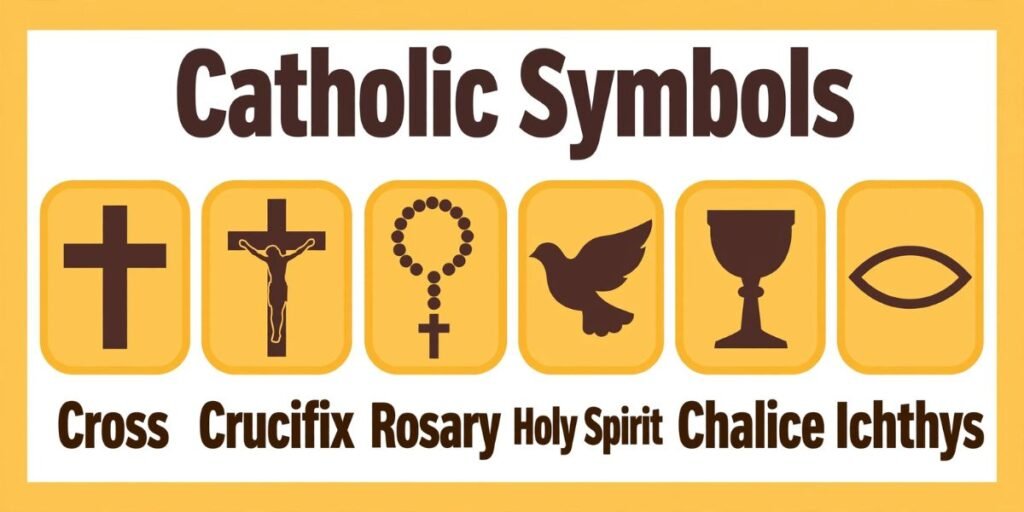
Catholic symbols are an important part of the Catholic faith, helping express religious beliefs through familiar images, signs, and objects. They can be seen in churches, stained-glass windows, paintings, statues, vestments, prayer cards, rosaries, medals, and other forms of Catholic devotion.
While some symbols are simple and immediately recognizable, their meanings can be connected to Scripture, the life of Jesus Christ, the sacraments, the Virgin Mary, the saints, and centuries of Christian tradition.
The cross and crucifix are among the most recognizable Catholic symbols, reminding believers of the Passion, death, and resurrection of Jesus. Other symbols, such as the dove, fish, chalice, Sacred Heart, Chi-Rho, and Alpha and Omega, communicate different aspects of Christian belief. Marian symbols also have an important place in Catholic tradition, reflecting devotion to the Virgin Mary and her role in the story of Christ.
Learning the meaning behind Catholic symbols can make religious artwork and church spaces easier to understand. These symbols are not simply decorative elements. They can serve as visual reminders of Scripture, prayer, worship, sacrifice, hope, love, and the central teachings of Christianity.
In this guide, we will look at some of the most important Catholic symbols, their meanings, historical background, and how they are used in Catholic life and worship.
Why Are Catholic Symbols Important?
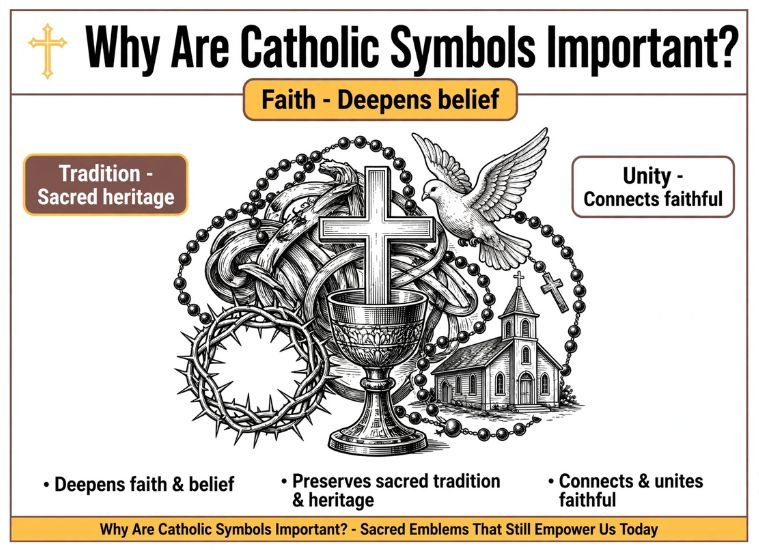
Catholic symbols help believers understand the Christian faith through simple and meaningful images. They represent the life of Jesus Christ, the Holy Spirit, the sacraments, and the teachings of the Bible. These symbols make spiritual ideas easier to understand and help Catholics remember God’s love, mercy, and promise of eternal life.
You can find Catholic symbols in churches, homes, schools, prayer books, stained glass windows, and religious artwork. They strengthen faith, encourage prayer, and connect modern believers with centuries of Catholic tradition.
Catholic Symbols
Search a Catholic symbol to learn what it represents.
The Cross
Learn more about Star Wars symbols meaning and discover the ideas behind these designs.
Catholic Symbols and Meanings
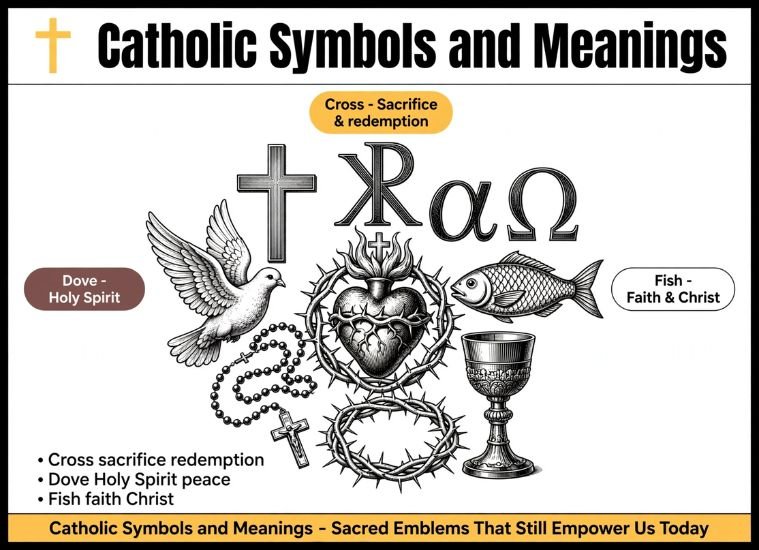
Catholic symbols teach important lessons about Christianity through visual signs. Some represent Jesus Christ and His sacrifice, while others point to the Holy Spirit, the Virgin Mary, the Eucharist, and the mission of the Catholic Church. Learning their meanings helps believers better understand Scripture, worship, and Catholic traditions.
| Catholic Symbol | Description | Meaning |
| Cross | Plain wooden cross | Salvation and Christian faith |
| Crucifix | Cross with Jesus Christ | Christ’s sacrifice and redemption |
| Sacred Heart | Heart with flames and thorns | Divine love and mercy |
| Dove | White dove | Holy Spirit and peace |
| Lamb of God | White lamb carrying a banner | Jesus Christ and salvation |
| Fish (Ichthys) | Ancient Christian fish symbol | Faith in Christ |
| Alpha and Omega | First and last Greek letters | Christ is eternal |
| Rosary | Prayer beads | Prayer and devotion |
| Holy Water | Blessed water | Baptism and spiritual cleansing |
| Bread and Wine | Eucharistic elements | Body and Blood of Christ |
| Paschal Candle | Easter candle | Resurrection of Christ |
| Keys of Saint Peter | Crossed gold and silver keys | Authority of the Catholic Church |
| Lily | White flower | Purity and holiness |
| Crown of Thorns | Thorn crown | Christ’s suffering |
| Holy Bible | Sacred Scriptures | God’s Word |
Explore the ideas and qualities associated with symbols of strength representation and discover how these designs express courage and resilience.
Cross Catholic Symbol Meaning
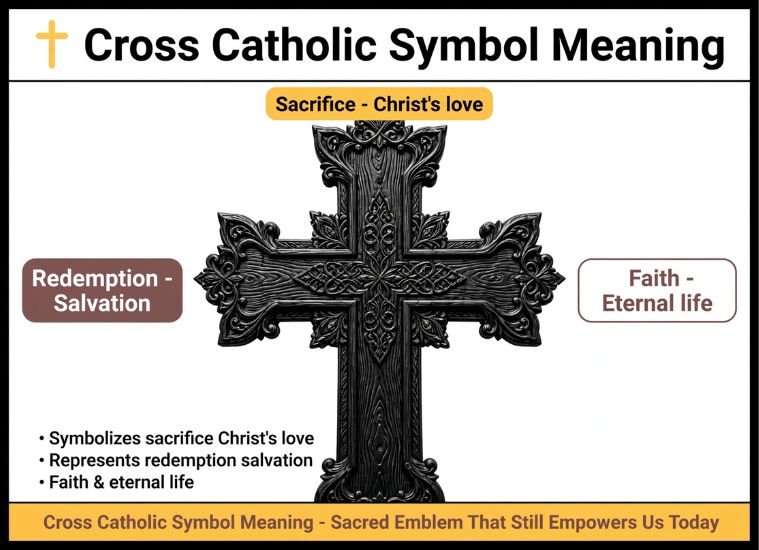
The Cross is the most recognized symbol of Christianity and the Catholic Church. It reminds believers of the death and resurrection of Jesus Christ and reflects God’s love for humanity.
Catholics see the Cross as a symbol of faith, hope, forgiveness, and eternal life. It appears in churches, homes, schools, cemeteries, and personal jewelry as a reminder to follow the teachings of Christ.
| Symbol | Description | Meaning |
| Cross | Two beams intersect to form a simple cross. | Represents Jesus Christ and the Christian faith. |
| Latin Cross | A vertical beam extends below a shorter horizontal beam. | Represents the crucifixion and sacrifice of Jesus. |
| Wooden Cross | A cross made from natural or carved wood. | Represents sacrifice, faith, and hope. |
| Church Cross | A cross displayed prominently inside or outside a Catholic church. | Represents Christ and His saving work. |
| Altar Cross | A cross placed near or above the Catholic altar. | Reminds worshippers of Christ’s sacrifice. |
| Pendant Cross | A small cross worn around the neck. | Represents personal faith and devotion. |
| Processional Cross | A cross carried during Catholic processions. | Represents Christ leading His people. |
| Wall Cross | A cross mounted on a church or home wall. | Serves as a visible reminder of Christian faith. |
| Prayer Cross | A small cross kept in a personal prayer space. | Represents prayer, trust, and devotion to God. |
| Baptismal Cross | A cross displayed near a baptismal font. | Represents new life through Christ. |
| Memorial Cross | A cross placed at a memorial or burial site. | Represents Christian hope in eternal life. |
| Cross on Scripture | A cross displayed beside or on a Bible. | Connects Christian teaching with Jesus Christ. |
| Carved Cross | A cross shaped or decorated through carving. | Represents faith and devotion to Christ. |
| Metal Cross | A cross made from metal and often used as a religious object. | Represents enduring faith and Christian identity. |
| Decorative Cross | A cross with artistic details or patterns. | Expresses faith while serving as a devotional symbol. |
| Church Entrance Cross | A cross placed near the entrance of a Catholic church. | Reminds people that Christ is central to Christian worship. |
| Home Cross | A cross displayed in a Catholic household. | Reminds family members of their Christian faith. |
| Prayer Cross | A cross used while praying or meditating. | Encourages remembrance of Christ and trust in God. |
| Catholic Cross | A traditional cross used in Catholic worship and devotion. | Represents Christ’s sacrifice, salvation, faith, and hope. |
| Simple Cross | An undecorated cross with two intersecting beams. | Represents the central message of Christianity. |
Explore the traditions and ideas connected to Christmas symbols significance and learn why these familiar designs remain meaningful during the holiday season.
Crucifix Catholic Symbol Meaning
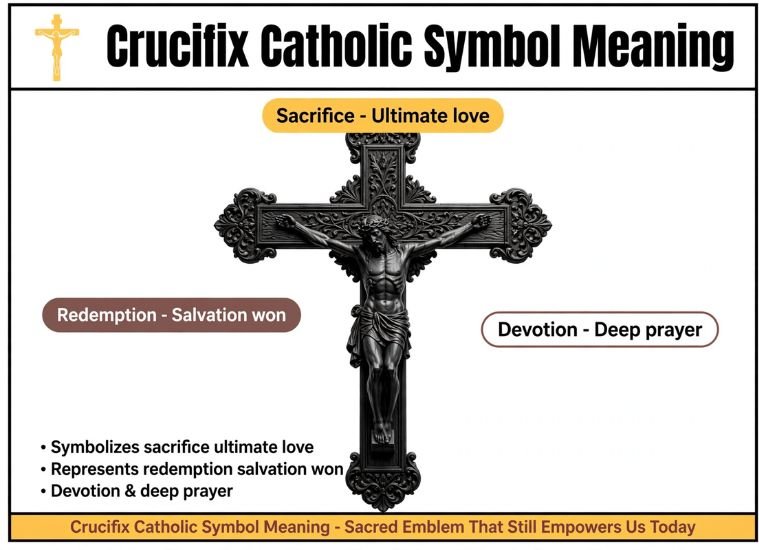
The Crucifix is one of the most meaningful symbols in the Catholic Church. Unlike a plain Cross, it includes the image of Jesus Christ. It reminds Catholics of Christ’s suffering, sacrifice, and the love He showed by giving His life for humanity.
The Crucifix is displayed above the altar because it keeps the focus on Jesus during the celebration of the Eucharist.
| Symbol | Description | Meaning |
| Crucifix | A cross with a figure of Jesus attached to it. | Represents Jesus’ suffering and sacrifice. |
| Wooden Crucifix | A crucifix carved from wood. | Reminds believers of Christ’s death and love. |
| Altar Crucifix | A crucifix displayed near or above the Catholic altar. | Represents Christ’s sacrifice during Catholic worship. |
| Wall Crucifix | A crucifix mounted on a church or home wall. | Serves as a reminder of Jesus and His sacrifice. |
| Pendant Crucifix | A small crucifix worn around the neck. | Represents personal faith and devotion to Jesus. |
| Prayer Crucifix | A crucifix kept in a personal prayer space. | Encourages prayer and reflection on Christ’s sacrifice. |
| Processional Crucifix | A crucifix carried during a Catholic procession. | Represents Christ leading His followers. |
| Chapel Crucifix | A crucifix displayed inside a Catholic chapel. | Reminds worshippers of Christ’s sacrifice and salvation. |
| Home Crucifix | A crucifix displayed in a Catholic home. | Reminds the household of Jesus’ love and sacrifice. |
| Memorial Crucifix | A crucifix placed at a memorial or burial site. | Represents faith in Christ and hope of eternal life. |
| Holy Week Crucifix | A crucifix prominently displayed during Holy Week. | Reminds Catholics of Jesus’ Passion and death. |
| Clergy Crucifix | A crucifix used or worn by Catholic clergy. | Represents Christ’s sacrifice and service to the Church. |
| Metal Crucifix | A crucifix made from metal. | Represents enduring faith and devotion. |
| Carved Crucifix | A detailed crucifix created through carving. | Draws attention to Jesus’ suffering and sacrifice. |
| Crucifix Necklace | A small crucifix worn as jewelry. | Represents Christian identity and devotion to Christ. |
| Crucifix on an Altar | A crucifix placed where Catholics gather for Mass. | Reminds worshippers of Christ’s sacrifice. |
| Crucifix Artwork | Jesus on the cross shown in Catholic religious art. | Represents suffering, love, forgiveness, and salvation. |
| Bedside Crucifix | A crucifix kept beside a bed. | Encourages prayer, faith, and trust in God. |
| Gift Crucifix | A crucifix given as a religious gift. | Represents faith, remembrance, and devotion to Jesus. |
| Catholic Crucifix | A traditional Catholic cross featuring the body of Jesus. | Represents Christ’s Passion, sacrifice, love, forgiveness, and hope. |
Explore the qualities and ideas associated with symbols of strength meaning and learn how these powerful designs reflect courage and resilience.
Holy Trinity Catholic Symbol Meaning
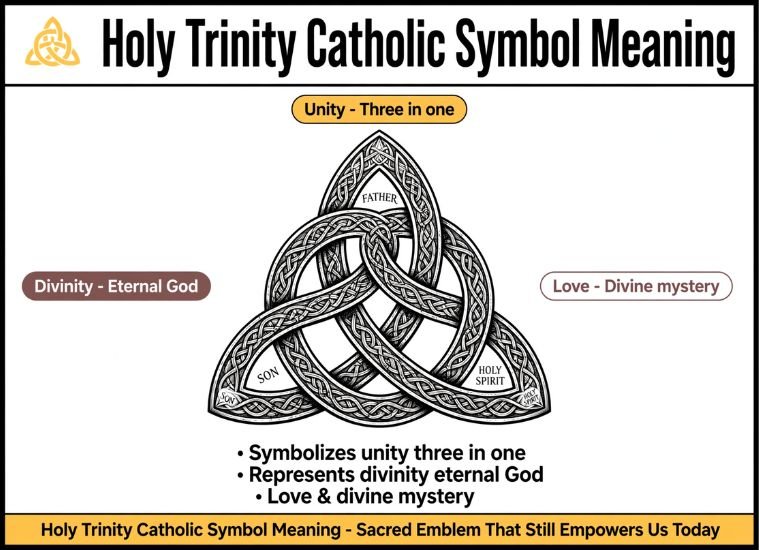
The Holy Trinity is one of the central beliefs of the Catholic faith. It teaches that there is one God in three divine Persons: the Father, the Son, and the Holy Spirit. Although they are distinct Persons, they are united as one God.
The Trinity is often represented by a triangle, three interlocking circles, or the triquetra. These designs remind believers of God’s perfect unity and everlasting love.
| Symbol | Description | Meaning |
| Trinity Triangle | A triangle with three equal sides. | Represents the Father, Son, and Holy Spirit as one God. |
| Triquetra | A three-part knot with interwoven curves. | Represents the unity of the three Persons of the Trinity. |
| Three Interlocking Circles | Three circles connected or overlapping. | Represents the three Persons united in one God. |
| Trinity Shield | A diagram connecting Father, Son, and Holy Spirit. | Shows the relationships within the Holy Trinity. |
| Three-Leaf Clover | A plant symbol with three connected leaves. | Can illustrate three distinct Persons in one God. |
| Three Rays | Three rays extending from a central point. | Represents the three Persons of the Trinity. |
| Trinity Cross | A cross combined with threefold design elements. | Connects Christ and His saving work with the Trinity. |
| Three Rings | Three linked rings forming one design. | Represents unity among the Father, Son, and Holy Spirit. |
| Threefold Knot | A knot formed from three connected sections. | Represents the eternal unity of the Trinity. |
| Three Flames | Three flames shown together. | Represents the Father, Son, and Holy Spirit. |
| Trinity Circle | A circular design divided into three parts. | Represents one God in three Persons. |
| Threefold Halo | A halo featuring a three-part pattern. | Represents the holiness of the Triune God. |
| Trinity Star | A three-pointed or three-part star design. | Represents the three Persons of the Trinity. |
| Three Interwoven Bands | Three bands woven into one shape. | Represents distinction and unity within the Trinity. |
| Three Petals | Three petals forming one flower-like design. | Represents the three Persons sharing one divine nature. |
| Trinity Emblem | A Christian emblem built around a three-part design. | Represents the mystery and unity of the Holy Trinity. |
| Three Arcs | Three curved sections forming one symbol. | Represents the three Persons in one God. |
| Trinity Circle Cross | A circle and cross combined with threefold elements. | Represents the Trinity and Christian faith. |
| Threefold Light | Three beams of light shown together. | Represents the Father, Son, and Holy Spirit. |
| Holy Trinity Symbol | A three-part Christian design used in Catholic art. | Represents one God in three divine Persons. |
Sacred Heart Catholic Symbol Meaning
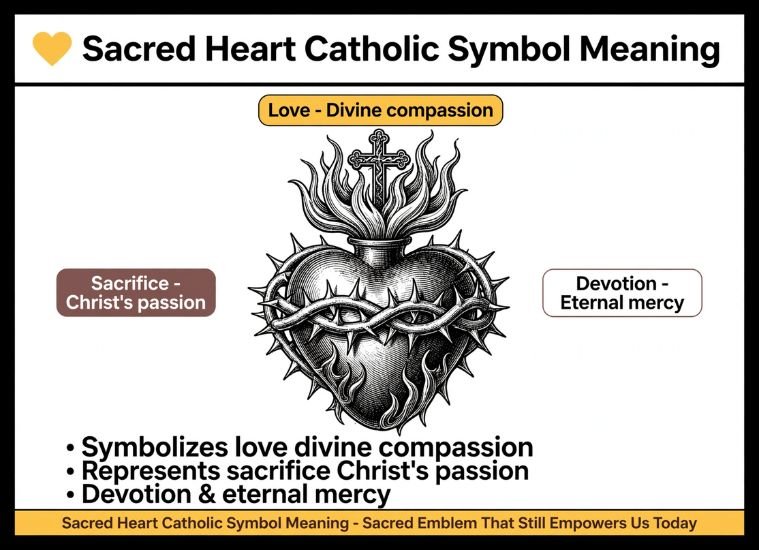
The Sacred Heart is one of the most loved symbols in the Catholic Church. It represents the endless love, mercy, and compassion of Jesus Christ. The image usually shows a heart surrounded by thorns, with flames rising above it and a Cross at the top.
The Sacred Heart reminds believers that Christ continues to love humanity despite sin and suffering.
| Symbol | Description | Meaning |
| Sacred Heart | A heart surrounded by rays of light. | Represents Jesus’ divine and human love for humanity. |
| Heart with Cross | A heart topped with a small cross. | Represents Christ’s love and sacrifice. |
| Heart with Crown of Thorns | A heart surrounded by thorns. | Represents Jesus’ suffering and His loving sacrifice. |
| Flaming Heart | A heart shown with flames rising above it. | Represents the burning love of Christ. |
| Heart with Rays | Rays of light extend from the heart. | Represents Christ’s grace and love shining upon humanity. |
| Heart with Wound | A heart shown with a wound or mark. | Represents the suffering Jesus endured for humanity. |
| Heart with Cross and Flames | A heart combining a cross and flames. | Represents Christ’s sacrifice and passionate love. |
| Crowned Heart | A Sacred Heart surrounded by a crown or rays. | Represents Christ’s kingship and loving authority. |
| Thorn-Crowned Heart | A heart encircled by a crown of thorns. | Represents Christ’s Passion and suffering. |
| Radiant Heart | A heart surrounded by bright rays. | Represents divine love and spiritual grace. |
| Sacred Heart Emblem | A devotional image centered on Jesus’ heart. | Represents devotion to the loving Heart of Jesus. |
| Heart with Sword | A heart shown with a sword or piercing mark. | Represents sorrow, suffering, and Christ’s wounded love. |
| Heart with Flame | A heart with a visible flame above it. | Represents the warmth and intensity of Christ’s love. |
| Heart on a Cross | A heart positioned beneath or beside a cross. | Represents love expressed through sacrifice. |
| Red Sacred Heart | A red heart used in Catholic devotional artwork. | Represents love, compassion, and Christ’s living heart. |
| Heart with Halo | A heart surrounded by a halo or radiant light. | Represents holiness and divine love. |
| Heart with Thorns and Flames | A heart combining thorns and flames. | Represents suffering alongside Christ’s enduring love. |
| Sacred Heart Statue | A devotional image of Jesus revealing His heart. | Represents Jesus offering His love and mercy. |
| Sacred Heart Image | A traditional Catholic depiction of the Heart of Jesus. | Represents Christ’s mercy, compassion, and love. |
| Sacred Heart Symbol | A heart featuring traditional Catholic devotional elements. | Represents the loving Heart of Jesus and devotion to Him. |
Dove Catholic Symbol Meaning
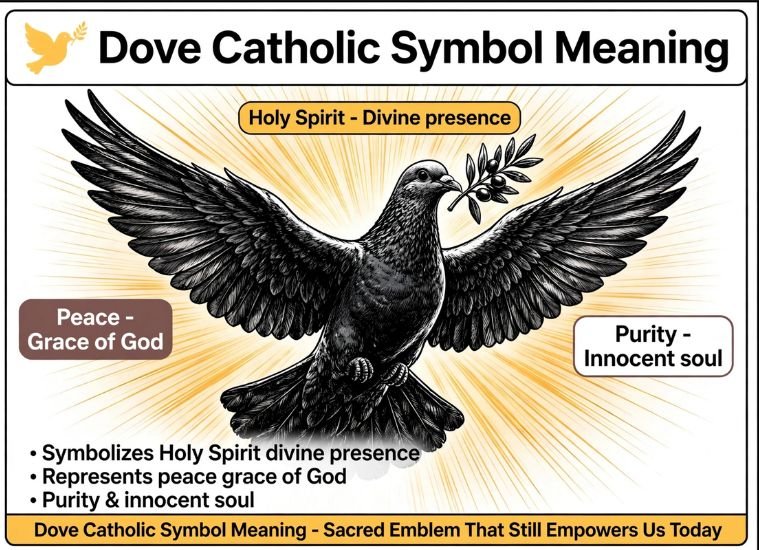
The Dove is the traditional symbol of the Holy Spirit. It comes from the Baptism of Jesus Christ, where the Holy Spirit descended like a dove. Since then, the Dove has represented God’s presence, peace, and spiritual guidance.
Today, the Dove appears in churches, baptismal fonts, stained glass windows, and Confirmation celebrations.
| Symbol | Description | Meaning |
| White Dove | A white bird shown with open wings. | Represents the Holy Spirit, peace, and purity. |
| Dove with Rays | A dove surrounded by rays of light. | Represents the Holy Spirit descending upon believers. |
| Descending Dove | A dove shown flying downward. | Represents the Holy Spirit coming upon humanity. |
| Dove Above Christ | A dove placed above an image of Jesus. | Represents the Holy Spirit and His presence with Christ. |
| Dove at Baptism | A dove shown in baptismal artwork. | Represents the Holy Spirit at Jesus’ Baptism. |
| Dove with Halo | A dove surrounded by a circular glow. | Represents the holiness of the Holy Spirit. |
| Dove in Church Art | A dove used in Catholic religious artwork. | Represents the Holy Spirit and divine presence. |
| Dove with Open Wings | A dove displayed with its wings spread. | Represents peace and the active presence of the Holy Spirit. |
| Dove with Light | A dove surrounded by bright light. | Represents spiritual guidance and divine grace. |
| Dove Over Water | A dove shown above water. | Connects the Holy Spirit with baptism and new spiritual life. |
| Dove and Cross | A dove shown beside or above a cross. | Represents the Holy Spirit and Christ-centered faith. |
| Dove Symbol | A simple dove used as a Christian symbol. | Represents peace, purity, and the Holy Spirit. |
| Flying Dove | A dove shown in flight. | Represents freedom, peace, and spiritual movement. |
| Dove at Pentecost | A dove used in artwork related to Pentecost. | Represents the Holy Spirit coming to the disciples. |
| Dove with Flame | A dove shown with flames or rays. | Represents the Holy Spirit’s presence and power. |
| Dove in a Circle | A dove enclosed within a circular design. | Represents the Holy Spirit and divine unity. |
| Dove Above the Altar | A dove displayed near a Catholic altar. | Represents the presence of the Holy Spirit in worship. |
| Peace Dove | A dove used as a sign of peace. | Represents peace through God and Christian faith. |
| Sacred Dove | A devotional image of a dove representing the Spirit. | Represents holiness, grace, and divine guidance. |
| Holy Spirit Dove | A traditional Catholic image of a dove. | Represents the Holy Spirit, the Third Person of the Trinity. |
Lamb of God Catholic Symbol Meaning
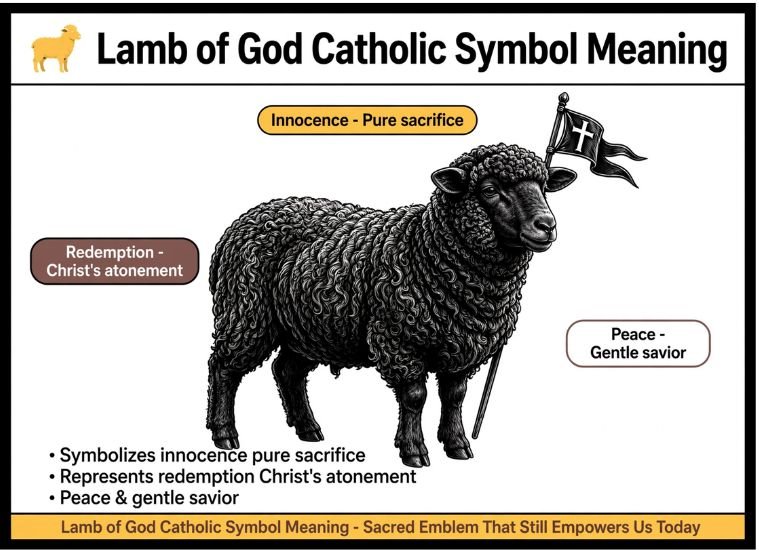
The Lamb of God is one of the oldest and most meaningful symbols in the Catholic Church. It refers to Jesus Christ, who willingly sacrificed His life to take away the sins of the world.
The title comes from the Bible and is spoken during every Catholic Mass before Holy Communion. This symbol reminds believers of Christ’s innocence, sacrifice, and victory over death.
| Symbol | Description | Meaning |
| Lamb of God | A lamb shown in traditional Christian artwork. | Represents Jesus Christ as the sacrificial Lamb. |
| Lamb with Cross | A lamb carrying or standing beside a cross. | Represents Christ’s sacrifice for humanity. |
| Lamb with Banner | A lamb holding a banner marked with a cross. | Represents Christ’s victory over sin and death. |
| Paschal Lamb | A lamb associated with Easter imagery. | Represents Christ’s death and Resurrection. |
| Lamb on a Book | A lamb shown resting on a book. | Represents Christ and God’s plan of salvation. |
| Lamb with Halo | A lamb surrounded by a halo. | Represents the holiness of Jesus Christ. |
| White Lamb | A pure white lamb used in religious art. | Represents innocence and purity. |
| Lamb with Red Cross | A lamb shown with a banner bearing a cross. | Represents Christ’s sacrifice and victory. |
| Lamb on an Altar | A lamb shown near or upon an altar. | Represents sacrificial offering and Christ’s self-giving. |
| Lamb of Revelation | A lamb used in imagery from Revelation. | Represents Christ as the victorious Lamb. |
| Lamb with Open Book | A lamb shown beside an open sacred book. | Represents Christ’s role in God’s revealed plan. |
| Sacrificial Lamb | A lamb depicted in a sacrificial setting. | Represents Jesus giving His life for humanity. |
| Victorious Lamb | A lamb shown holding a banner or cross. | Represents Christ’s victory over death. |
| Lamb with Crown | A lamb shown with a crown. | Represents Christ’s kingship and victory. |
| Lamb and Cross | A lamb paired with a Christian cross. | Represents Jesus’ Passion and saving sacrifice. |
| Eucharistic Lamb | A lamb used in Catholic Eucharistic artwork. | Represents Christ as the sacrificial Lamb present in the Eucharist. |
| Lamb with Banner of Victory | A lamb carrying a victory banner. | Represents Christ’s triumph over sin and death. |
| Holy Lamb | A devotional image of a sacred lamb. | Represents Jesus Christ in His purity and sacrifice. |
| Paschal Lamb Symbol | A traditional Easter symbol showing a lamb and cross. | Represents Christ’s Passion, Resurrection, and victory. |
| Agnus Dei | A traditional Latin image of the Lamb of God. | Represents Jesus Christ as the Lamb who takes away the sins of the world. |
Fish (Ichthys) Catholic Symbol Meaning
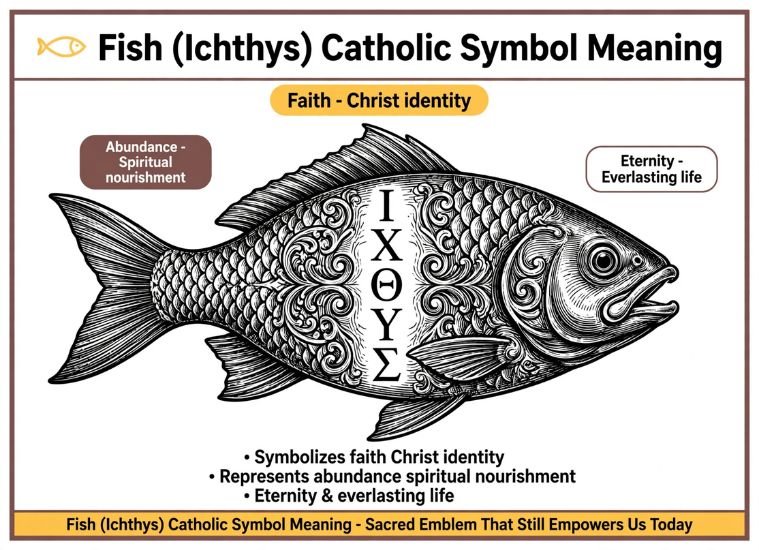
The Fish, also called the Ichthys, is one of the earliest Christian symbols. During the first centuries of Christianity, believers used the fish as a secret sign to recognize one another during times of persecution.
Today, it remains a symbol of faith in Jesus Christ and the message of the Gospel.
| Symbol | Description | Meaning |
| Ichthys Fish | A simple fish-shaped Christian symbol. | Represents Jesus Christ and Christian faith. |
| Fish with Cross | A fish combined with a cross. | Represents faith in Christ and His sacrifice. |
| Greek Fish | A fish linked to the Greek word “Ichthys.” | Represents Jesus Christ, Son of God, and Savior. |
| Fish Emblem | A fish used as a Christian emblem. | Represents belief in Jesus as Savior. |
| Fish Pendant | A small fish symbol worn as jewelry. | Represents personal Christian faith. |
| Fish on a Cross | A fish shown with or around a cross. | Connects Christ with early Christian symbolism. |
| Fish and Water | A fish shown near water. | Represents baptism and new life in Christ. |
| Eucharistic Fish | A fish used with bread or Eucharistic imagery. | Represents early Christian faith and Christ as spiritual nourishment. |
| Two Fish | Two fish shown together in Christian art. | Can represent Christian community and shared faith. |
| Fish with Bread | Fish displayed alongside bread. | Recalls Jesus feeding the multitude and Christian fellowship. |
| Ichthys Outline | A simple curved outline forming a fish. | Represents Christian identity and belief in Jesus. |
| Fish Mosaic | A fish symbol created in religious mosaic art. | Represents Christ and the Christian community. |
| Fish on Church Art | A fish included in Catholic religious artwork. | Represents Jesus and early Christian faith. |
| Fish Pendant Cross | A fish and cross combined into jewelry. | Represents devotion to Christ. |
| Fish and Scripture | A fish shown beside Christian Scripture. | Represents faith in Jesus and His teachings. |
| Baptismal Fish | A fish symbol used near baptismal imagery. | Represents new life and Christian initiation. |
| Fish with Alpha and Omega | Fish combined with Alpha and Omega symbols. | Represents Christ as the beginning and end. |
| Christian Fish | A traditional fish symbol used by Christians. | Represents Jesus Christ and salvation. |
| Ichthys Sign | A simple fish-shaped sign used by Christians. | Represents Christian faith and identity. |
| Catholic Ichthys | The fish symbol used within Catholic devotional art. | Represents Jesus Christ as the Son of God and Savior. |
Alpha and Omega Catholic Symbol Meaning
The Alpha and Omega are the first and last letters of the Greek alphabet. In the Book of Revelation, Jesus calls Himself the Alpha and the Omega, showing that He is the beginning and the end of all things. This symbol reminds Catholics that Christ is eternal and has authority over all creation.
| Symbol | Description | Meaning |
| Alpha and Omega | The Greek letters Alpha and Omega shown together. | Represent God as the beginning and the end. |
| Alpha | The first letter of the Greek alphabet. | Represents the beginning. |
| Omega | The last letter of the Greek alphabet. | Represents the end. |
| Alpha and Omega Cross | Greek letters placed beside a cross. | Represents Christ as eternal and central to Christian faith. |
| Alpha Omega Halo | Alpha and Omega shown around Christ or within a halo. | Represents Christ’s eternal nature. |
| Alpha Omega Candle | The letters placed on the Paschal Candle. | Represents Christ as the beginning and end of all things. |
| Alpha Omega Church Art | Greek letters used in Catholic religious artwork. | Represents God’s eternity and sovereignty. |
| Alpha Omega Bible Symbol | The letters displayed with Scripture. | Represents God’s eternal Word and authority. |
| Alpha Omega Circle | Alpha and Omega placed inside a circular design. | Represents eternity without beginning or end. |
| Alpha Omega Crossbar | Letters placed on opposite sides of a cross. | Represents Christ’s eternal reign. |
| Alpha Omega Monogram | The two Greek letters combined into a religious emblem. | Represents God’s eternal presence. |
| Alpha Omega Easter Symbol | Letters used in Easter and Resurrection artwork. | Represents Christ’s victory and eternal life. |
| Alpha Omega Paschal Symbol | Letters displayed on the Paschal Candle. | Represents Christ, who is eternal and risen. |
| Alpha Omega Altar Symbol | Letters used near a Catholic altar. | Represents God’s eternal presence in worship. |
| Alpha Omega Stained Glass | Greek letters incorporated into church windows. | Represents God’s eternal nature and divine authority. |
| Alpha Omega Christ Symbol | Alpha and Omega associated with an image of Jesus. | Represents Jesus as eternal Lord. |
| Alpha Omega Book | Letters shown on a Christian religious book. | Represents God as the beginning and end of history. |
| Alpha Omega Cross Design | A cross decorated with Alpha and Omega. | Represents Christ’s eternal role in salvation. |
| Alpha Omega Candle Mark | The letters marked on a lit Paschal Candle. | Represents Christ as the light and eternal Lord. |
| Alpha Omega Catholic Symbol | Traditional Catholic use of the first and last Greek letters. | Represents God’s eternity and Christ’s words, “the beginning and the end.” |
Rosary Catholic Symbol Meaning
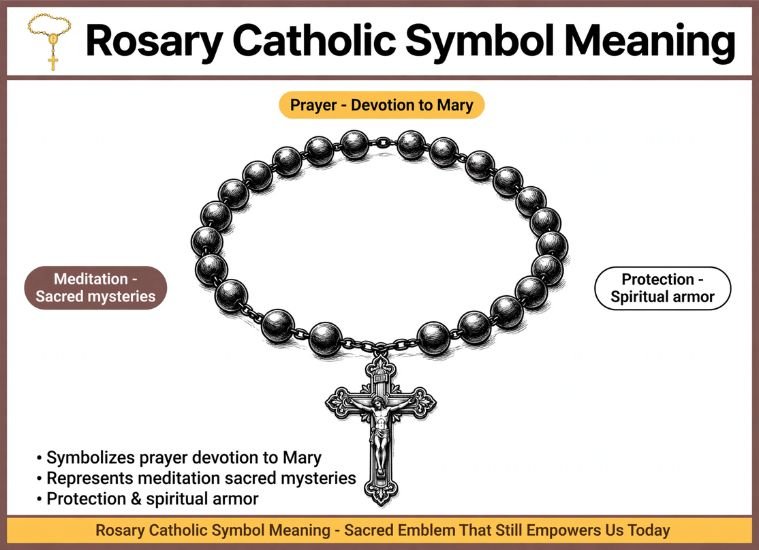
The Rosary is one of the most recognized symbols of Catholic prayer and devotion. It consists of a series of beads that help believers meditate on important events in the lives of Jesus Christ and the Virgin Mary. The Rosary encourages prayer, reflection, and spiritual growth.
| Symbol | Description | Meaning |
| Rosary Beads | A string of beads used for Catholic prayer. | Represents prayer and meditation on the life of Christ and Mary. |
| Rosary Cross | A cross attached to the end of a rosary. | Represents Jesus Christ and Christian salvation. |
| Rosary Crucifix | A crucifix connected to the rosary beads. | Reminds believers of Christ’s sacrifice. |
| Rosary Centerpiece | A medal or centerpiece connecting the rosary sections. | Often represents Mary, Jesus, or a Catholic devotion. |
| Decade Beads | Groups of ten small beads in the rosary. | Help count the Hail Mary prayers. |
| Our Father Bead | A larger bead separating groups of ten. | Marks prayers such as the Our Father. |
| Hail Mary Beads | Smaller beads used in groups. | Help count repeated Hail Mary prayers. |
| Rosary Chain | Metal links connecting the beads. | Holds the prayer beads together as one devotional object. |
| Rosary Medal | A religious medal placed in the center or attached to a rosary. | Represents a particular Catholic devotion or saint. |
| Marian Rosary | A rosary featuring an image or medal of Mary. | Represents devotion to Mary and prayerful reflection on Christ. |
| Rosary Cross Pendant | A rosary ending with a cross or crucifix. | Represents faith in Jesus Christ. |
| Rosary Bracelet | A shorter wearable form of rosary beads. | Provides a portable aid for Catholic prayer. |
| Wooden Rosary | A rosary made from wooden beads. | Represents simplicity and devotion in prayer. |
| Pearl Rosary | A rosary made with pearl-like beads. | Represents beauty while serving as a prayer aid. |
| Rosary with Crucifix | Beads connected to a crucifix. | Represents prayer centered on Christ’s life and sacrifice. |
| Rosary Bead Circle | The main loop formed by connected rosary beads. | Represents the repeated rhythm of Catholic prayer. |
| Rosary Heart Medal | A heart-shaped religious medal attached to a rosary. | Can represent love, devotion, and prayer. |
| Rosary Cross Symbol | The cross used as the final symbol of the rosary. | Represents Christ’s sacrifice and redemption. |
| Holy Rosary | A complete set of Catholic prayer beads. | Represents meditation on important events in the lives of Jesus and Mary. |
| Catholic Rosary | The traditional Catholic prayer devotion using beads. | Represents prayer, meditation, devotion, and faith in God. |
Bread and Wine Catholic Symbol Meaning
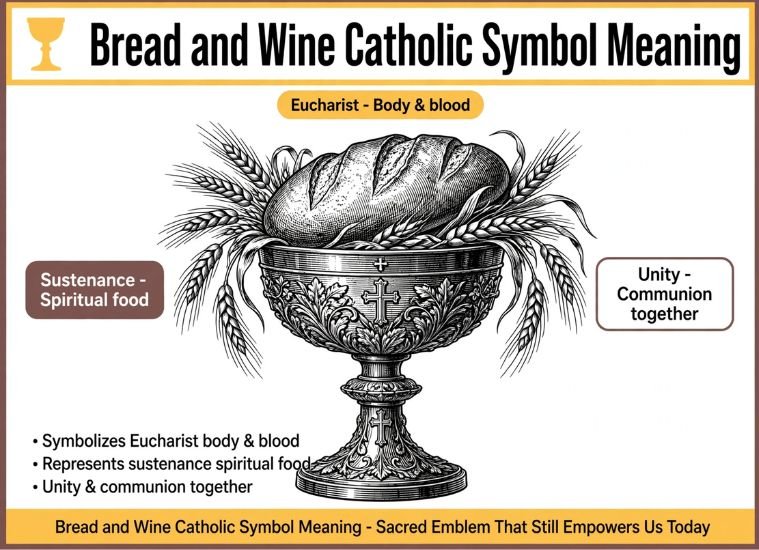
Bread and Wine are the central symbols of the Eucharist. During the celebration of Mass, Catholics believe they become the Body and Blood of Jesus Christ. They remind believers of the Last Supper and Christ’s sacrifice for the salvation of the world.
| Symbol | Description | Meaning |
| Bread | Unleavened bread used during Catholic Mass. | Represents the Body of Christ in the Eucharist. |
| Wine | Wine offered during the celebration of Mass. | Represents the Blood of Christ. |
| Eucharistic Bread | Consecrated bread used in Holy Communion. | Represents Christ’s presence in the Eucharist. |
| Eucharistic Wine | Wine consecrated during Mass. | Represents Christ’s Blood and His sacrifice. |
| Bread and Chalice | Bread shown beside a Eucharistic cup. | Represents the Eucharist and Christ’s self-giving. |
| Communion Bread | Small consecrated hosts used for Holy Communion. | Represents believers receiving Christ in the Eucharist. |
| Chalice | A sacred cup used to hold wine during Mass. | Represents the cup of Christ’s Blood. |
| Host | A round wafer used during Catholic worship. | Becomes the Body of Christ through consecration. |
| Wheat Bread | Bread made from wheat and used for the Eucharist. | Represents nourishment and Christ as the Bread of Life. |
| Grapes and Wine | Grapes or wine shown in Catholic artwork. | Represents Christ’s Blood and the Eucharistic sacrifice. |
| Bread on the Altar | Eucharistic bread placed on the altar. | Represents Christ’s offering and presence. |
| Wine Chalice | A chalice containing Eucharistic wine. | Represents Christ’s Blood poured out for humanity. |
| Bread and Grapes | Bread displayed with grapes. | Represents the Eucharistic elements of bread and wine. |
| Communion Elements | Bread and wine prepared for Catholic Mass. | Represent Christ’s Body and Blood. |
| Eucharistic Host and Chalice | A host shown above or beside a chalice. | Represents the central mystery of the Eucharist. |
| Loaf of Bread | A traditional loaf used as Christian imagery. | Represents nourishment, sharing, and Christ as the Bread of Life. |
| Vine and Bread | Grapevines shown with bread in religious artwork. | Represents Christ’s Eucharistic sacrifice. |
| Altar Bread and Wine | Bread and wine prepared on a Catholic altar. | Represents the offering made during the Eucharistic celebration. |
| Sacred Host and Wine | Consecrated Eucharistic elements. | Represent Christ’s real presence in the Eucharist. |
| Bread and Wine | The two traditional Eucharistic elements. | Represent Christ’s Body and Blood and His sacrifice for humanity. |
Holy Water Catholic Symbol Meaning
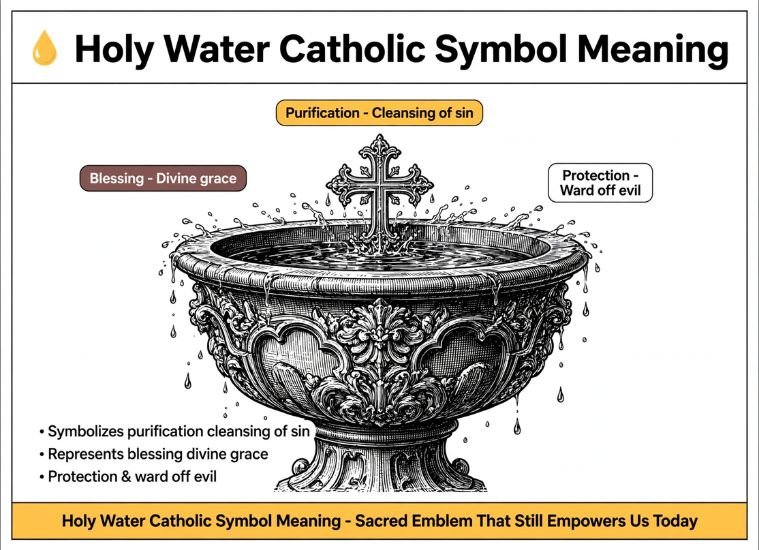
Holy Water is blessed by a priest and is used throughout Catholic worship. It reminds believers of their Baptism and God’s cleansing grace. Catholics often bless themselves with Holy Water when entering or leaving a church as a sign of faith and renewal.
| Symbol | Description | Meaning |
| Holy Water | Water blessed by a Catholic priest or deacon. | Represents blessing, purification, and remembrance of Baptism. |
| Holy Water Font | A basin containing holy water near a church entrance. | Invites people to bless themselves and remember their Baptism. |
| Baptismal Water | Water used during the Sacrament of Baptism. | Represents cleansing from sin and new life in Christ. |
| Sprinkling Water | Holy water sprinkled over people during worship. | Represents purification and God’s blessing. |
| Holy Water Bottle | A container used to hold blessed water. | Allows Catholics to use holy water for prayer and devotion. |
| Aspergillum | A liturgical tool used to sprinkle holy water. | Represents the blessing and purification of the faithful. |
| Holy Water Bowl | A small bowl containing blessed water. | Provides holy water for devotional use. |
| Baptismal Font | A sacred basin used for Baptism. | Represents spiritual rebirth through Baptism. |
| Cross and Holy Water | A cross displayed near a holy water font. | Connects Baptism and blessing with Christ’s sacrifice. |
| Holy Water Stoup | A small basin attached to a church wall or entrance. | Provides water for making the Sign of the Cross. |
| Blessed Water | Water formally blessed for Catholic devotional use. | Represents God’s blessing and remembrance of Baptism. |
| Holy Water at Entrance | A font positioned at the doorway of a church. | Reminds worshippers of their Baptism as they enter. |
| Holy Water Sprinkler | An implement used during Catholic ceremonies. | Represents blessing and purification. |
| Baptismal Water Vessel | A vessel used to hold water during Baptism. | Represents new spiritual life through Christ. |
| Holy Water Font Cross | A cross placed beside or above a holy water font. | Connects holy water with Christian faith and Baptism. |
| Water Blessing | Holy water used during a Catholic blessing. | Represents God’s protection and grace. |
| Holy Water and Cross | Holy water used together with the Sign of the Cross. | Represents faith, blessing, and remembrance of Christ. |
| Holy Water at Home | Blessed water kept in a Catholic home. | Supports personal prayer and devotional practices. |
| Blessed Water Vessel | A small religious container holding holy water. | Represents a tangible reminder of Baptism and faith. |
| Catholic Holy Water | Water blessed according to Catholic tradition. | Represents blessing, purification, and remembrance of Baptism. |
Keys Of Saint Peter Catholic Symbol Meaning
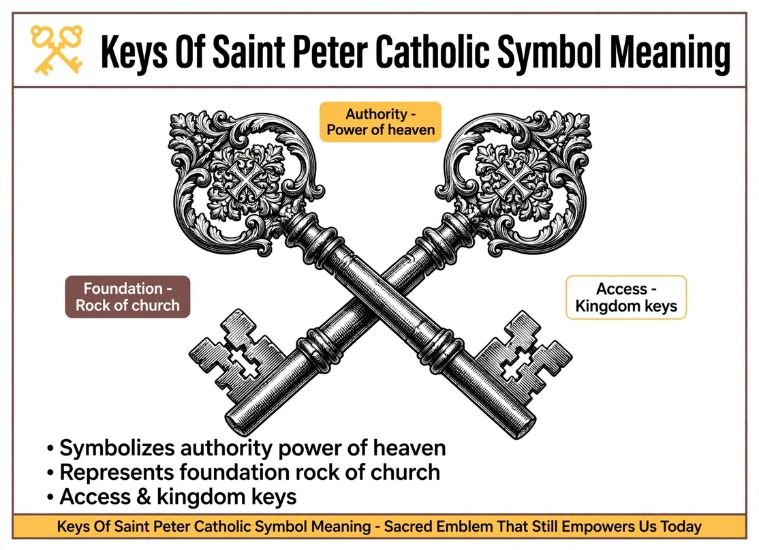
The Keys of Saint Peter represent the authority that Jesus Christ gave to Saint Peter, the first Pope. This symbol reflects the leadership, teaching authority, and unity of the Catholic Church. The crossed keys also appear in the coat of arms of Vatican City.
| Symbol | Description | Meaning |
| Two Keys | Two keys crossed or displayed together. | Represent the authority given to Saint Peter by Christ. |
| Gold Key | One of the traditional keys associated with Saint Peter. | Represents heavenly or spiritual authority. |
| Silver Key | The second traditional key associated with Saint Peter. | Represents authority connected with the Church on earth. |
| Crossed Keys | Two keys arranged in a crossed pattern. | Represent the power of binding and loosing given to Peter. |
| Keys and Papal Emblem | Keys shown beneath or behind the papal coat of arms. | Represent the authority of the Pope as Peter’s successor. |
| Keys of Heaven | Keys representing Saint Peter’s role at heaven’s gates. | Symbolize Christ-given authority and the promise of the Kingdom of Heaven. |
| Saint Peter Keys | Keys associated with images of Saint Peter. | Represent Peter’s leadership among the Apostles. |
| Papal Keys | Crossed keys used in Catholic papal symbolism. | Represent papal authority and the Petrine office. |
| Keys with Tiara | Crossed keys displayed with the papal tiara. | Represent the authority and office of the Pope. |
| Keys and Cross | Keys shown alongside a Christian cross. | Connect Peter’s authority with Christ and the Church. |
| Golden Key and Silver Key | Two differently colored keys displayed together. | Represent heavenly and earthly authority. |
| Keys Behind Shield | Crossed keys placed behind a shield. | Represent the authority of the Holy See and the papal office. |
| Keys of Peter Emblem | A traditional Catholic emblem featuring two keys. | Represents Saint Peter’s authority and his role in the Church. |
| Vatican Keys | Crossed keys used in Vatican and papal imagery. | Represent the spiritual authority of the Pope. |
| Peter with Keys | Saint Peter depicted holding keys. | Represents his leadership and authority among Christ’s Apostles. |
| Keys and Fisherman | Saint Peter shown with keys as a fisherman. | Represents his calling by Christ and his leadership of the Church. |
| Keys at Heaven’s Gate | Peter depicted holding keys near a heavenly entrance. | Represents the traditional image of Peter receiving authority over the Kingdom of Heaven. |
| Apostolic Keys | Keys connected with Saint Peter’s apostolic role. | Represent the authority entrusted to him by Christ. |
| Petrine Keys | Keys associated with the office of Saint Peter. | Represent the continuing Petrine authority of the Catholic Church. |
| Keys of Saint Peter | The traditional crossed-key symbol connected with Saint Peter. | Represents Christ giving Peter authority to bind and loose and to lead the Church. |
Lily Catholic Symbol Meaning
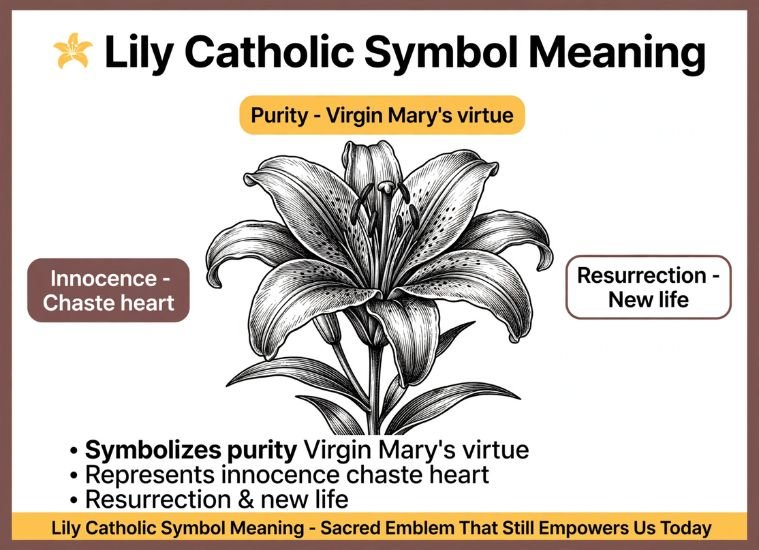
The Lily is a traditional Catholic symbol of purity and holiness. It is closely connected with the Virgin Mary and Saint Joseph. The white petals represent innocence, faithful obedience, and a life dedicated to God.
| Symbol | Description | Meaning |
| White Lily | A white flower commonly shown in Catholic artwork. | Represents purity, innocence, and holiness. |
| Madonna Lily | A traditional white lily associated with the Virgin Mary. | Represents Mary’s purity and holiness. |
| Lily of Saint Joseph | A lily associated with Saint Joseph in Catholic art. | Represents his purity, righteousness, and faithful care of Mary and Jesus. |
| Lily with Mary | A lily shown beside the Virgin Mary. | Represents Mary’s purity and virginity. |
| Lily with Saint Joseph | A lily shown in Saint Joseph’s hand. | Represents his purity and virtuous life. |
| Lily and Cross | A lily combined with a Christian cross. | Represents purity joined with Christian faith. |
| Three-Lobed Lily | A lily with petals arranged in a three-part form. | Can represent the Holy Trinity and purity. |
| Lily in Annunciation Art | A lily shown during scenes of the Annunciation. | Represents Mary’s purity and obedience to God. |
| Lily in Church Art | A lily used in Catholic religious artwork. | Represents holiness, purity, and spiritual beauty. |
| Lily Bouquet | A group of lilies used in Catholic devotional imagery. | Represents purity and reverence. |
| Lily at the Altar | Lilies displayed near a Catholic altar. | Represents purity and the beauty of worship. |
| Lily with Angel | A lily shown with an angel in religious art. | Represents purity and God’s heavenly message. |
| Lily and Virgin Mary | A lily placed beside an image of Mary. | Represents Mary’s purity and faithful devotion to God. |
| Lily and Saint Joseph | A lily placed beside an image of Joseph. | Represents his purity and holiness. |
| Easter Lily | A white lily commonly associated with Easter celebrations. | Represents purity, new life, and the Resurrection. |
| Lily Flower | A simple lily used as a Catholic symbol. | Represents purity and holiness. |
| White Lily Branch | A flowering lily branch shown in religious artwork. | Represents innocence and spiritual purity. |
| Lily with Halo | A lily displayed beside a saint with a halo. | Represents the saint’s purity and holiness. |
| Sacred Lily | A lily used in Catholic devotional imagery. | Represents purity, virtue, and devotion to God. |
| Catholic Lily | The lily used as a traditional Catholic religious symbol. | Represents purity, holiness, innocence, and virtue. |
Paschal Candle Catholic Symbol Meaning
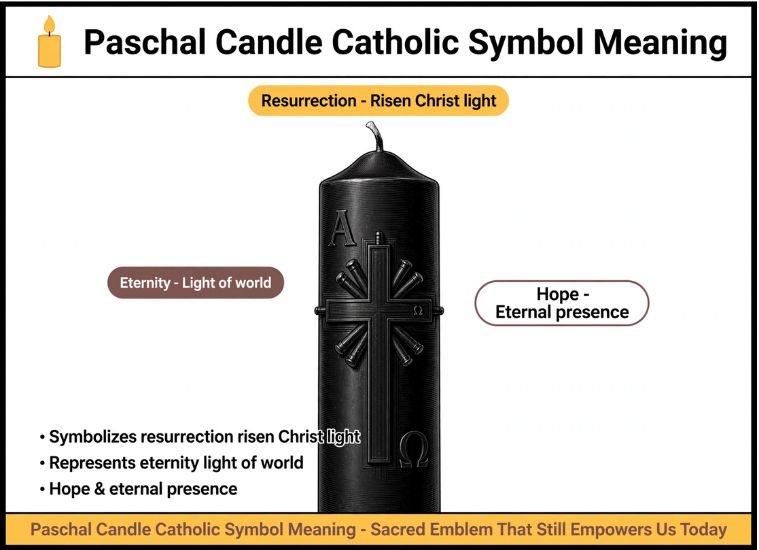
The Paschal Candle is one of the most important symbols of the Easter season in the Catholic Church. It represents the risen Jesus Christ, who overcame sin and death through His resurrection.
The candle is blessed during the Easter Vigil and remains near the altar throughout the Easter season. It is also used during baptisms and funerals as a reminder of Christ’s light and the promise of eternal life.
| Symbol | Description | Meaning |
| Paschal Candle | A large candle used during the Easter season. | Represents the risen Christ as the Light of the World. |
| Cross on Paschal Candle | A cross marked on the candle. | Represents Christ’s sacrifice and victory over death. |
| Alpha on Candle | The Greek letter Alpha placed near the top. | Represents Christ as the beginning. |
| Omega on Candle | The Greek letter Omega placed near the bottom. | Represents Christ as the end. |
| Year on Candle | The current year marked on the candle. | Represents Christ present throughout time. |
| Five Incense Grains | Five grains inserted into the candle in a cross pattern. | Represent the five wounds of Christ. |
| Flame of Paschal Candle | The candle is lit during Easter worship. | Represents Christ’s Resurrection and divine light. |
| Easter Candle | Another name commonly used for the Paschal Candle. | Represents Christ risen from the dead. |
| Candle at Baptism | The Paschal Candle used near the baptismal font. | Represents new life in Christ through Baptism. |
| Candle at Funerals | The Paschal Candle placed near a casket during Catholic funerals. | Represents Christian hope in Resurrection and eternal life. |
| Candle at Easter Vigil | The candle carried into the dark church during the Easter Vigil. | Represents Christ bringing light into darkness. |
| Light of Christ | The Paschal Candle represents Christ’s light. | Represents hope, salvation, and the Resurrection. |
| Candle with Cross and Letters | A candle marked with a cross, Alpha, and Omega. | Represents Christ as Lord of all time. |
| Decorated Paschal Candle | A large candle decorated with Christian symbols. | Represents Christ’s victory and presence. |
| Paschal Flame | The flame taken from the Easter fire. | Represents the risen Christ and new life. |
| Candle and Water | The Paschal Candle placed near baptismal water. | Connects Christ’s Resurrection with Baptism. |
| Candle in the Sanctuary | The Paschal Candle displayed in the church sanctuary. | Represents Christ’s presence and light. |
| Candle and Resurrection | A lit Paschal Candle used during Easter celebrations. | Represents Jesus rising from the dead. |
| Holy Saturday Candle | The Paschal Candle introduced during the Easter Vigil. | Represents Christ’s triumph over darkness and death. |
| Catholic Paschal Candle | The large liturgical candle used during Easter and certain sacraments. | Represents Christ, the risen Light of the World. |
Liturgical Colors Catholic Symbol Meaning
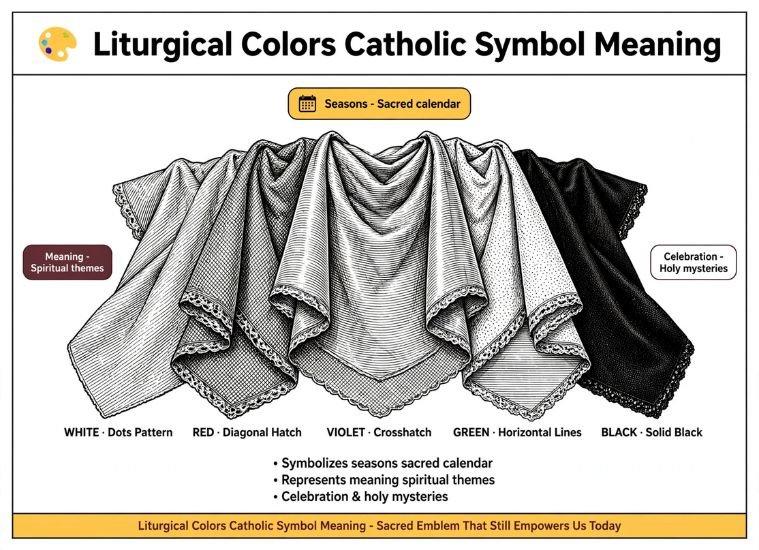
Liturgical colors help Catholics understand the meaning of different seasons and celebrations throughout the Church year. These colors appear on the priest’s vestments, altar cloths, and church decorations. Each color reflects a spiritual message and helps believers prepare for worship.
| Symbol | Description | Meaning |
| White | White or gold vestments and decorations used on certain feast days. | Represents joy, purity, glory, and resurrection. |
| Gold | Golden vestments and decorations used for important celebrations. | Represents glory, honor, and celebration. |
| Green | Green vestments commonly used during Ordinary Time. | Represents growth, life, and hope. |
| Red | Red vestments used on certain feasts and commemorations. | Represents the Holy Spirit, martyrdom, and Christ’s Passion. |
| Purple | Purple or violet vestments used during Advent and Lent. | Represents preparation, penance, and reflection. |
| Rose | Rose-colored vestments used on specific Sundays. | Represents joy during a season of preparation. |
| Black | Black vestments may be used in certain Catholic funeral or memorial liturgies. | Represents mourning and prayer for the dead. |
| White and Gold | White and gold used together in festive Catholic worship. | Represents celebration, glory, and heavenly joy. |
| Green Vestments | Green clothing worn by priests during Ordinary Time. | Represents spiritual growth and the ongoing Christian journey. |
| Red Vestments | Red clothing worn by priests on Pentecost and martyr feasts. | Represents the Holy Spirit, fire, blood, and sacrifice. |
| Violet Vestments | Violet clothing used during penitential seasons. | Represents repentance and spiritual preparation. |
| Rose Vestments | Rose clothing used on Gaudete and Laetare Sundays. | Represents joy and encouragement during preparation. |
| White Funeral Vestments | White may be worn during Catholic funeral liturgies. | Represents resurrection, hope, and eternal life. |
| Red Palm Sunday Vestments | Red vestments used during the celebration of Palm Sunday. | Represents Christ’s Passion and kingship. |
| White Easter Vestments | White or gold used during Easter celebrations. | Represents Christ’s Resurrection and victory. |
| Green Ordinary Time Color | Green used throughout much of the liturgical year. | Represents growth in faith and Christian life. |
| Purple Advent Color | Purple used during much of Advent. | Represents preparation for Christ’s coming. |
| Purple Lent Color | Purple used throughout Lent. | Represents repentance, prayer, and preparation for Easter. |
| Liturgical Color Cycle | Different colors are used throughout the Catholic liturgical year. | Helps express the spiritual character of each season and celebration. |
| Catholic Liturgical Colors | The traditional color system used in Catholic worship. | Represents different themes such as joy, repentance, growth, sacrifice, and hope. |
Catholic Church Symbols
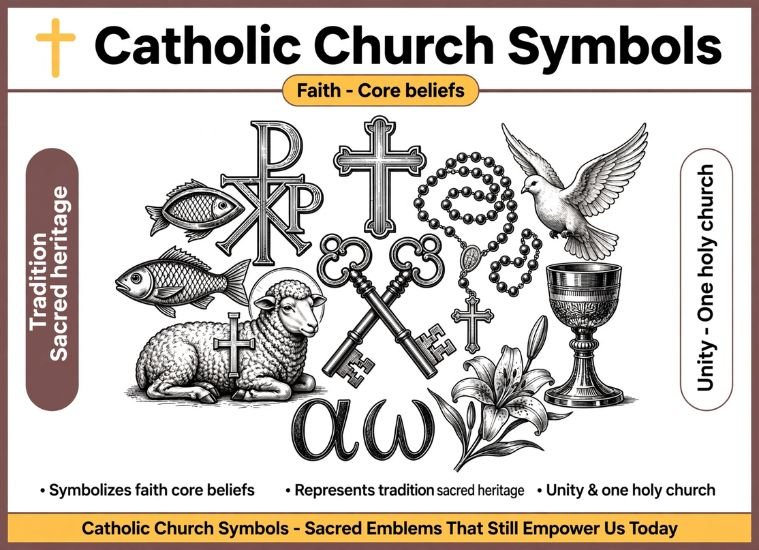
A Catholic church contains many sacred symbols that help believers worship God and understand the teachings of the Bible. Every object inside the church has a spiritual purpose and reminds Catholics of God’s presence.
| Symbol | Description | Meaning |
| Cross | Two beams intersect to form a Christian cross. | Represents Jesus Christ, His sacrifice, and salvation. |
| Crucifix | A cross with the figure of Jesus attached to it. | Represents Christ’s suffering and sacrifice for humanity. |
| Holy Trinity | A three-part design representing the Father, Son, and Holy Spirit. | Represents one God in three Persons. |
| Sacred Heart | A heart often shown with flames, rays, and a crown of thorns. | Represents the loving and merciful Heart of Jesus. |
| Dove | A white dove often shown descending with wings spread. | Represents the Holy Spirit, peace, and purity. |
| Lamb of God | A lamb often shown with a cross or victory banner. | Represents Jesus as the sacrificial Lamb who takes away sin. |
| Ichthys | A simple fish-shaped Christian symbol. | Represents Jesus Christ, the Son of God and Savior. |
| Alpha and Omega | The first and last letters of the Greek alphabet. | Represent Christ as the beginning and the end. |
| Rosary | A chain of beads ending with a cross or crucifix. | Supports Catholic prayer and meditation on Christ and Mary. |
| Keys of Saint Peter | Two crossed keys associated with Saint Peter. | Represent the authority Christ gave to Peter. |
| Lily | A white flower frequently shown with Mary or Saint Joseph. | Represents purity, holiness, and virtue. |
| Paschal Candle | A large Easter candle marked with Christian symbols. | Represents the risen Christ as the Light of the World. |
| Holy Water | Blessed water kept in fonts or other sacred vessels. | Represents blessing, purification, and remembrance of Baptism. |
| Eucharistic Bread | Consecrated bread used during Holy Communion. | Represents the Body of Christ. |
| Chalice | A sacred cup used during the celebration of Mass. | Represents the Blood of Christ in the Eucharist. |
| Papal Tiara | A traditional three-tiered papal crown. | Represents the historical authority and office of the Pope. |
| Mitre | A ceremonial pointed head covering worn by bishops. | Represents the bishop’s role and authority in the Church. |
| Incense | Fragrant material burned during certain Catholic ceremonies. | Represents prayer rising toward God and reverence for sacred things. |
| Sanctuary Lamp | A lamp kept burning near the tabernacle. | Indicates the presence of Christ in the Eucharist. |
| Tabernacle | A sacred container where consecrated hosts are reserved. | Represents the reserved presence of Christ in the Eucharist. |
Catholic Symbols Used In Everyday Life
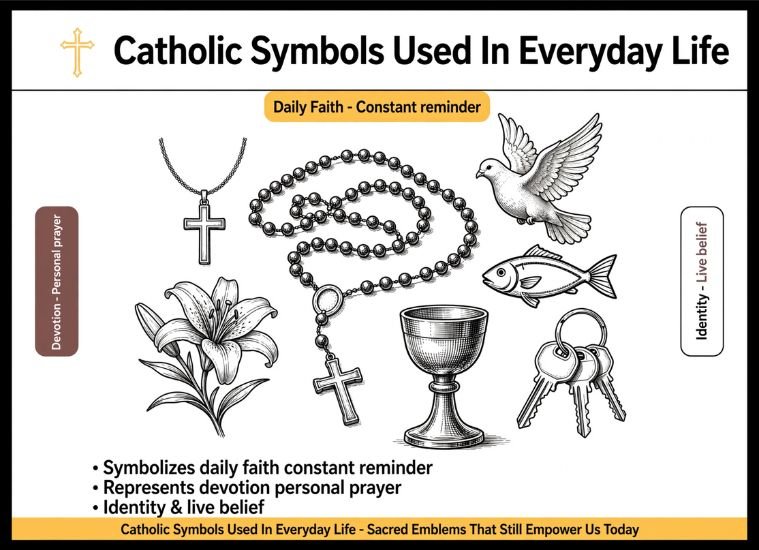
Catholic symbols are not only found in churches. Many believers keep these symbols in their homes or carry them as daily reminders of their faith. These simple practices encourage prayer and strengthen a person’s relationship with God.
| Symbol | Description | Meaning |
| Cross Necklace | A small cross worn around the neck. | Represents Christian faith and devotion to Christ. |
| Crucifix Necklace | A necklace featuring Jesus on the cross. | Reminds the wearer of Christ’s sacrifice and love. |
| Rosary | Catholic prayer beads often carried or kept at home. | Represents prayer, devotion, and meditation. |
| Holy Water Font | A small container of blessed water placed near a church entrance or in a home. | Reminds Catholics of Baptism and God’s blessing. |
| Prayer Card | A small card featuring a saint, prayer, or sacred image. | Supports personal prayer and devotion. |
| Saint Medal | A small medal featuring a saint or religious image. | Represents devotion and a reminder of Christian faith. |
| Scapular | A devotional religious item worn around the neck. | Represents Catholic devotion and commitment to a particular spiritual tradition. |
| Sacred Heart Medal | A medal displaying the Sacred Heart of Jesus. | Represents Christ’s love, mercy, and compassion. |
| Miraculous Medal | A Catholic medal featuring Mary and traditional devotional imagery. | Represents devotion to the Virgin Mary and prayer for her intercession. |
| Saint Benedict Medal | A medal containing symbols and letters associated with Saint Benedict. | Represents faith and devotion connected with Saint Benedict. |
| Cross Bracelet | A bracelet decorated with one or more crosses. | Serves as a visible reminder of Christian faith. |
| Rosary Bracelet | A wearable bracelet designed to assist with Catholic prayer. | Provides a convenient aid for prayer and devotion. |
| Catholic Home Cross | A cross displayed on a wall or in a home prayer area. | Represents Christ’s presence and Christian identity. |
| Family Crucifix | A crucifix displayed in a Catholic household. | Reminds the family of Jesus’ sacrifice and faith. |
| Bible with Cross | A Bible displayed with a cross or cross design. | Connects Scripture with Christian belief in Christ. |
| Religious Artwork | Catholic images of Jesus, Mary, saints, or biblical scenes. | Supports prayer, reflection, and devotion. |
| Advent Wreath | A wreath with four candles used during Advent. | Represents preparation for Christ’s coming. |
| Christmas Nativity | A display showing the birth of Jesus. | Represents the Incarnation and birth of Christ. |
| Palm Branch | A palm branch used especially during Palm Sunday. | Represents Jesus’ entry into Jerusalem and His kingship. |
| Catholic Candle | A candle used during prayer or religious devotion. | Represents Christ as light and can accompany prayer and worship. |
Common Misunderstandings About Catholic Symbols
Some people believe Catholics worship crosses, statues, or other religious objects. This is not what the Catholic Church teaches. Catholics honor what these symbols represent rather than the physical objects themselves.
For example, the Crucifix points to Jesus Christ and His sacrifice. The Rosary helps believers meditate on the Gospel. Holy Water reminds Catholics of Baptism, while religious images encourage prayer and reflection. The purpose of every Catholic symbol is to draw people closer to God.
FAQs
Q1: What are Catholic symbols?
A1: Catholic symbols are signs, objects, and images that represent important beliefs, teachings, and traditions of the Catholic Church.
Q2: What is the most important Catholic symbol?
A2: The cross is one of the most important Catholic symbols because it represents the crucifixion and sacrifice of Jesus Christ.
Q3: What are some common Catholic symbols?
A3: Common Catholic symbols include the cross, crucifix, dove, fish, rosary, Sacred Heart, and Chi Rho.
Q4: What does the rosary symbolize?
A4: The rosary is associated with Catholic prayer and devotion, especially prayers that reflect on events in the lives of Jesus and Mary.
Q5: What does the dove symbolize in Catholicism?
A5: The dove commonly represents the Holy Spirit, especially in connection with peace and God’s presence.
Q6: Why are Catholic symbols important?
A6: Catholic symbols help communicate Christian beliefs visually and serve as reminders of faith, prayer, Scripture, and Church traditions.