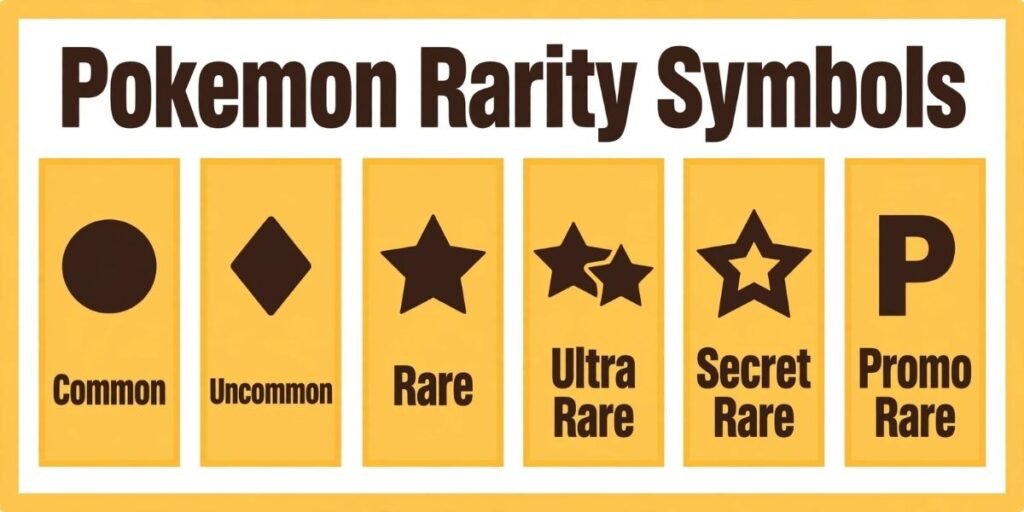
Ever wonder about the little symbol on a Pokémon card? The rarity symbols on the cards provide a quick reference guide to a collector’s identification of their card’s classification in its set. A small circle, diamond, star, or special star shape will indicate whether a card is in the Common, Uncommon, Rare, or special rarity group.
These symbols can be particularly useful when organizing your cards, collecting a set of Pokémon cards, or determining the position of a card within a Pokémon Trading Card Game set. Over the years, the system has evolved as well, and may use different rarity marks than newer releases may.
In modern cards there are categories like Double Rare, Ultra Rare, Illustration Rare, Special Illustration Rare and Hyper Rare. Knowing these symbols is essential for making card collecting easy, and helps you to compare cards without making judgments based only on the artwork or appearance of the card.
Common Pokémon Rarity Symbols
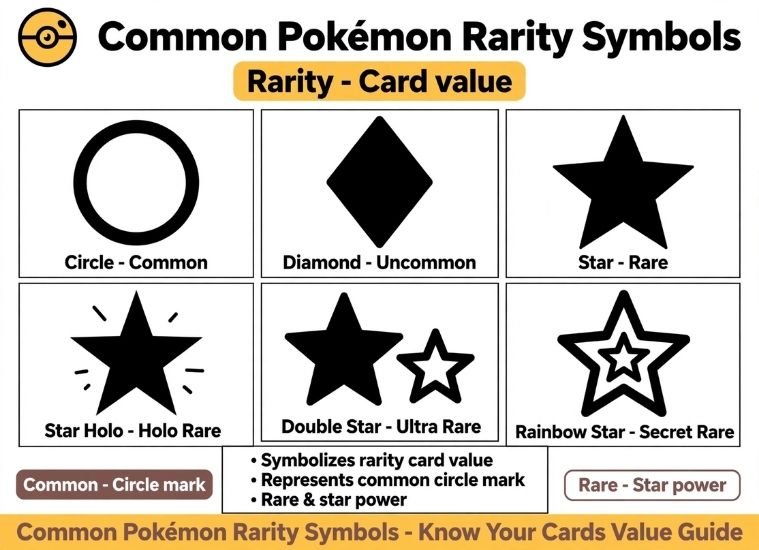
Common cards are among the basic cards found in Pokémon TCG sets. The traditional Common mark is a solid circle, and it helps collectors quickly separate these cards from higher basic rarity levels.
| Name | Meaning | Description |
| Circle Symbol | Common | The solid circle is the traditional rarity symbol used for Common Pokémon cards. |
| Common Card Mark | Basic rarity | This mark identifies a card belonging to the Common category of its set. |
| Common Pokémon Symbol | Regular card | The symbol provides a quick way to recognize an ordinary Common Pokémon card. |
| Common Set Mark | Set classification | It shows that the card has been assigned Common rarity within its expansion. |
| Common Rarity Icon | Frequent card | The icon identifies a card that belongs to the basic Common rarity group. |
| Circle Rarity Mark | Common status | The circle is one of the most familiar symbols used for Pokémon card rarity. |
| Basic Card Symbol | Standard rarity | This symbol can identify cards that do not belong to a higher rarity group. |
| Regular Card Mark | Common level | The mark helps collectors sort regular cards from special rarity cards. |
| Common Collection Mark | Card sorting | Collectors can use this symbol when arranging cards by rarity. |
| Standard Common Symbol | Common | This traditional mark represents the basic Common classification. |
| Common Pokémon Mark | Basic card | Pokémon cards with this classification belong to the Common rarity level. |
| Circle Card Icon | Common | The circle makes Common cards easy to identify when checking a collection. |
| Basic Rarity Mark | Common | This mark represents one of the standard lower rarity categories. |
| Common Expansion Mark | Set rarity | It shows the card’s rarity classification within a particular expansion. |
| Common Card Identifier | Identification | The symbol gives collectors a simple visual clue about card rarity. |
| Traditional Circle | Common | The circle has long been associated with Common cards in the Pokémon TCG. |
| Common Set Symbol | Regular set card | It identifies a Common card included in the main card pool of a set. |
| Circle Classification | Common | The mark classifies the card without describing its gameplay strength. |
| Common Print Mark | Basic rarity | The symbol relates to rarity rather than the physical condition of the card. |
| Regular Rarity Icon | Common | This icon helps distinguish basic cards from special cards. |
| Common Card Circle | Frequent rarity | A circle indicates that the card belongs to the Common rarity group. |
| Standard Card Mark | Basic card | The symbol is useful when organizing cards according to their rarity. |
| Common Collection Symbol | Organization | Collectors can quickly group cards carrying the same Common mark. |
| Circle Set Identifier | Card rarity | The circle provides information about the card’s rarity within its set. |
| Common Rarity Symbol | Common | This familiar mark represents a basic rarity classification. |
| Regular Common Mark | Standard card | The mark identifies an ordinary card rather than a premium rarity. |
| Common Card Classification | Basic level | It places the card within the Common section of a rarity system. |
| Circle Card Mark | Common | The simple circle is easy for new collectors to recognize. |
| Common Expansion Symbol | Set status | The symbol helps identify a card’s rarity when checking an expansion. |
| Basic Common Icon | Common | This icon represents the standard Common level in the traditional system. |
Pokémon Rarity Symbols
Search a Pokémon rarity symbol to learn what it represents.
Common
Uncommon Pokémon Rarity Symbols
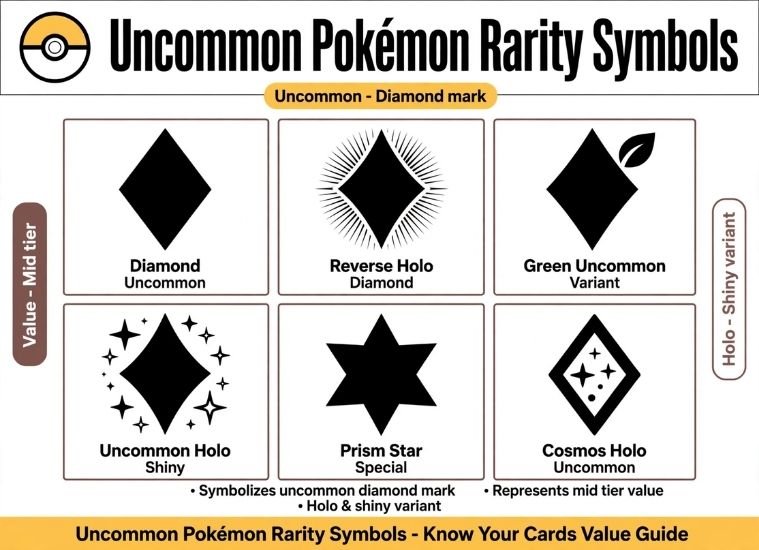
Uncommon cards traditionally use a diamond symbol. They sit above Common cards in the basic rarity system and are another important group for collectors sorting a Pokémon card set.
| Name | Meaning | Description |
| Diamond Symbol | Uncommon | A solid diamond is the traditional symbol used to identify Uncommon cards. |
| Uncommon Card Mark | Moderate rarity | The mark shows that a card is classified above Common rarity. |
| Uncommon Pokémon Symbol | Uncommon | This symbol identifies Pokémon assigned to the Uncommon category. |
| Diamond Rarity Mark | Uncommon status | The diamond provides a simple visual clue about the card’s rarity. |
| Uncommon Set Mark | Set classification | It identifies an Uncommon card within its particular Pokémon TCG expansion. |
| Diamond Card Icon | Uncommon | This icon helps collectors separate Uncommon cards from Common cards. |
| Standard Diamond | Uncommon | The diamond is one of the best-known traditional Pokémon rarity symbols. |
| Uncommon Collection Mark | Card sorting | Collectors can use the mark when arranging cards by rarity. |
| Diamond Collection Symbol | Organization | This symbol makes it easier to group cards with Uncommon classification. |
| Uncommon Rarity Icon | Moderate level | The icon represents the Uncommon category in the traditional rarity system. |
| Diamond Set Symbol | Card rarity | It indicates that a card has Uncommon rarity within its expansion. |
| Uncommon Card Identifier | Identification | The symbol gives a quick visual indication of the card’s rarity. |
| Diamond Classification | Uncommon | The classification places the card above the Common level. |
| Uncommon Expansion Mark | Set rarity | The mark identifies the card’s rarity within a specific expansion. |
| Diamond Pokémon Mark | Uncommon Pokémon | A diamond can identify a Pokémon card with Uncommon classification. |
| Traditional Diamond Mark | Uncommon | This familiar symbol has been used to represent Uncommon cards. |
| Uncommon Card Symbol | Less frequent | The diamond distinguishes Uncommon cards from the more basic Common group. |
| Diamond Rarity Icon | Uncommon | The icon is a recognizable marker for this traditional rarity level. |
| Basic Uncommon Mark | Moderate rarity | The symbol represents a card that is above Common in the basic system. |
| Uncommon Set Identifier | Card status | Collectors can use the mark to identify the card’s rarity in a set. |
| Diamond Card Classification | Uncommon | This classification helps organize cards according to rarity. |
| Uncommon Collection Icon | Organization | The icon is useful when separating different rarity groups in a collection. |
| Diamond Expansion Mark | Set rarity | The mark provides information about the card’s rarity in an expansion. |
| Standard Uncommon Symbol | Uncommon | The symbol identifies a card belonging to the Uncommon category. |
| Uncommon Card Icon | Moderate rarity | This icon helps distinguish Uncommon cards from Common and Rare cards. |
| Diamond Card Identifier | Recognition | The symbol allows collectors to recognize Uncommon cards at a glance. |
| Uncommon Print Symbol | Card rarity | The mark describes rarity rather than card condition or market value. |
| Diamond Collection Mark | Card organization | Collectors can use this symbol while sorting cards into rarity groups. |
| Uncommon Rarity Mark | Uncommon | The diamond represents a traditional basic rarity classification. |
| Diamond Set Identifier | Set classification | The symbol helps identify an Uncommon card when reviewing a set list. |
Explore the history, meanings, and cultural traditions connected to Witch Symbols imagery and learn how these distinctive designs have been associated with folklore, magic, and spiritual traditions.
Rare Pokémon Rarity Symbols
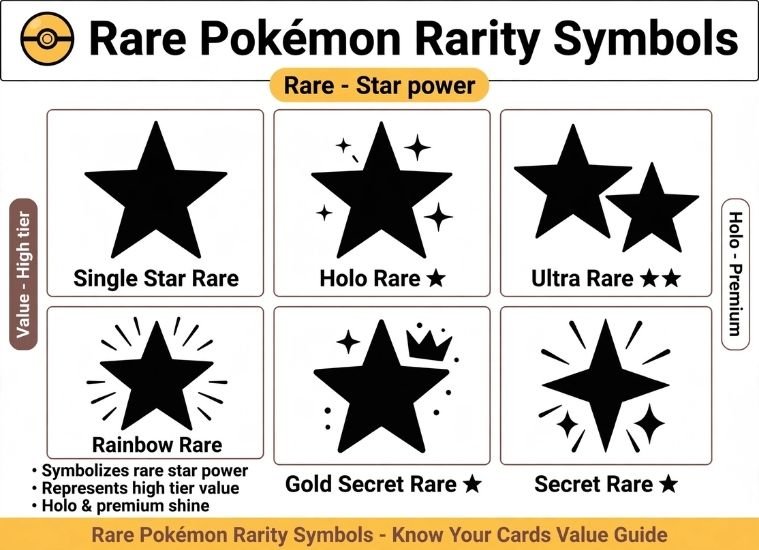
Rare cards traditionally use a star symbol. Rare cards can be more difficult to find than Common and Uncommon cards, although rarity alone does not determine a card’s collector value.
| Name | Meaning | Description |
| Black Star Symbol | Rare | A solid black star is the traditional symbol used for Rare cards. |
| Rare Card Mark | Higher rarity | The star identifies a card belonging to the standard Rare category. |
| Rare Pokémon Symbol | Rare status | This mark shows that the Pokémon has Rare classification in its set. |
| Single Star Mark | Rare | One solid star is a familiar visual sign of traditional Rare rarity. |
| Rare Set Mark | Set classification | The symbol identifies the card’s Rare status within its expansion. |
| Star Rarity Mark | Rare | The star provides a quick visual way to recognize a Rare card. |
| Rare Collection Symbol | Organization | Collectors can use the star when sorting Rare cards from lower rarities. |
| Rare Card Icon | Rare status | This icon represents the standard Rare category in the traditional system. |
| Star Card Mark | Higher rarity | The mark separates Rare cards from Common and Uncommon cards. |
| Rare Expansion Mark | Set rarity | It identifies the Rare classification assigned to a card in an expansion. |
| Rare Pokémon Mark | Rare | A star can identify a Pokémon that has Rare classification. |
| Traditional Star | Rare | The star is one of the most recognizable Pokémon TCG rarity symbols. |
| Rare Card Identifier | Identification | Collectors can check the symbol to identify a card’s basic rarity. |
| Star Collection Mark | Card sorting | This mark helps collectors organize Rare cards in a larger collection. |
| Rare Rarity Icon | Rare | The icon provides a simple visual indicator of Rare classification. |
| Star Set Symbol | Set status | The symbol shows that the card has Rare status within its set. |
| Rare Card Classification | Higher level | The classification places the card above Common and Uncommon rarity. |
| Single Star Symbol | Rare | One star is traditionally associated with the standard Rare category. |
| Rare Expansion Symbol | Card rarity | The mark helps identify Rare cards when reviewing an expansion checklist. |
| Star Card Identifier | Recognition | The symbol allows collectors to recognize a Rare card quickly. |
| Rare Collection Mark | Organization | The star can help separate Rare cards from the rest of a collection. |
| Standard Rare Mark | Rare status | The mark represents the regular Rare category rather than a special premium category. |
| Rare Set Identifier | Card status | It provides a quick indication of the card’s rarity within its set. |
| Star Rarity Icon | Rare | The star is a simple and familiar visual marker for Rare cards. |
| Rare Pokémon Card Mark | Rare | This mark identifies Pokémon cards assigned Rare classification. |
| Classic Rare Symbol | Traditional rarity | The star has been used as a familiar rarity indicator across Pokémon TCG history. |
| Rare Card Symbol | Higher rarity | The symbol distinguishes Rare cards from the two basic lower rarity levels. |
| Star Collection Symbol | Rare group | Collectors can use the symbol when grouping cards by rarity. |
| Rare Card Icon | Rare status | The icon gives a fast visual clue when examining a Pokémon card. |
| Standard Star Mark | Rare | This traditional star represents the standard Rare classification. |
Explore the cultural meanings and historical traditions connected to Symbols of Death concepts and learn how these meaningful designs have represented mortality, remembrance, and the cycle of life across cultures.
Special Pokémon Rarity Symbols
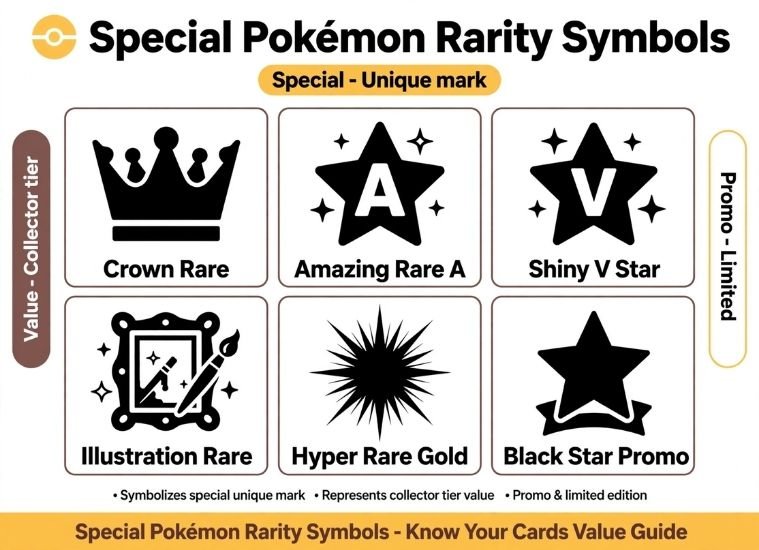
Modern Pokémon cards include several special rarity groups beyond the traditional Common, Uncommon, and Rare categories. These marks help identify cards with special artwork, premium finishes, or particular card treatments.
| Name | Meaning | Description |
| Double Rare Symbol | Double Rare | Two solid black stars identify the Double Rare category in the modern system. |
| Ultra Rare Symbol | Ultra Rare | Two shiny stars identify the Ultra Rare category used on certain special cards. |
| Illustration Rare Symbol | Special artwork | This rarity features Pokémon cards with artwork that fills much of the card. |
| Special Illustration Rare | Premium artwork | This category features highly detailed full-art designs with a strong collector focus. |
| Hyper Rare Symbol | Premium rarity | Three shiny gold stars identify the modern Hyper Rare category. |
| Gold Rarity Symbol | Gold card | Gold-style cards are associated with the Hyper Rare category in the modern system. |
| Pokémon ex Symbol | Special Pokémon | Standard Pokémon ex cards commonly carry the Double Rare classification. |
| Full Art Symbol | Expanded artwork | Full-art cards use artwork that covers a much larger area of the card. |
| Illustration Card Mark | Artwork | The mark identifies a special illustration-focused rarity. |
| Special Art Symbol | Detailed design | Special artwork gives these cards a distinct visual style for collectors. |
| Gold Card Mark | Premium design | Gold cards have a distinctive appearance that separates them from regular cards. |
| Double Star Mark | Double Rare | Two solid stars are used for the Double Rare category in modern sets. |
| Shiny Star Mark | Higher rarity | Shiny star patterns are used for several modern special rarity categories. |
| Three Star Symbol | Hyper Rare | Three shiny stars identify the Hyper Rare level. |
| Illustration Mark | Artistic rarity | The symbol identifies cards where artwork is a major part of the card’s appeal. |
| Special Illustration Mark | Premium art | This mark identifies a higher illustration-based rarity category. |
| Ultra Star Symbol | Ultra Rare | Two shiny stars indicate the Ultra Rare classification. |
| Gold Star Symbol | Hyper Rare | Three shiny gold stars are associated with Hyper Rare cards. |
| Premium Rarity Mark | Special card | This general mark represents a card that belongs to a higher rarity group. |
| Art Rarity Symbol | Special artwork | The symbol helps collectors identify cards with expanded artistic presentation. |
| Modern Rarity Mark | Current system | Modern Pokémon sets use several special symbols beyond the traditional three levels. |
| Special Card Symbol | Higher rarity | This mark can help separate special cards from regular set cards. |
| Illustrated Pokémon Mark | Artwork | The symbol identifies cards known for their expanded Pokémon artwork. |
| Premium Card Icon | Collector interest | Higher rarity icons can help collectors identify cards with special treatments. |
| Gold Card Symbol | Special finish | A gold visual treatment is commonly associated with modern Hyper Rare cards. |
| Rare Art Mark | Artistic value | Special artwork can make a card visually different from standard cards. |
| Special Rarity Icon | Premium group | This icon helps identify cards outside the basic Common, Uncommon, and Rare groups. |
| High Rarity Symbol | Special classification | The mark indicates that a card belongs to one of the higher rarity categories. |
| Collector Rarity Mark | Collection appeal | Special rarity marks help collectors sort premium and artwork-focused cards. |
| Modern Special Symbol | Modern rarity | These symbols are part of the newer Pokémon TCG rarity structure. |
Explore the rich history, cultural meanings, and traditions connected to Irish Symbols heritage and learn how these meaningful designs continue to reflect Irish culture and identity.
Pokémon Card Rarity Symbols By Card Type
Different Pokémon card types can appear at several rarity levels. Pokémon, Trainer, and Energy cards may have different treatments depending on the set, while special Pokémon cards can use newer rarity classifications.
| Name | Meaning | Description |
| Pokémon ex Card Mark | Special Pokémon | Pokémon ex cards are powerful Pokémon cards that use special rules and can carry modern rarity classifications. |
| Tera Pokémon ex Mark | Tera card | Tera Pokémon ex cards have a distinct gameplay identity and can appear with different artwork and rarity treatments. |
| Trainer Gallery Mark | Special artwork | Trainer Gallery cards feature Pokémon together with Trainers and were used in specific Sword & Shield era products. |
| Character Rare Mark | Character artwork | Character Rare cards show Pokémon alongside characters and are known for their illustrated presentation. |
| Character Super Rare Mark | Special character art | Character Super Rare cards provide larger artwork featuring a Pokémon and its associated Trainer. |
| Amazing Rare Mark | Special rarity | Amazing Rare cards use colorful artwork and a distinctive rarity treatment found in selected Pokémon TCG sets. |
| Shining Card Mark | Shiny Pokémon | Shining cards feature Pokémon with alternate shiny coloration and appeared in particular historical sets. |
| Radiant Pokémon Mark | Radiant Pokémon | Radiant Pokémon cards feature shiny Pokémon and special gameplay rules introduced during the Sword & Shield era. |
| Prime Card Mark | Pokémon Prime | Pokémon Prime cards were a special card style used during the HeartGold & SoulSilver period. |
| Legend Card Mark | LEGEND cards | LEGEND cards were special cards that required two separate pieces to create the complete card image. |
| Pokémon Star Mark | Pokémon Star | Pokémon ☆ cards feature alternate-color Pokémon and are highly recognizable among older collectors. |
| Delta Species Mark | Pokémon type variation | Delta Species cards feature Pokémon with unusual types and belong to a notable historical card theme. |
| Dark Pokémon Mark | Dark Pokémon | Dark Pokémon cards are associated with Team Rocket and feature Pokémon with a darker theme. |
| Light Pokémon Mark | Light Pokémon | Light Pokémon cards appeared in the Neo-era card sets and used a special naming and artwork style. |
| Crystal Pokémon Mark | Crystal type | Crystal Pokémon are associated with the EX Crystal Guardians era and feature distinctive Poké-Body mechanics. |
| Gold Star Pokémon Mark | Rare vintage card | Gold Star Pokémon cards are famous collector cards featuring shiny Pokémon and a gold star beside the name. |
| Pokémon V Mark | V card | Pokémon V cards were introduced during the Sword & Shield era and use special Pokémon V rules. |
| Pokémon VMAX Mark | VMAX card | Pokémon VMAX cards represent Dynamax or Gigantamax Pokémon and follow special knockout rules. |
| Pokémon VSTAR Mark | VSTAR card | Pokémon VSTAR cards introduced powerful VSTAR Powers and became part of the Sword & Shield card pool. |
| Pokémon V-Union Mark | V-UNION card | V-UNION cards are made from multiple cards that combine to form one larger Pokémon image. |
| Pokémon TAG TEAM Mark | Partner Pokémon | TAG TEAM cards feature two Pokémon working together and were introduced during the Sun & Moon era. |
| GX Card Mark | GX Pokémon | Pokémon-GX cards feature powerful GX attacks and were introduced during the Sun & Moon era. |
| BREAK Card Mark | BREAK evolution | Pokémon BREAK cards feature a horizontal design and special attacks or abilities. |
| EX Card Mark | Pokémon-EX | Pokémon-EX cards were a major special Pokémon card type used before Pokémon ex returned in the Scarlet & Violet era. |
| LV.X Card Mark | Level-Up Pokémon | Pokémon LV.X cards allowed certain Pokémon to be placed on top of their normal versions. |
| Pokémon SP Mark | Special Pokémon | Pokémon SP cards appeared in the Platinum era and represented Pokémon connected to specific Trainers or groups. |
| Team Plasma Mark | Team Plasma | Team Plasma cards belong to a themed group from the Black & White era and carry the Team Plasma designation. |
| Team Magma Mark | Team Magma | Team Magma cards are connected to the Hoenn villainous team and its special card theme. |
| Team Aqua Mark | Team Aqua | Team Aqua cards represent Pokémon connected with Team Aqua in the EX-era card sets. |
| Rocket’s Pokémon Mark | Team Rocket | These cards connect Pokémon with Team Rocket and use the organization as part of the card identity. |
Explore the festive traditions and cultural meanings connected to Christmas Symbols elements and learn how these familiar designs have become meaningful parts of Christmas traditions and celebrations.
Pokémon Rarity Symbols For Special Artwork
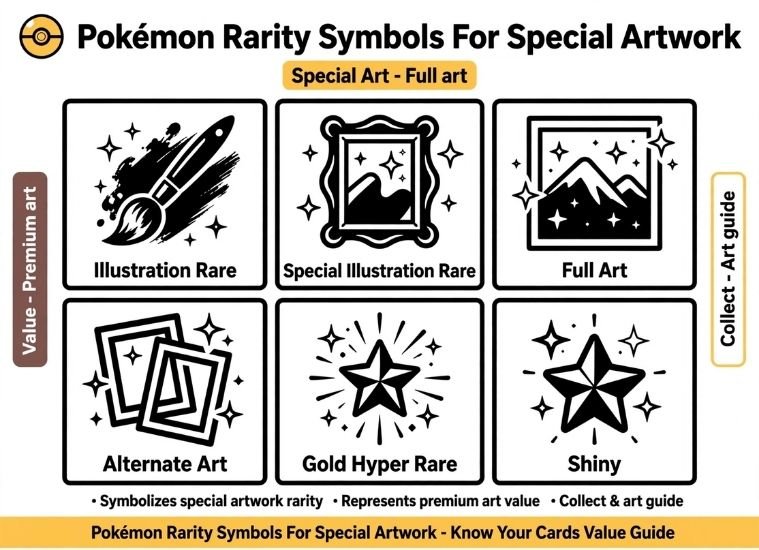
Artwork is an important part of modern Pokémon card collecting. Several rarity categories are known for large illustrations, alternate scenes, character interactions, or special visual treatments.
| Name | Meaning | Description |
| Full Art Card Symbol | Full artwork | Full Art cards use artwork across most or all of the card’s main visual area. |
| Alternate Art Mark | Alternate artwork | Alternate Art cards use a different illustration from the regular version of the same Pokémon. |
| Alternate Full Art Symbol | Special artwork | Alternate Full Art cards combine a different scene with a full-card artistic presentation. |
| Secret Rare Mark | Hidden set rarity | Secret Rare cards historically had card numbers that could extend beyond the standard numbered set. |
| Rainbow Rare Mark | Rainbow finish | Rainbow Rare cards use a rainbow-colored visual treatment and were prominent in the Sun & Moon and Sword & Shield eras. |
| Shiny Vault Mark | Shiny Pokémon | Shiny Vault cards feature alternate-color Pokémon and appeared in special subsets. |
| Baby Shiny Mark | Shiny Pokémon | Baby Shiny cards feature shiny Pokémon in a smaller, character-focused card presentation. |
| Shiny Full Art Mark | Full-art shiny | These cards combine shiny Pokémon with a larger full-art design. |
| Amazing Rare Symbol | Colorful rarity | Amazing Rare cards use bright, multicolor artwork and a special rarity style. |
| Radiant Rare Mark | Radiant Pokémon | Radiant Rare cards feature shiny Pokémon and were limited to a small number per deck. |
| Gallery Card Mark | Art collection | Gallery cards focus strongly on artistic scenes and appeared in dedicated subsets. |
| Art Rare Symbol | Illustration rarity | Art Rare is a term used for illustration-focused cards in modern Pokémon products. |
| Illustration Rare Mark | Special illustration | Illustration Rare cards feature artwork that presents the Pokémon in a larger illustrated scene. |
| Special Illustration Mark | Premium illustration | Special Illustration Rare cards use highly detailed artwork and are among the notable modern collector rarities. |
| Hyper Rare Mark | Gold rarity | Hyper Rare cards use a distinctive gold appearance and represent a high modern rarity category. |
| Gold Card Symbol | Premium finish | Gold cards have a metallic-style visual design that makes them stand out from regular cards. |
| Rainbow Card Mark | Rainbow design | Rainbow-style cards use a multicolor treatment that was especially common in earlier modern sets. |
| Secret Illustration Mark | Special artwork | This term can describe artwork-focused cards with a special place within a set’s rarity structure. |
| Alternate Scene Mark | Different artwork | Alternate artwork presents the Pokémon in a scene that differs from its regular card illustration. |
| Character Artwork Mark | Trainer connection | Character-focused cards show a Pokémon together with a Trainer or story character. |
| Shiny Artwork Mark | Shiny Pokémon | These cards combine alternate-color Pokémon with special artistic presentation. |
| Special Art Card Mark | Collector artwork | Special art cards place greater attention on unique scenes and detailed illustration. |
| Gallery Rarity Mark | Art-focused card | Gallery-style cards are valued by collectors partly for their artistic presentation. |
| Gold Artwork Mark | Gold design | Gold artwork cards use a premium visual treatment associated with higher rarity groups. |
| Full Illustration Mark | Expanded art | The illustration occupies a larger part of the card and creates a different visual style. |
| Alternate Scene Symbol | Unique art | The symbol can be used as a general description for cards featuring an alternate Pokémon scene. |
| Premium Illustration Mark | Higher art rarity | Premium illustration cards combine collectible artwork with a special rarity classification. |
| Shiny Illustration Mark | Shiny artwork | This style combines shiny Pokémon with an illustration-focused presentation. |
| Special Gallery Symbol | Art collection | Gallery symbols are useful when identifying cards that belong to artwork-focused subsets. |
| Premium Art Symbol | Collector appeal | Premium art treatments make certain cards visually different from ordinary versions. |
Explore the heartfelt meanings and cultural traditions connected to Symbols of Love expressions and learn how these meaningful designs represent affection, connection, devotion, and lasting bonds.
Pokémon Rarity Symbols From Older Sets
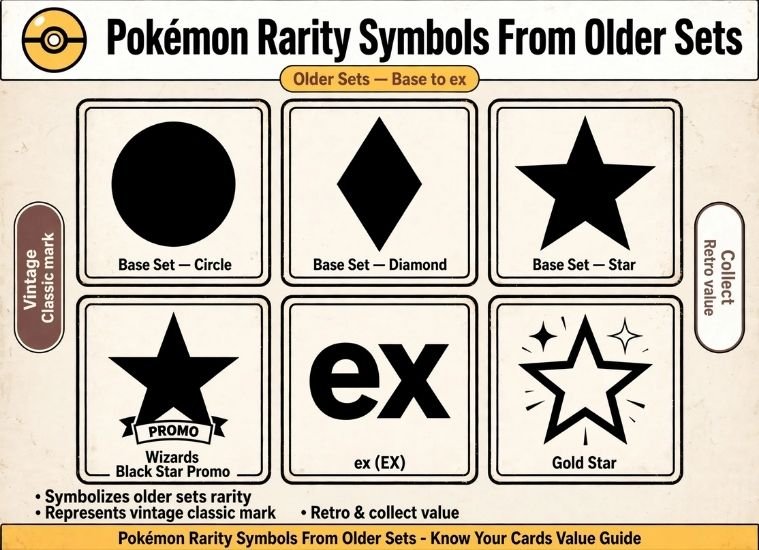
Pokémon cards have used many rarity systems over the years. Older symbols and card styles can therefore look very different from the marks found on current Scarlet & Violet era cards.
| Name | Meaning | Description |
| Pokémon ☆ Symbol | Shiny Pokémon | The star symbol beside a Pokémon’s name identifies the classic Pokémon ☆ card style. |
| Holo Rare Mark | Holographic Rare | Holo Rare cards use a holographic card area and traditionally carry a Rare star symbol. |
| Non-Holo Rare Mark | Rare card | Some older Rare cards use the Rare star while having a regular non-holographic appearance. |
| Neo Genesis Rarity Mark | Vintage set | Neo-era cards follow older rarity conventions and are recognized by their period-specific card design. |
| Base Set Rare Mark | Vintage Rare | Base Set Rare cards use the classic black star rarity symbol. |
| Jungle Rare Mark | Vintage rarity | Jungle expansion Rare cards follow the early Pokémon TCG rarity system. |
| Fossil Rare Mark | Vintage rarity | Fossil Rare cards use the traditional star classification from the early TCG era. |
| Team Rocket Rare Mark | Rocket rarity | Team Rocket cards use the early rarity system and include themed Dark Pokémon. |
| Gym Heroes Rare Mark | Gym rarity | Gym Heroes cards combine Gym Leader themes with the traditional Pokémon rarity system. |
| Gym Challenge Rare Mark | Gym rarity | Gym Challenge cards continue the Gym series with traditional rarity symbols. |
| Neo Revelation Rare Mark | Neo rarity | Neo Revelation contains several vintage rarity types, including holographic Rare cards. |
| Neo Destiny Rare Mark | Neo rarity | Neo Destiny is known for Dark and Light Pokémon alongside its older rarity system. |
| EX Series Rare Mark | EX-era rarity | EX-series sets introduced many special card styles while retaining familiar basic rarity symbols. |
| Gold Star Mark | Shiny rarity | Gold Star cards feature shiny Pokémon and are among the best-known cards from the EX era. |
| Crystal Type Mark | Crystal Pokémon | Crystal Pokémon cards are associated with a special EX-era design and gameplay mechanic. |
| Stamped Promo Mark | Promotional card | A stamp can indicate that a card was distributed through a specific event or promotion. |
| Black Star Promo Mark | Promotional card | The Black Star Promo designation identifies Pokémon cards released outside regular expansion sets. |
| WOTC Promo Mark | Early promotion | Wizards of the Coast-era promotional cards can have unique numbering and promotional identifiers. |
| E-Reader Mark | E-Reader era | E-Reader cards are recognizable by their distinctive layout and compatibility with the e-Reader accessory. |
| Aquapolis Mark | Expansion identity | Aquapolis is an e-Reader era expansion with its own set symbol and card numbering. |
| Skyridge Mark | Expansion identity | Skyridge was another e-Reader expansion with distinctive card design and symbols. |
| Expedition Mark | Expansion identity | Expedition Base Set introduced the e-Reader card format to the Pokémon TCG. |
| Southern Islands Mark | Special collection | Southern Islands cards belong to a special themed collection with connected artwork. |
| Legendary Collection Mark | Special expansion | Legendary Collection is known for its distinctive reverse-holographic pattern. |
| Reverse Holo Mark | Card finish | Reverse holographic cards have a foil treatment on the card background or surrounding area. |
| First Edition Mark | Early printing | The First Edition stamp identifies certain early Pokémon TCG printings. |
| Unlimited Mark | Later printing | Unlimited refers to cards printed without the First Edition designation. |
| Shadowless Mark | Printing variation | Shadowless Base Set cards lack the drop shadow around the Pokémon artwork frame. |
| 1st Edition Stamp | First printing | The classic 1st Edition stamp is an important identifier for certain vintage Pokémon cards. |
| Vintage Holo Symbol | Holographic rarity | Older holographic cards commonly combine the Rare star symbol with a reflective card finish. |
Explore the magical stories and visual details connected to Harry Potter Symbols motifs and learn how these recognizable designs add meaning to the characters, stories, and wizarding world.
Pokémon Rarity Symbols For Special Card Treatments
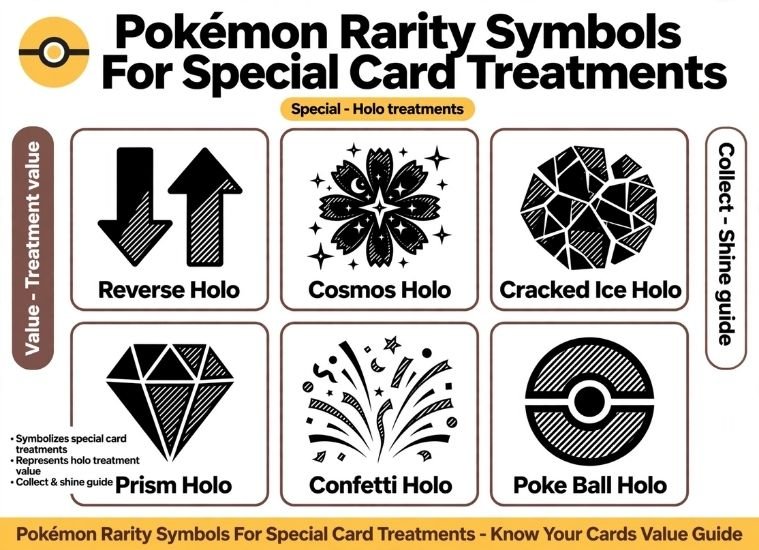
Special card treatments can make Pokémon cards look very different from regular cards. Foil patterns, special borders, alternate artwork, and unique finishes are often connected with particular card categories or set designs.
| Name | Meaning | Description |
| Reverse Holofoil | Foil treatment | Reverse Holofoil cards have a reflective pattern across much of the card outside the main artwork area. |
| Holofoil Pattern | Shiny finish | Holofoil cards use a reflective finish that gives the card a noticeable shine when viewed under light. |
| Cosmos Holofoil | Special pattern | Cosmos Holofoil uses a circular or star-like foil pattern that has appeared on selected Pokémon cards. |
| Cracked Ice Holofoil | Ice-like pattern | Cracked Ice Holofoil uses a distinctive angular foil effect that resembles fractured ice. |
| Galaxy Holofoil | Starry finish | Galaxy-style foil creates a space-like appearance with many small reflective points across the card. |
| Shattered Glass Foil | Special foil | This treatment uses a fractured visual pattern that gives the card a textured glass-like appearance. |
| Poké Ball Foil | Poké Ball pattern | Some special cards use repeated Poké Ball shapes within their foil background. |
| Master Ball Foil | Master Ball pattern | The Master Ball foil treatment uses a repeating Master Ball design and is associated with special Japanese card variants. |
| Mirror Foil | Reflective finish | Mirror foil creates a stronger reflective appearance and has been used on selected promotional and special cards. |
| Stamped Foil | Promotional marking | A stamp can be printed over a card to identify an event, product, competition, or special distribution. |
| Cosmos Pattern | Foil design | The Cosmos pattern adds a recognizable scattered foil effect to the card surface. |
| Parallel Foil | Variant treatment | Parallel-style cards use a different foil or background pattern from the standard version. |
| Poké Ball Pattern | Collector variant | A repeating Poké Ball design can distinguish a special variant from an ordinary card. |
| Master Ball Pattern | Collector variant | The Master Ball pattern is a recognizable special treatment found on selected Pokémon cards. |
| Etched Foil | Textured foil | Etched foil gives parts of the card a more detailed reflective appearance than standard foil. |
| Textured Foil | Premium finish | Textured surfaces can give higher-rarity cards a noticeable feel and appearance. |
| Metallic Finish | Premium appearance | Metallic-style finishes create a shiny surface that can make special cards stand out. |
| Gold Foil Finish | Gold appearance | Gold-style foil is commonly associated with premium-looking Pokémon cards. |
| Rainbow Foil Finish | Multicolor effect | Rainbow finishes use shifting colors across the card surface to create a distinctive appearance. |
| Silver Foil Finish | Silver appearance | Silver-style foil gives selected cards a bright reflective look. |
| Holographic Border | Foil border | Some cards use reflective material around the artwork or card frame. |
| Holographic Background | Shiny background | A holographic background creates a reflective visual field behind or around the card artwork. |
| Patterned Reverse Foil | Decorative foil | Patterned reverse foil adds repeated designs to the reflective portion of a card. |
| Special Foil Variant | Alternate finish | A special foil variant changes the card’s surface appearance without necessarily changing its main artwork. |
| Promo Foil Treatment | Promotional finish | Promotional cards may receive special foil patterns that distinguish them from regular set cards. |
| Event Foil Mark | Event card | Certain event-distributed cards can use special foil treatments or stamps connected with their release. |
| League Foil Mark | League distribution | Pokémon League cards can feature special markings or foil treatments connected with organized play. |
| Prize Foil Treatment | Tournament card | Some cards distributed as prizes have special treatments that distinguish them from normal set versions. |
| Special Set Foil | Special release | Special products and subsets can use foil patterns that are not found throughout the main expansion. |
| Promotional Holographic Mark | Promo card | A holographic treatment can give a promotional card a different appearance from its regular counterpart. |
Pokémon Rarity Symbols For Promotional Cards
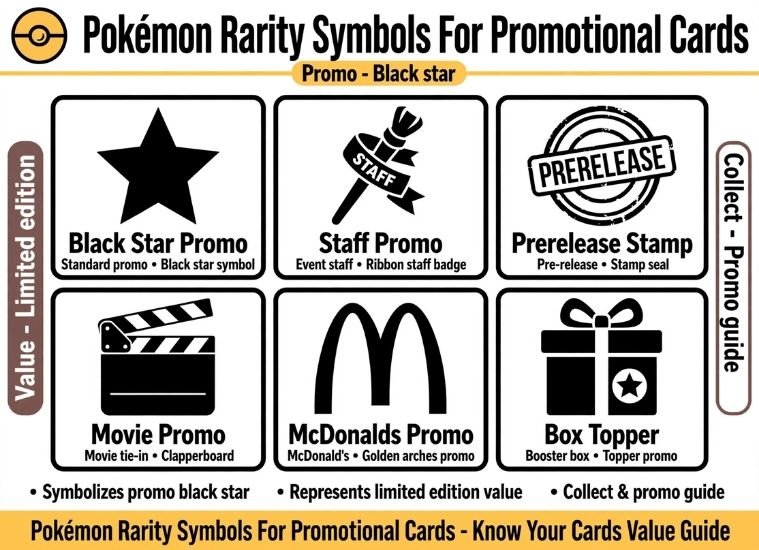
Promotional cards are released outside the normal numbered card pool of a standard expansion. Their identification usually comes from promo numbering, stamps, set information, or the product and event through which they were distributed.
| Name | Meaning | Description |
| Black Star Promo | Promotional card | Black Star Promos are identified by a distinctive black star and promo numbering rather than a normal expansion number. |
| SWSH Black Star Promo | Sword & Shield promo | This designation identifies promotional cards released during the Sword & Shield era. |
| SV Black Star Promo | Scarlet & Violet promo | SV Black Star Promos are promotional cards released during the Scarlet & Violet era. |
| SM Black Star Promo | Sun & Moon promo | SM Black Star Promos belong to the Sun & Moon period of the Pokémon TCG. |
| XY Black Star Promo | XY promo | XY Black Star Promos were distributed during the XY era through various products and promotions. |
| BW Black Star Promo | Black & White promo | BW Black Star Promos belong to the Black & White generation of Pokémon cards. |
| DP Black Star Promo | Diamond & Pearl promo | DP promotional cards were released during the Diamond & Pearl era. |
| HGSS Black Star Promo | HeartGold & SoulSilver promo | HGSS promos were released during the HeartGold & SoulSilver period. |
| POP Series Promo | Organized play | POP Series cards were connected with Pokémon Organized Play and have their own numbering system. |
| Play! Pokémon Promo | Event distribution | Play! Pokémon promotions have included cards distributed through organized Pokémon events. |
| League Promo | League distribution | League Promos are associated with Pokémon League activities and organized play. |
| Prerelease Promo | Prerelease event | Prerelease cards are connected with Pokémon TCG prerelease events and often have a special stamp. |
| Staff Promo | Event staff | Staff cards are promotional versions associated with people working at certain Pokémon TCG events. |
| Championship Promo | Competitive event | Championship-related promos can be distributed through official competitive Pokémon events. |
| World Championships Promo | World event | These cards are connected with the Pokémon World Championships and may carry event-specific markings. |
| Regional Championship Promo | Regional event | Regional Championship cards are connected with official competitive events at the regional level. |
| International Promo | International release | International promotional cards may be distributed through official Pokémon products or events. |
| Japan Promo | Japanese promotion | Japanese Pokémon promotions include cards released through products, magazines, events, and special campaigns. |
| Magazine Promo | Magazine release | Some Pokémon cards were distributed with magazines or publications as promotional items. |
| Box Promo | Product bonus | Box Promos are included with selected Pokémon products as bonus cards. |
| Tin Promo | Tin release | Tin Promos are distributed as part of certain Pokémon TCG tins. |
| Collection Box Promo | Box release | Collection Boxes can include exclusive promotional Pokémon cards. |
| ETB Promo | Elite Trainer Box | Selected Elite Trainer Boxes include promotional cards exclusive to that product. |
| Blister Promo | Blister product | Blister packs can contain promotional cards that are not part of the main expansion. |
| Deck Promo | Deck release | Some Pokémon cards are included as promotional cards with special preconstructed decks. |
| Theme Deck Promo | Deck product | Older Pokémon products sometimes included promotional cards connected with theme decks. |
| Battle Arena Promo | Special deck | Battle Arena products have included cards connected with specific Pokémon or deck themes. |
| Event Stamp Promo | Event marking | An event stamp can identify a promotional version distributed at a particular Pokémon event. |
| Prerelease Stamp Promo | Prerelease marking | The special stamp identifies a promotional version associated with a prerelease event. |
| League Stamp Promo | League marking | A League stamp can identify a card distributed through Pokémon League activities. |
Pokémon Rarity Symbols For Vintage Card Variants
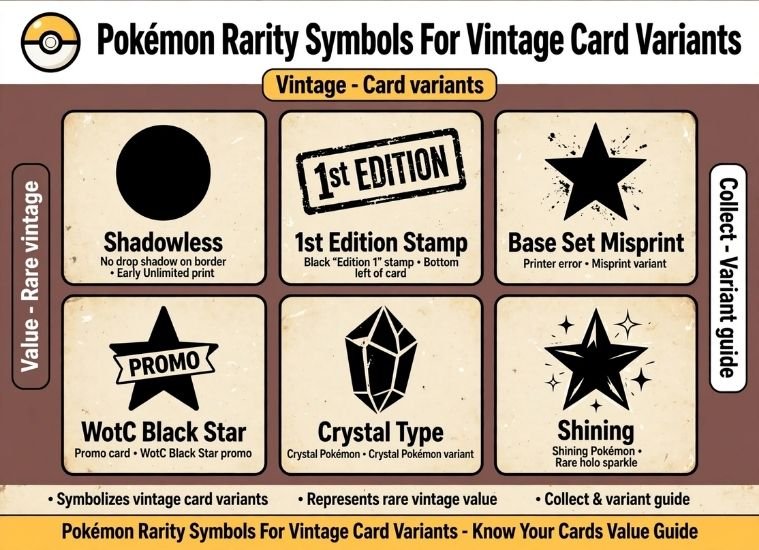
Vintage Pokémon cards can have important differences that are not always shown through a simple rarity symbol. Printing features, edition marks, holographic patterns, and set symbols can all help identify a particular version.
| Name | Meaning | Description |
| First Edition Stamp | First printing | The First Edition stamp identifies certain early Pokémon TCG printings. |
| Shadowless Variant | Printing difference | Shadowless Base Set cards lack the shadow that normally appears around the Pokémon illustration frame. |
| Unlimited Variant | Standard printing | Unlimited cards are printings that do not carry the First Edition designation. |
| No Rarity Variant | Japanese variation | Some early Japanese Pokémon cards lack the usual rarity symbol, creating a notable vintage variant. |
| Base Set Holo | Vintage holographic | Base Set Holo cards combine the early card design with a holographic artwork area. |
| Base Set Non-Holo | Vintage Rare | Some Base Set Rare cards do not have a holographic artwork area despite carrying Rare classification. |
| Jungle 1st Edition | Early printing | First Edition Jungle cards carry the relevant edition marking and belong to the Jungle expansion. |
| Fossil 1st Edition | Early printing | First Edition Fossil cards are early printings from the Fossil expansion. |
| Rocket 1st Edition | Early Team Rocket card | These cards belong to the First Edition printing of the Team Rocket expansion. |
| Gym Heroes 1st Edition | Early Gym card | First Edition Gym Heroes cards belong to the early printing of the Gym Heroes expansion. |
| Gym Challenge 1st Edition | Early Gym card | These cards are First Edition printings from the Gym Challenge expansion. |
| Neo Genesis 1st Edition | Neo-era printing | First Edition Neo Genesis cards belong to the earliest printing of the Neo Genesis expansion. |
| Neo Discovery 1st Edition | Neo-era printing | These cards are First Edition versions from Neo Discovery. |
| Neo Revelation 1st Edition | Neo-era printing | First Edition Neo Revelation cards carry the early-printing designation. |
| Neo Destiny 1st Edition | Neo-era printing | These cards are First Edition versions from the Neo Destiny expansion. |
| Legendary Collection Reverse Holo | Special foil | Legendary Collection is famous for its distinctive reverse-holographic pattern. |
| Expedition Reverse Holo | E-Reader foil | Expedition reverse-holographic cards use the special e-Reader era card design. |
| Aquapolis Reverse Holo | E-Reader foil | Aquapolis reverse-holographic cards combine the expansion design with a reflective treatment. |
| Skyridge Reverse Holo | E-Reader foil | Skyridge reverse-holographic cards have a distinctive vintage e-Reader appearance. |
| Crystal Pokémon | Special vintage rarity | Crystal Pokémon cards are special cards from the EX-era period with distinctive artwork and mechanics. |
| Gold Star | Shiny Pokémon | Gold Star cards feature shiny Pokémon and are among the most recognizable vintage premium cards. |
| EX Ruby Sapphire Holo | EX-era rarity | Holographic cards from this era use the EX-series design and traditional rarity classifications. |
| EX Sandstorm Holo | EX-era rarity | These holographic cards belong to the Sandstorm expansion from the EX era. |
| EX Team Rocket Returns Holo | EX-era rarity | These cards combine holographic treatment with the Team Rocket Returns expansion design. |
| EX Deoxys Holo | EX-era rarity | Holographic cards from EX Deoxys are part of the distinctive EX-era card pool. |
| EX Emerald Holo | EX-era rarity | These holographic cards come from the EX Emerald expansion. |
| EX Unseen Forces Holo | EX-era rarity | Holographic cards from this set feature the visual style associated with the Unseen Forces expansion. |
| EX Delta Species Holo | Special type theme | Holographic cards from EX Delta Species feature the set’s unusual Pokémon typing theme. |
| EX Legend Maker Holo | EX-era rarity | These holographic cards belong to the Legend Maker expansion. |
| EX Holon Phantoms Holo | EX-era rarity | Holon Phantoms cards are known for their unusual Pokémon themes and EX-era design. |
How Pokémon Rarity Symbols Help Collectors
Rarity symbols make it easier to sort a Pokémon card collection. They can also help when checking a set checklist, identifying special cards, or comparing different versions of a Pokémon.
A rarity symbol does not automatically tell you the price of a card. A highly rare card can have low demand, while a popular Pokémon with attractive artwork may be much more sought after. Condition, set, printing, artwork, popularity, and collector demand can all affect interest.
FAQs About Pokémon Rarity Symbols
Q1: What are Pokémon rarity symbols?
A1: Pokémon rarity symbols are markings printed on Pokémon Trading Card Game cards to show their rarity level, such as Common, Uncommon, or Rare.
Q2: What are the common Pokémon rarity symbols?
A2: The traditional Pokémon TCG rarity symbols include a circle for Common, diamond for Uncommon, and star for Rare. Newer card sets may also use additional rarity indicators.
Q3: What does the star symbol mean on a Pokémon card?
A3: A star traditionally indicates that a Pokémon card is Rare. However, special sets can use different star-based markings for higher rarity levels.
Q4: How can I identify a Pokémon card’s rarity?
A4: Look for the rarity symbol or rarity marking, usually printed near the bottom of the card. The exact system can vary between Pokémon TCG sets and card eras.
Q5: Do Pokémon rarity symbols affect card value?
A5: Yes, rarity can influence a card’s value, but condition, demand, print variations, popularity, and the specific set also play important roles.
Q6: Are Pokémon rarity symbols the same in every set?
A6: No. Pokémon TCG rarity systems have changed over time, so symbols and rarity classifications can differ between older and newer sets.