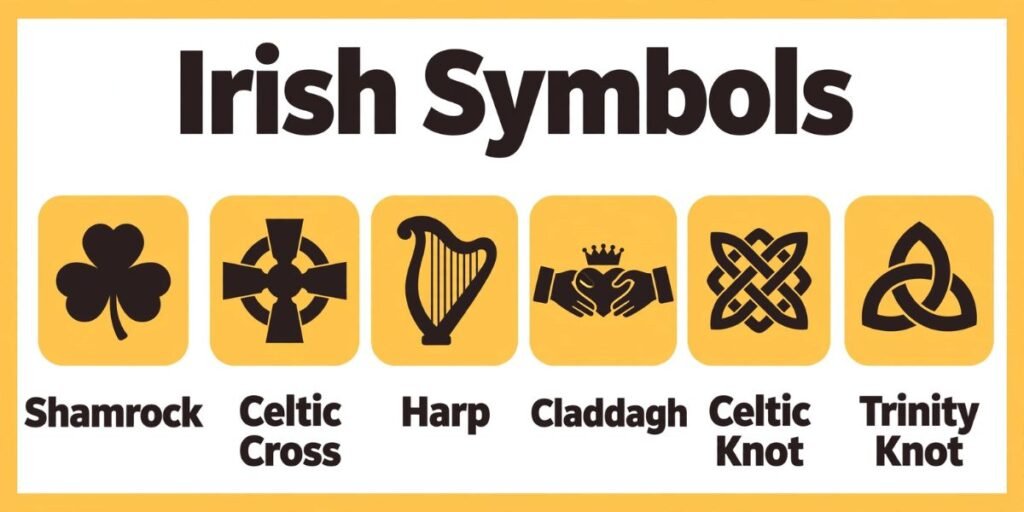
When you think of Ireland, what do you think of? A green landscape, an old castle, traditional music and the famous shamrock? Irish symbols relate to the history, culture, religions, landscapes and people of Ireland. Some of the symbols have ancient Celtic origins, others have become significant due to Irish Christianity, national history and current Irish identity.
The shamrock is associated with Ireland and the harp is featured on the Irish state flag and coin. The Celtic knotwork is loved for its connected designs and the Claddagh for its heart, hands and crown. The Irish flag, round towers, Celtic crosses and Irish wolfhound are other symbols that represent various aspects of the nation’s history.
This guide is designed to teach you in an easy to understand way what are meaningful symbols in Ireland. It also explores what they symbolize and why they are still popular in jewelry, tattoos, art, and Irish cultural designs throughout the world, in celebrations and in clothing.
Irish National Symbols
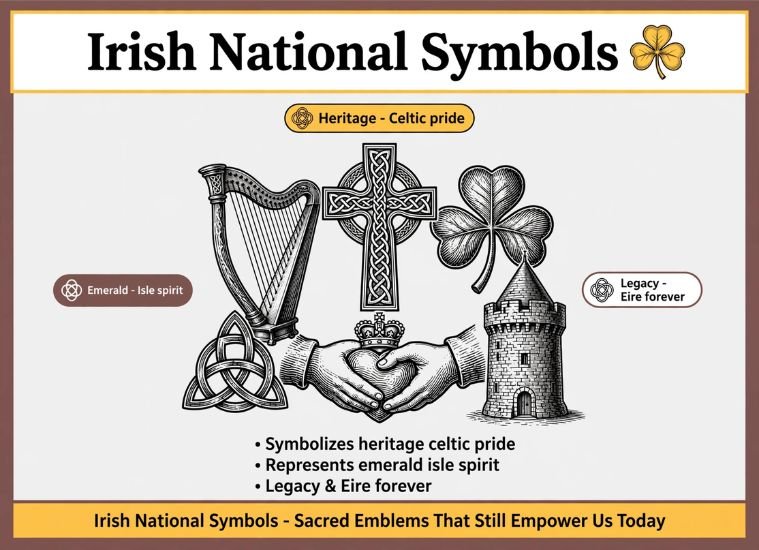
Ireland has several symbols strongly connected with national identity. Some are official state symbols, while others are widely recognized cultural signs. Together, they reflect Irish history, language, heritage, and the country’s connection with its people.
| Name | Meaning | Description |
| Irish Harp | National identity | The harp is a major symbol of Ireland and appears on the coat of arms of the state. |
| Shamrock | Irish heritage | The shamrock is strongly associated with Ireland and is traditionally linked with Saint Patrick. |
| Irish Tricolour | Unity and peace | The green, white, and orange flag represents different traditions and the hope for peaceful relations. |
| Celtic Cross | Faith and heritage | The Celtic cross combines a Christian cross with a distinctive circular design associated with Celtic art. |
| Claddagh | Love and loyalty | The Claddagh features a heart, hands, and crown, commonly associated with love, friendship, and loyalty. |
| Irish Wolfhound | Strength and heritage | The Irish wolfhound is an ancient breed strongly associated with Ireland’s cultural and historical traditions. |
| Celtic Knot | Continuity | Interwoven Celtic designs are widely used to represent connection, continuity, and Irish artistic heritage. |
| Harp of Brian Boru | Historical heritage | The medieval harp displayed at Trinity College Dublin is traditionally associated with Brian Boru and Irish history. |
| Irish Coat of Arms | State identity | The coat of arms of Ireland features a golden harp on a blue background. |
| Irish Presidential Seal | State authority | The seal is connected with the office of the President of Ireland and official state functions. |
| National Flag | Irish nation | The tricolour serves as the national flag and is one of Ireland’s most recognizable symbols. |
| Green Color | Irish identity | Green has become strongly associated with Ireland, especially through Irish cultural and national traditions. |
| White Color | Peace | White forms the central stripe of the Irish tricolour and is traditionally associated with peace between traditions. |
| Orange Color | Protestant tradition | Orange represents the tradition associated with William of Orange and Irish Protestants in the symbolism of the flag. |
| Irish Language | Cultural heritage | Irish, or Gaeilge, is a national and first official language of Ireland and represents an important part of Irish culture. |
| Éire | Irish identity | Éire is the Irish-language name for Ireland and appears in official and cultural contexts. |
| Irish Passport | National citizenship | The Irish passport represents citizenship and Ireland’s place within the international community. |
| National Anthem | National pride | Amhrán na bhFiann is the national anthem of Ireland and is used at important national events. |
| Irish State Emblem | National authority | The harp serves as the official emblem of the Irish state. |
| Irish Euro Coins | National identity | Irish euro coins feature the harp as their national design on the common European currency. |
Irish Symbols
Search an Irish symbol to learn what it represents.
Shamrock
Explore the cultural meanings and heartfelt ideas connected to symbols of love expressions and learn how these meaningful designs represent affection, connection, and devotion.
Irish Celtic Symbols
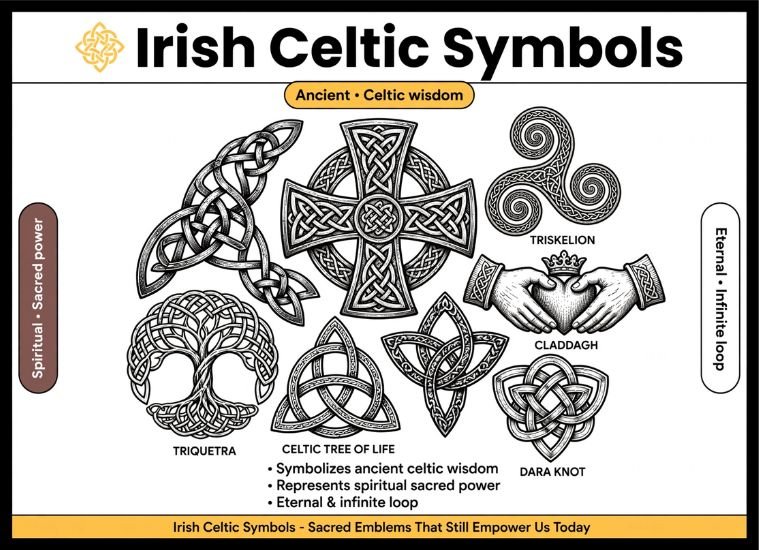
Celtic symbols are closely associated with Ireland’s artistic heritage. Many use repeating lines, spirals, circles, and interwoven patterns. Their modern meanings are sometimes broader than their original historical meanings, so it is useful to separate ancient evidence from later interpretations.
| Name | Meaning | Description |
| Triskele | Movement | The triskele is a three-armed spiral design found in ancient Celtic contexts and often associated with movement or cycles today. |
| Triquetra | Threefold design | The triquetra is a three-pointed knot form used in medieval Christian manuscripts and later Celtic-inspired art. |
| Spiral Motif | Growth | Spiral designs are found in prehistoric Irish monuments and are often interpreted through ideas of movement and cycles. |
| Triple Spiral | Cycles | The triple spiral at Newgrange is one of Ireland’s best-known prehistoric artistic motifs. |
| La Tène Pattern | Celtic art | La Tène artistic traditions influenced the decorative style of Celtic objects across parts of Europe. |
| Interlaced Knotwork | Connection | Interlaced patterns became a major feature of medieval Insular art and remain popular in Irish-inspired designs. |
| Zoomorphic Knot | Animal heritage | Some Celtic-style manuscripts and artworks combine interlacing with animal forms. |
| Serpent Pattern | Transformation | Serpentine forms appear in Celtic and Insular art, although their meanings varied across periods and objects. |
| Celtic Spiral | Continuity | Spiral motifs appear in prehistoric Irish art and are often used today as symbols of continuous movement. |
| Three Spiral Design | Repetition | Repeated spiral forms can be seen in prehistoric Irish monuments and later Celtic-inspired artwork. |
| Interwoven Band | Unity | Interlaced bands create continuous patterns that are commonly used in Irish decorative art. |
| Celtic Border | Heritage | Repeating knot borders are widely associated with Irish and broader Insular artistic traditions. |
| Animal Interlace | Artistic tradition | Interlaced animal forms appear in medieval manuscript decoration and metalwork. |
| Spiral Stone Carving | Ancient heritage | Carved spirals on prehistoric Irish monuments provide evidence of Ireland’s early symbolic art. |
| Knotwork Circle | Continuity | Circular knotwork combines an enclosed shape with continuous interlacing. |
| Triple Knot | Threefold pattern | Three-part knot designs are common in modern Celtic-inspired jewelry and artwork. |
| Celtic Wave | Movement | Curving patterns inspired by Celtic art are often used to suggest flowing movement. |
| Celtic Vine | Growth | Vine-like interlacing is frequently used in modern Celtic decorative designs. |
| Interlaced Cross | Faith and heritage | Celtic-inspired crosses often combine Christian imagery with traditional interwoven decoration. |
| Celtic Shield Knot | Protection | The shield knot is a modern name for a type of Celtic-inspired interlaced design often used in protective imagery. |
Explore the magical stories and visual details connected to Harry Potter symbols iconography and learn how these recognizable designs contribute to the identity of the wizarding world.
Irish Christian Symbols
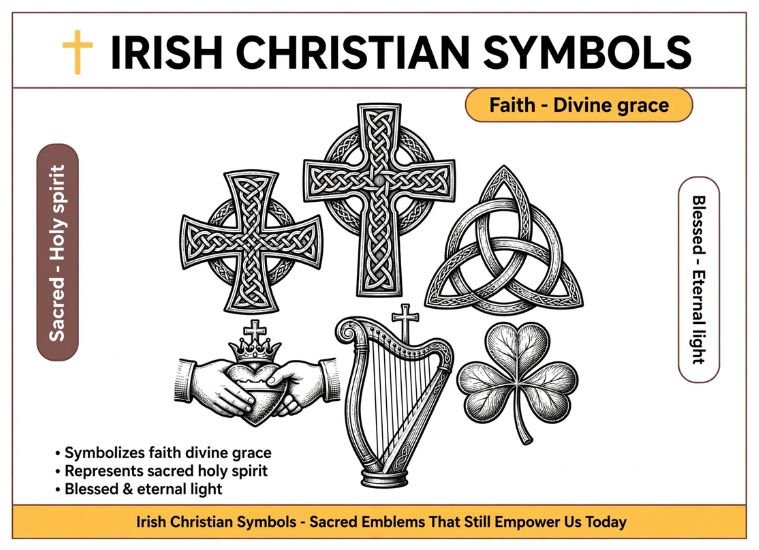
Christianity has played a major role in Irish history. Monasteries, illuminated manuscripts, stone crosses, churches, and saints all contributed to Ireland’s religious and artistic heritage. Several Irish symbols combine Christian ideas with local artistic traditions.
| Name | Meaning | Description |
| Saint Patrick’s Cross | Christianity | Cross designs associated with Saint Patrick reflect Ireland’s long Christian tradition. |
| High Cross | Faith | Ireland’s high stone crosses were important religious monuments and often contain biblical scenes. |
| Celtic High Cross | Christian heritage | These crosses combine Christian imagery with distinctive Irish and Insular stone carving. |
| Chi Rho | Christ | The Chi Rho monogram represents Christ and appears prominently in early Christian manuscripts. |
| Book of Kells Cross | Faith and art | Cross imagery in the Book of Kells demonstrates the rich decoration of medieval Irish Christian manuscripts. |
| Saint Patrick’s Saltire | Historical association | The red saltire is associated with Saint Patrick in later heraldic tradition, although its connection to the saint is debated historically. |
| Shepherd’s Crook | Christian leadership | Croziers used by bishops became important objects in Irish Christian history. |
| Pastoral Staff | Religious authority | The pastoral staff represents the office and responsibility of a bishop. |
| Monastic Bell | Worship | Bells were important in Irish monasteries for marking prayer and community activities. |
| Irish Gospel Book | Christian learning | Decorated gospel books represent Ireland’s medieval tradition of religious scholarship and manuscript art. |
| Saint Brigid’s Cross | Protection | Saint Brigid’s Cross is traditionally associated with Brigid and is commonly displayed in Irish homes. |
| Brigid’s Cross | Irish tradition | Made traditionally from rushes, the cross remains a recognizable Irish cultural and Christian symbol. |
| Crosier | Faith and authority | Irish medieval crosiers were ceremonial objects connected with religious leaders and monasteries. |
| Monastic Cross | Spiritual heritage | Stone crosses found at historic monastic sites reflect Ireland’s early Christian landscape. |
| Latin Cross | Christianity | The Latin cross is a central Christian symbol and appears throughout Irish churches and monuments. |
| Saint Patrick | Irish Christianity | Saint Patrick is Ireland’s best-known patron saint and is strongly connected with Irish Christian heritage. |
| Saint Brigid | Faith and tradition | Saint Brigid is one of Ireland’s most important saints and is associated with both Christian and older Irish traditions. |
| Saint Columba | Monastic heritage | Saint Columba was an influential Irish monk and missionary associated with early medieval Christianity. |
| Monastic Round Tower | Religious heritage | Irish round towers were built at medieval monastic sites and are important parts of Ireland’s Christian landscape. |
| Illuminated Manuscript | Scholarship | Decorated manuscripts such as the Book of Kells represent Ireland’s medieval tradition of religious learning and artistic craftsmanship. |
Explore the powerful ideas and qualities associated with symbols of strength qualities and learn how these meaningful designs can represent courage, resilience, and inner power.
Irish Symbols Of Luck And Protection
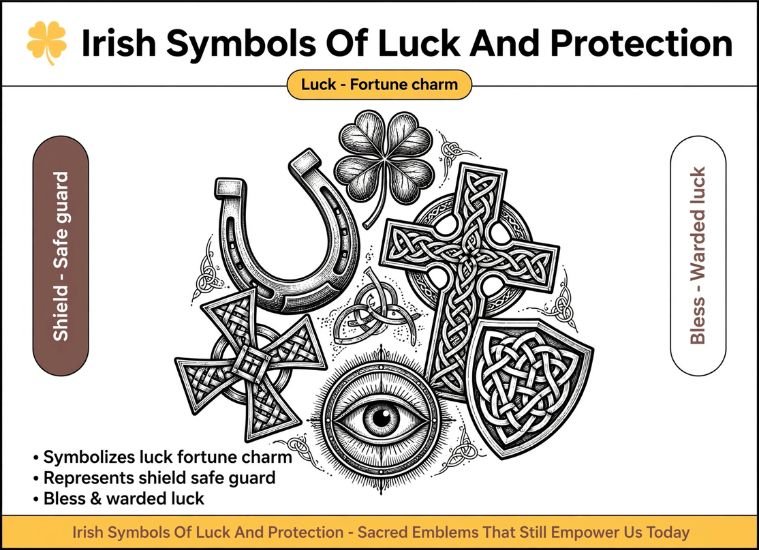
Several symbols are commonly connected with good fortune, protection, and positive wishes. Some have strong links to Irish folklore, while others became popular through later cultural traditions. Their modern meanings can be different from their earliest historical use.
| Name | Meaning | Description |
| Four-Leaf Clover | Good luck | A four-leaf clover is widely recognized as a symbol of good fortune, although it should not be confused with Ireland’s traditional shamrock. |
| Horseshoe | Luck | Horseshoes have long been associated with good fortune in European folklore and became popular in Irish decorative traditions. |
| Leprechaun | Folklore | The leprechaun is a famous figure in Irish folklore and later became strongly connected with ideas of luck and hidden treasure. |
| Pot of Gold | Fortune | The pot of gold is a modern folklore image associated with the leprechaun and the end of the rainbow. |
| Rainbow | Hope | The rainbow is commonly linked with the leprechaun story and the idea of finding treasure. |
| Oak Leaf | Strength | Oak trees have long been valued for their strength, and oak imagery can represent endurance and protection. |
| Rowan Tree | Protection | Rowan has a long history in Irish and wider Celtic folklore, where it was associated with protection. |
| Holly | Protection | Holly appears in Irish folklore and European traditions with associations involving protection and winter. |
| Hawthorn | Folklore | Hawthorn trees hold an important place in Irish folklore and traditional beliefs about special places. |
| Ash Tree | Strength | Ash trees have historical and cultural importance in Ireland and are associated with traditional tools and folklore. |
| Hazel Tree | Wisdom | Hazel has strong associations with wisdom in Irish mythology and traditional stories. |
| Salmon | Wisdom | The Salmon of Knowledge is an important figure in Irish mythology and is associated with wisdom and learning. |
| White Stag | Mystery | The white stag appears in Celtic and Irish folklore as a remarkable and unusual creature. |
| Swan | Transformation | Swans appear in Irish mythology, including stories involving transformation and enchanted people. |
| Raven | Prophecy | Ravens and similar birds appear in Irish mythology and can be associated with battle, prophecy, and supernatural events. |
| Boar | Courage | The boar appears in Irish mythology and heroic stories and can represent strength and bravery. |
| Deer | Nature | Deer appear in Irish mythology and folklore and are often connected with the wilderness and the supernatural. |
| Bee | Community | Bees have been valued in Irish rural traditions and can represent cooperation and productive community life. |
| Oak Acorn | Potential | An acorn can represent the beginning of something that may grow into something strong and lasting. |
| Sea Shell | Protection | Shells have associations with the sea and are sometimes used in Irish-inspired designs connected with coastal heritage. |
Explore the seasonal customs and cultural ideas connected to Christmas symbols celebrations and learn how these familiar designs have become meaningful parts of holiday celebrations.
Irish Symbols Of Nature
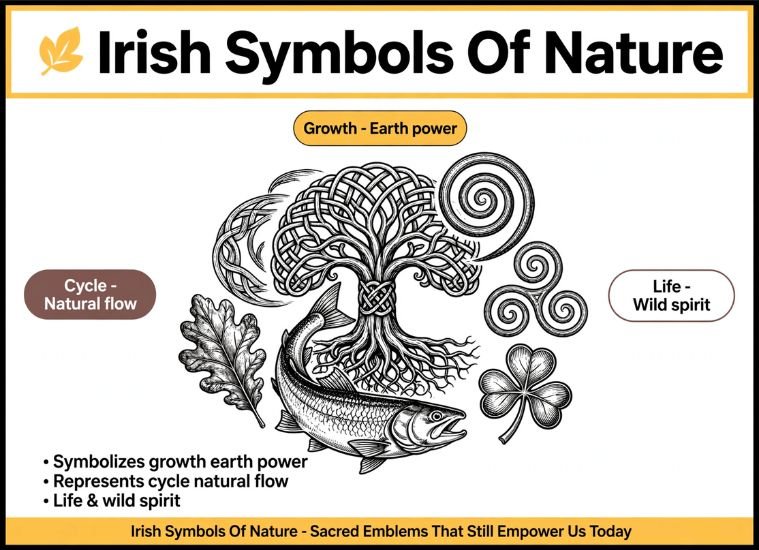
Nature has a strong place in Irish culture, folklore, and landscape. Trees, flowers, animals, and natural features appear in old stories and modern Irish designs. These symbols can represent strength, beauty, wisdom, protection, and connection with the land.
| Name | Meaning | Description |
| Irish Hare | Wild heritage | The Irish hare is native to Ireland and is an important part of the country’s natural wildlife. |
| Red Deer | Wilderness | Red deer have lived in Ireland for centuries and are associated with forests, mountains, and the natural landscape. |
| Salmon Of Knowledge | Wisdom | This famous figure from Irish mythology gains wisdom after eating magical hazelnuts and becomes connected with knowledge. |
| Hazel Tree | Wisdom | Hazel has an important place in Irish mythology and is associated with knowledge and inspiration. |
| Rowan Tree | Protection | Rowan trees appear in Irish folklore and were traditionally associated with protective qualities. |
| Hawthorn Tree | Folklore | Hawthorn trees have a special place in Irish tradition and are sometimes associated with fairy folklore. |
| Ash Tree | Strength | Ash has long been important in Ireland for practical uses and appears in traditional folklore. |
| Oak Tree | Endurance | The oak represents strength and long-lasting growth and has strong connections with Ireland’s woodland heritage. |
| Willow Tree | Reflection | Willow trees are associated with water, flexibility, and gentle natural beauty. |
| Heather | Landscape | Heather is strongly associated with Irish hills and upland landscapes and adds color to the countryside. |
| Wild Rose | Beauty | Wild roses can represent the natural beauty of the Irish countryside. |
| Bluebell | Spring | Bluebells are associated with woodland landscapes and the arrival of spring. |
| Shamrock Flower | Irish heritage | The shamrock is a famous Irish plant and is strongly connected with Irish cultural identity. |
| Seaweed | Coastal life | Seaweed reflects Ireland’s long coastline and the importance of the sea in Irish communities. |
| Atlantic Wave | Ocean heritage | Waves represent Ireland’s relationship with the Atlantic Ocean and its coastal landscape. |
| Cliffs | Strength | Ireland’s cliffs can represent the dramatic power and beauty of the country’s coastline. |
| Green Hills | Irish landscape | Green hills are a familiar part of Ireland’s countryside and have become an important visual image of the country. |
| Stone Landscape | Ancient heritage | Ireland’s stone walls and monuments connect the natural landscape with centuries of human history. |
| River Shannon | Heritage | The Shannon is Ireland’s longest river and has major geographical and cultural importance. |
| Atlantic Sea | Coastal identity | The Atlantic Ocean has shaped Ireland’s history, trade, communities, and landscape. |
Explore the faith, history, and visual traditions connected to Catholic symbols heritage and learn how these meaningful designs reflect important aspects of Catholic tradition.
Irish Symbols Of Mythology
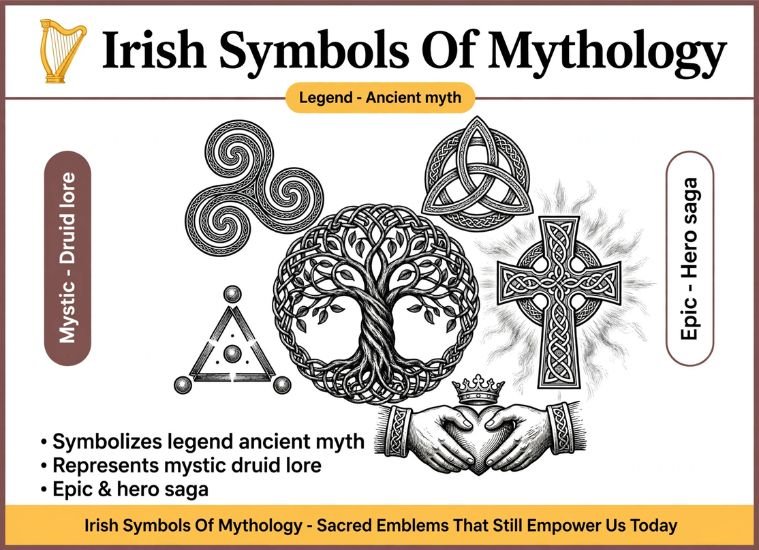
Irish mythology contains heroes, supernatural beings, magical animals, and legendary objects. These stories were passed down through generations and remain an important part of Irish cultural heritage. Many modern Irish designs draw inspiration from these traditional figures.
| Name | Meaning | Description |
| Cú Chulainn | Heroism | Cú Chulainn is one of the best-known heroes of the Ulster Cycle and is famous for his bravery. |
| Fionn Mac Cumhaill | Wisdom | Fionn is a major figure in the Fenian Cycle and is closely connected with stories of knowledge and heroic deeds. |
| Brigid | Inspiration | Brigid is an important figure in Irish tradition and later became associated with Saint Brigid. |
| The Morrígan | Power | The Morrígan is a powerful figure in Irish mythology associated with war, fate, and sovereignty. |
| Lugh | Skill | Lugh is a major figure of the Tuatha Dé Danann and is associated with many skills and talents. |
| Dagda | Leadership | The Dagda is an important member of the Tuatha Dé Danann and is portrayed as a powerful and influential figure. |
| Nuada | Kingship | Nuada is a king of the Tuatha Dé Danann and is connected with leadership and heroic tradition. |
| Manannán mac Lir | Sea | Manannán is a supernatural figure strongly associated with the sea and the Otherworld. |
| Danu | Ancestry | Danu is traditionally presented as a mother figure connected with the Tuatha Dé Danann, although details about her are limited in surviving sources. |
| Medb | Sovereignty | Queen Medb is a major figure in the Ulster Cycle and is remembered for her power and ambition. |
| Deirdre | Tragedy | Deirdre is a famous figure in Irish legend whose story is associated with love, loss, and tragedy. |
| Gráinne | Independence | Gráinne is a major figure in the Fenian Cycle and is associated with the story of Diarmuid and Gráinne. |
| Diarmuid | Loyalty | Diarmuid is a heroic figure in Irish mythology, especially known from the Fenian tradition. |
| Oisín | Poetry | Oisín is a famous poet and warrior in the Fenian Cycle and the son of Fionn Mac Cumhaill. |
| Tír na nÓg | Eternal youth | Tír na nÓg is a legendary Otherworld associated with youth and an enchanted existence. |
| Sídhe | Otherworld | The sídhe are supernatural beings connected with Irish folklore and the Otherworld. |
| Púca | Mystery | The púca is a shape-shifting creature found in Irish folklore and is often portrayed as unpredictable. |
| Banshee | Warning | The banshee is a supernatural figure in Irish folklore associated with a mournful cry and death omens. |
| Leprechaun | Folklore | The leprechaun is a famous Irish folklore figure traditionally associated with a small supernatural being. |
| Selkie | Transformation | Selkies appear in Irish and wider Celtic folklore as beings that can change between seal and human forms. |
Explore the characters, stories, and visual details connected to Star Wars symbols themes and see how these recognizable designs reflect important ideas throughout the galaxy.
Irish Symbols Of History And Heritage
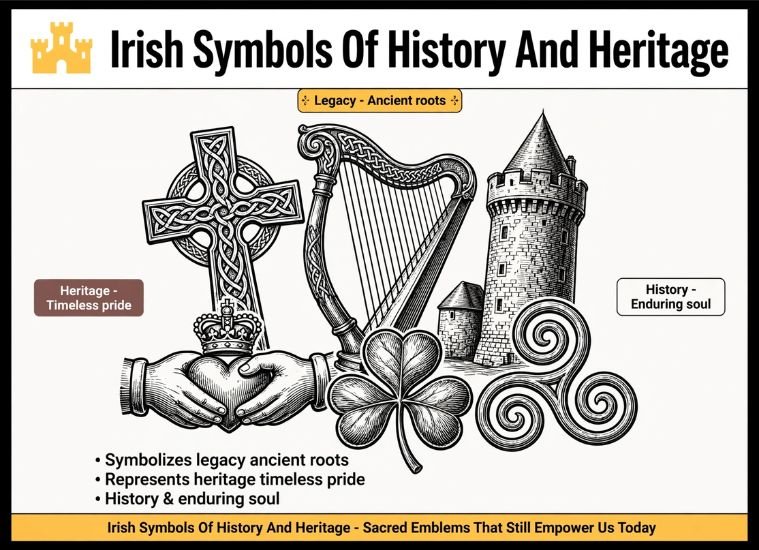
Ireland’s history is reflected in its monuments, manuscripts, buildings, music, and traditional objects. These symbols connect modern Ireland with earlier generations. They also help preserve stories about religion, education, art, politics, and everyday life.
| Name | Meaning | Description |
| Newgrange | Ancient heritage | Newgrange is a prehistoric passage tomb in County Meath and one of Ireland’s most famous archaeological monuments. |
| Book Of Kells | Medieval art | The Book of Kells is a richly decorated illuminated manuscript and an important example of Insular art. |
| Round Tower | Monastic heritage | Irish round towers were built at medieval monastic sites and are distinctive features of Ireland’s historic landscape. |
| Ogham Stones | Early writing | Ogham stones contain inscriptions using the early medieval Ogham writing system. |
| Hill Of Tara | Kingship | Tara is an important archaeological and legendary site associated with the high kings of Ireland. |
| Rock Of Cashel | Religious history | The Rock of Cashel is a historic site with major connections to medieval Irish religious and political history. |
| Blarney Stone | Folklore | The Blarney Stone is associated with the famous tradition of gaining eloquence by kissing it. |
| Irish Bell | Monastic tradition | Early Irish bells are associated with Christian monasteries and religious communities. |
| Celtic Brooch | Craftsmanship | Decorative brooches were important objects in early medieval Ireland and demonstrate skilled metalwork. |
| Torc | Status | Torcs were neck rings used in ancient Celtic societies and are associated with status and personal adornment. |
| Ogham Script | Language | Ogham is an early Irish writing system found mainly on standing stones. |
| Stone Circle | Ancient landscape | Stone circles are prehistoric monuments found in several parts of Ireland and remain important archaeological sites. |
| Dolmen | Prehistoric burial | Dolmens are megalithic structures associated with prehistoric communities and burial traditions. |
| High Cross | Christian heritage | Ireland’s high crosses combine religious themes with detailed stone carving. |
| Monastic Ruins | Religious heritage | Historic monastic ruins preserve evidence of Ireland’s medieval religious communities. |
| Celtic Manuscript | Learning | Illuminated manuscripts show the importance of writing, scholarship, and artistic decoration in medieval Ireland. |
| Traditional Harp | Music | The harp has been central to Irish musical tradition and became an important national symbol. |
| Bodhrán | Irish music | The bodhrán is a traditional Irish frame drum commonly used in Irish folk music. |
| Uilleann Pipes | Irish music | Uilleann pipes are a distinctive Irish bagpipe tradition with a major place in Irish music. |
| Cláirseach | Harp tradition | Cláirseach refers to the Irish harp tradition and connects the instrument with Ireland’s musical heritage. |
Irish Symbols Of Love And Friendship
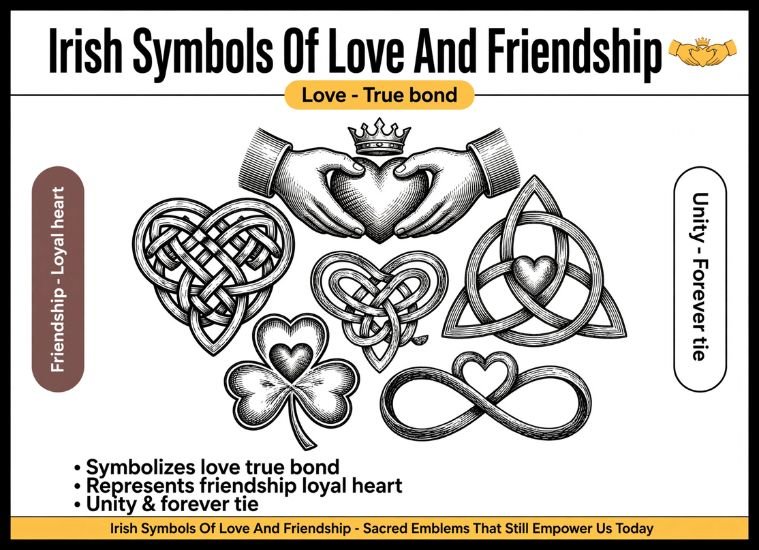
Irish culture has several designs associated with relationships and personal bonds. Some are traditional, while others became popular through later jewelry and decorative traditions. These symbols are especially common in rings, necklaces, wedding designs, and gifts.
| Name | Meaning | Description |
| Claddagh Heart | Love | The heart at the center of the Claddagh design represents love. |
| Claddagh Hands | Friendship | The hands surrounding the heart are commonly interpreted as friendship and support. |
| Claddagh Crown | Loyalty | The crown above the heart is traditionally associated with loyalty. |
| Celtic Love Knot | Connection | Interwoven knotwork is often used in modern Irish-inspired designs to represent a lasting bond. |
| Irish Wedding Bell | Marriage | Wedding bells are commonly associated with marriage, celebration, and a new life together. |
| Handfasting Cord | Commitment | Handfasting is a historical marriage-related tradition, and cords are used in some modern ceremonies inspired by it. |
| Irish Wedding Ring | Partnership | Irish-inspired wedding rings often incorporate Claddagh or Celtic designs to represent commitment. |
| Celtic Heart Knot | Affection | Heart-shaped knotwork combines a familiar love symbol with Irish-inspired interlacing. |
| Matching Celtic Rings | Unity | Matching rings can represent two people sharing a relationship and a common commitment. |
| Irish Friendship Knot | Companionship | Interwoven designs are often chosen to represent a friendship that remains connected over time. |
| Celtic Heart Pendant | Love | A heart pendant with Celtic-style decoration combines affection with Irish artistic influences. |
| Claddagh Pendant | Devotion | A Claddagh pendant carries the traditional heart, hands, and crown design close to the wearer. |
| Celtic Heart Bracelet | Connection | Celtic-inspired heart bracelets are commonly used as gifts representing affection and closeness. |
| Irish Love Charm | Affection | Irish-inspired charms can combine hearts, knots, or traditional motifs to create personal jewelry. |
| Celtic Knot Bracelet | Continuity | Continuous interwoven patterns are often used to represent an ongoing connection. |
| Irish Heart Locket | Memory | A heart-shaped locket can hold a photograph or keepsake connected with someone important. |
| Celtic Infinity Knot | Enduring bond | Modern Celtic-inspired infinity designs combine continuous lines with the idea of lasting connection. |
| Irish Couple Pendant | Partnership | Matching pendants can serve as a personal reminder of a shared relationship. |
| Celtic Promise Ring | Commitment | Celtic knotwork can be incorporated into promise rings to create a meaningful relationship design. |
| Irish Family Knot | Family unity | Interwoven patterns can represent family members remaining connected through generations. |
FAQs About Irish Symbols
Q1: What are Irish symbols?
A1: Irish symbols are signs, designs, plants, and objects connected with Ireland’s history, culture, folklore, and traditions.
Q2: What are some common Irish symbols?
A2: Common Irish symbols include the shamrock, Celtic knot, Claddagh, Celtic cross, harp, and tricolour flag.
Q3: What does the shamrock symbolize in Ireland?
A3: The shamrock is strongly associated with Ireland and Saint Patrick. According to tradition, Saint Patrick used its three leaves to explain the Christian concept of the Trinity.
Q4: What does the Claddagh symbol mean?
A4: The Claddagh design features a heart, crown, and hands, traditionally representing love, loyalty, and friendship.
Q5: Why are Irish symbols important?
A5: Irish symbols help represent Ireland’s cultural heritage, historical traditions, folklore, and national identity.
Q6: Where can Irish symbols be found?
A6: Irish symbols can be found in jewelry, artwork, clothing, architecture, celebrations, flags, manuscripts, and traditional crafts.