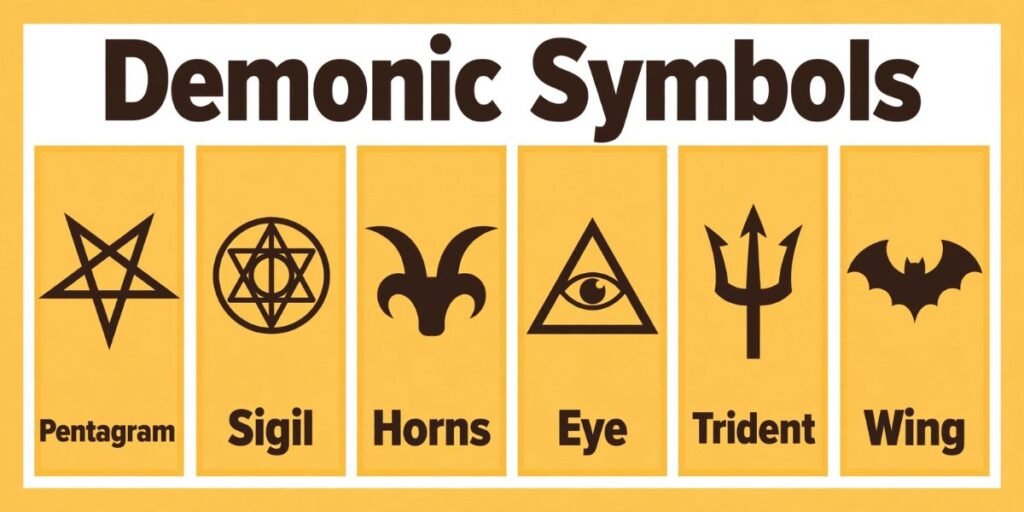
When you hear the term “demonic symbols”, what do you think? These enigmatic markings have also been seen in folklore, religious scriptures, horror stories, historical paintings and contemporary media. Some have demonic, evil spirit, temptation, or supernatural connotations, and others have meanings which are culture and time specific.
These symbols have to be understood and not simply identified by the shapes. They may have different meanings for people because they come from different cultures and religions and were used in different ways in the past. Some images are of ancient origin, others were added to the demonic story because of their later appearances in books, film or popular culture.
This guide contains information on common demonic symbols, their alleged significance and beliefs associated with them. It also distinguishes historical facts from myth and contemporary explanations, allowing readers to grasp the topic without being misled by the cultural symbolism involved in the historical facts and the proven supernatural claims.
Demonic Symbols And Their Meanings
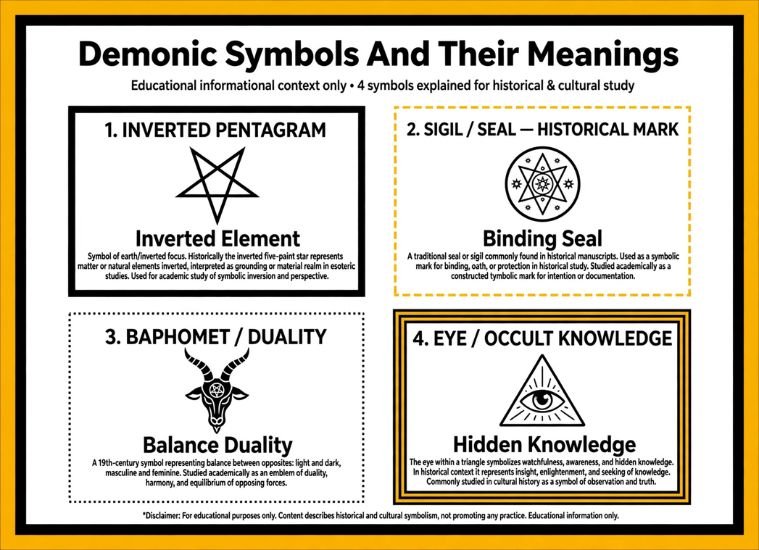
Demonic symbols are signs that people have linked to evil spirits, dark forces, or opposition to the divine. Their meanings depend on who is using them and in what setting. A symbol can stand for fear, rebellion, protection, or a warning.
To understand one properly, you need to look at its history and not just how it looks today. Many of these symbols also carry more than one meaning at the same time.
A shape that scares one person can be a harmless emblem to another. Context, culture, and intent all change how a symbol should be read. That’s why a quick image search rarely tells you the full story.
| Icon | Symbol | Meaning | Origin | Description |
| ⛧ | Inverted Pentagram | Rebellion, matter over spirit | 19th-century occultism (Éliphas Lévi) | A five-pointed star with two points up, often in a circle. |
| 🐐 | Sigil of Baphomet | Duality, forbidden knowledge | Lévi’s 1856 drawing; Church of Satan (1969) | A goat’s head inside an inverted pentagram, ringed by Hebrew letters. |
| 🌅 | Sigil of Lucifer | Light-bringer, pride, defiance | Grimoires such as the Grimorium Verum | A geometric mark with a horned or crossed form. |
| ♾️ | Leviathan Cross | Balance of sulfur and infinity | Alchemy, popularized in modern Satanism | A double-barred cross over an infinity sign. |
| 🜍 | Alchemical Sulfur | Fire, corruption, brimstone | Medieval alchemy | A cross beneath a triangle, tied to hellfire. |
Learn how each planet is represented in astrology and astronomy with this guide to Planet Symbols meanings and explore the history and significance of these familiar planetary signs.
Different Types Of Demonic Symbols
Demonic symbols fall into a few main groups. Some are sigils tied to a single spirit, others are shapes like inverted crosses and stars, and others are creatures or hybrid beasts.
Each type serves a different purpose, from identifying a spirit to representing a belief. Sorting them by type makes it much easier to study them.
Sigils are usually unique marks, often built from lines and letters. Geometric symbols tend to be simple and easy to recognize. Animal and creature symbols rely on a feeling, like fear, cunning, or power. Knowing the type helps you guess what the symbol was meant to do.
| Icon | Symbol | Meaning | Origin | Description |
| 🪰 | Sigil of Beelzebub | Lord of the Flies, decay | Biblical name; later grimoires | A line-and-loop sigil linked to plague and filth. |
| 💔 | Sigil of Asmodeus | Lust, wrath | Book of Tobit; Lesser Key of Solomon | An angular glyph for a demon of desire and destruction. |
| ⚔️ | Sigil of Belial | Worthlessness, lawlessness | Hebrew Bible; Dead Sea Scrolls | A sigil for a demon of deceit and rebellion. |
| 💰 | Sigil of Mammon | Greed, wealth | Matthew 6:24 | A mark tied to material obsession. |
| 🔥 | Sigil of Moloch | Sacrifice, fire | Canaanite and Hebrew Bible references | A fiery emblem linked to child-sacrifice accounts. |
Learn about the spiritual meaning and significance of baptism through these Baptism Symbols traditions.
Ancient Demonic Symbols And Their Origins
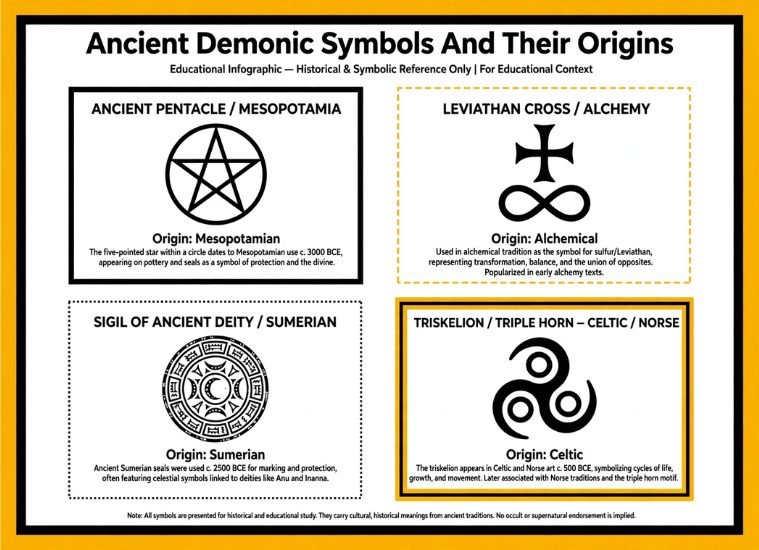
Many symbols now seen as demonic started out with very different meanings in ancient societies. Early cultures used horns, serpents, and star shapes to represent gods, nature, and the unknown.
Later religions often reframed those images as evil when they replaced older beliefs. Knowing the original meaning helps you separate real history from modern myth.
A horned figure, for example, once stood for fertility and the wild in many places. A snake could mean healing, wisdom, or danger depending on the region. Over time, stories and fear changed how people saw them. Tracing a symbol back to its roots often turns up a surprising first meaning.
| Icon | Symbol | Meaning | Origin | Description |
| 👹 | Pazuzu | King of wind demons, also a protector | Assyria and Babylon, 1st millennium BCE | A winged figure with a canine face. Amulets of him warded off other evils. |
| 🪦 | Lamashtu | Fear, illness, infant death | Mesopotamia | A lion-headed demoness with a spear and snakes. |
| 🐍 | Apep (Apophis) | Chaos, darkness | Ancient Egypt | A giant serpent that attacked Ra’s sun boat each night. |
| 🐉 | Tiamat | Primordial chaos | Babylonian Enuma Elish | A sea-dragon goddess, later seen as a monster. |
| 💀 | Nergal | Plague, war, death | Mesopotamia | The underworld god, shown with a lion’s features and weapons. |
Learn what common laboratory warning signs mean and how to recognize them with this Lab Safety Symbols guide.
Famous Demonic Symbols In History
A handful of symbols have become well known through books, art, and film. The inverted pentagram, the goat-headed figure, and the sigil of Lucifer show up again and again in popular culture.
Their fame often comes from how writers and artists used them, not from ancient practice. That is why many people know the image without knowing the story behind it.
Some became famous in the 19th century through occult writers and illustrators. Others spread quickly once horror movies and album covers picked them up.
Each time they were reused, the meaning shifted a little. Looking at when a symbol became popular tells you a lot about what people feared at the time.
| Icon | Symbol | Meaning | Origin | Description |
| 📜 | Seal of Solomon (Ars Goetia) | Control over 72 demons | 17th-century Lesser Key of Solomon | Seals for summoning and binding demons. |
| 🔱 | Devil’s Trident | Authority over hell | Medieval and Renaissance art | The pitchfork-like weapon in the Devil’s hand. |
| 🔤 | Sator Square | Protection, mystery | Roman-era Pompeii | A Latin palindrome square used as a charm, later linked to demons in folklore. |
| 🩸 | Witch’s / Devil’s Mark | Pact with the Devil | European witch trials, 15th–17th centuries | A mole or scar claimed as proof of a diabolical pact. |
| 🤘 | Sign of the Horns | Devil’s horns, rebellion | Ancient gestures; rock music in the 1970s | A hand gesture with the index and little fingers raised. |
Find meaningful ways to express your personality and values through these Symbols That Represent Me ideas.
Demonic Symbols In Different Cultures
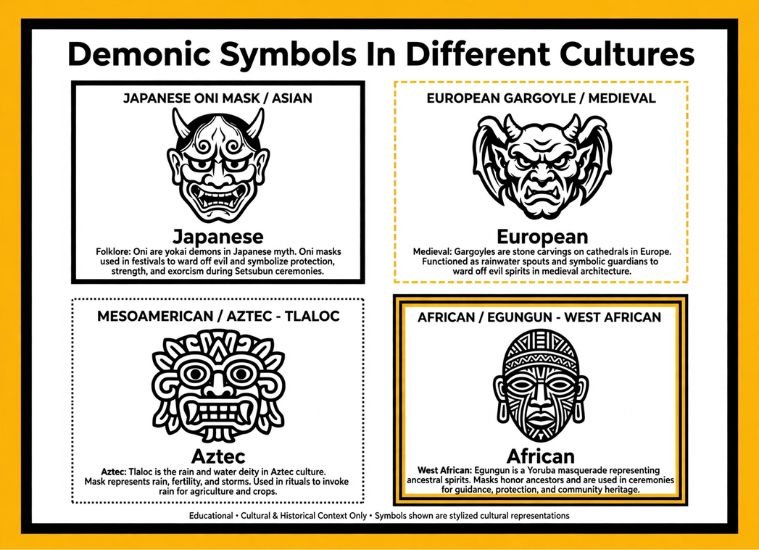
Almost every culture has its own idea of dark spirits and the signs that go with them. Japanese oni masks, Hindu rakshasa imagery, and Mesopotamian demon figures all carry local meanings.
The same shape can mean something good in one place and something frightening in another. Looking at them side by side shows how differently people have explained evil.
In some traditions, a demon is a trickster more than a villain. In others, it is a spirit that can be calmed with ritual and offerings. Masks, statues, and temple art often use bold features to show these beings. Studying them across cultures gives you a wider and fairer view than one belief system alone.
| Icon | Symbol | Meaning | Origin | Description |
| 👺 | Oni Mask | Evil spirits, punishment | Japan | A horned ogre of folklore, driven away at Setsubun. |
| 🕉️ | Rakshasa | Shape-shifting evil beings | Hindu epics (Ramayana) | Fanged demons with fierce faces, such as Ravana. |
| 🌑 | Chernobog | Darkness, misfortune | Slavic mythology (disputed) | The “Black God,” set against the white god Belobog. |
| ☪️ | Iblis / Shaitan | Temptation, disobedience | Qur’an and Islamic tradition | A being of fire who refused to bow to Adam. |
| 🪷 | Mara | Desire, illusion, death | Buddhist texts | The tempter who tried to stop the Buddha’s enlightenment. |
Explore symbols that reflect optimism, resilience, and brighter days with these Symbols of Hope inspiration.
Demonic Symbols In Christianity And Religious Texts
In Christian writing, demons are usually described through images like serpents, beasts, and fallen angels. Texts and later church art turned these ideas into visual symbols that warned believers about temptation.
The inverted cross and the serpent are among the most common examples. Many of these images are drawn from interpretation and tradition more than from direct description in scripture.
Medieval churches often carved gargoyles and devils into stone as a reminder of sin. Paintings of judgment scenes used horns, wings, and flames to make the message clear. Other religious texts have their own versions of evil spirits and warning signs. Reading them side by side shows how each faith explains the struggle between good and evil.
| Icon | Symbol | Meaning | Origin | Description |
| 6️⃣ | Mark of the Beast (666) | Allegiance to evil, tyranny | Revelation 13 | A number placed on the right hand or forehead. |
| 🐲 | Seven-Headed Dragon | Satan’s power on earth | Revelation 12 | A red dragon with seven heads and ten horns that fought Michael’s angels. |
| 🍎 | Serpent of Eden | Temptation, deception | Genesis 3 | The serpent that persuaded Eve, later identified with Satan. |
| ✝️ | Inverted Cross (Cross of St. Peter) | Humility, not evil | Early Christian tradition | Peter was said to be crucified upside down. Anti-religious groups later adopted it. |
| 🐑 | Scapegoat (Azazel) | Sin carried away | Leviticus 16 | A goat sent into the wilderness on the Day of Atonement. Azazel was later seen as a demon. |
Learn about the origins and symbolism behind familiar spooky decorations with these Halloween Symbols meanings.
Demonic Symbols In Medieval Demonology
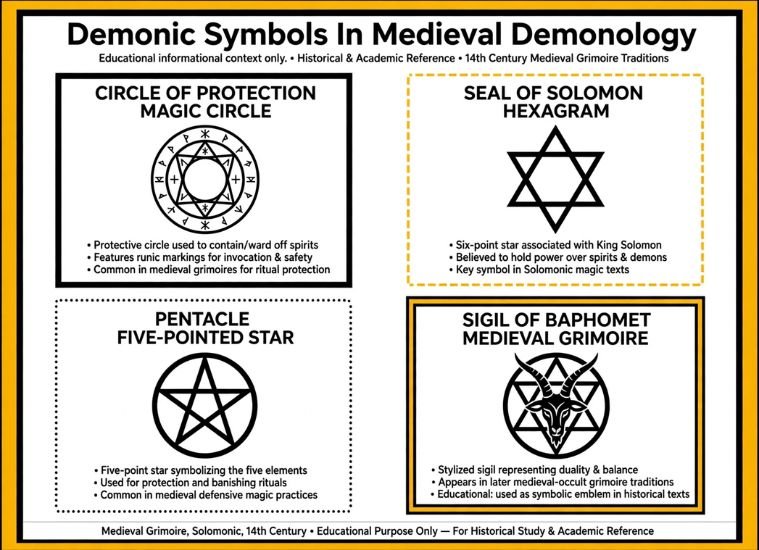
Medieval scholars wrote detailed catalogs of demons, ranks, and the marks said to belong to each one. These works gave us many of the sigils and seals that people still discuss today.
Most were written by clergy and magicians who wanted to classify spiritual beings in an orderly way. They are valuable for studying how people in that era understood fear and belief. Many of the books listed demons like nobles, with titles such as king, duke, and prince. Each one was given a special seal, a rank, and a set of powers. Handwritten copies passed between scholars and changed slightly each time. That is why you’ll often see more than one version of the same symbol.
| Icon | Symbol | Meaning | Origin | Description |
| 👑 | Seal of Solomon (Lesser Key) | Control over bound demons | Lesser Key of Solomon, 17th-century grimoire based on earlier medieval texts | A magical circle and triangle used by exorcists to command and confine spirits |
| 🐐 | Seal of Baphomet | Fusion of opposites, heresy | Linked to accusations against the Knights Templar (14th century) | A goat-headed figure, later turned into a pentagram design |
| 🔱 | Pitchfork | Torment of sinners | Medieval Christian art and mystery plays | A tool carried by devils to punish souls in Hell |
| 🦇 | Bat Wings | Darkness and fallen angels | Medieval church paintings and manuscripts | Leathery wings used to set demons apart from feathered angels |
| 🌑 | Hellmouth | Entrance to damnation | English and European medieval art and theater | A giant monster jaw that swallows the damned |
Demonic Symbols In Ancient Mythology
Ancient myths are full of monsters, tricksters, and underworld beings that later became linked with demons. Winged beasts, horned figures, and fire imagery often showed up in these stories.
They were meant to explain natural disasters, disease, and death. Over time, many of these figures were absorbed into later demon lore. Greek, Egyptian, and Mesopotamian myths all had creatures that guarded the underworld or spread chaos. Some were feared, while others were respected as part of the natural order.
Later writers borrowed their looks and gave them new roles. Understanding the myth first makes the later demon version much easier to follow.
| Icon | Symbol | Meaning | Origin | Description |
| 🐍 | Apep (Apophis) Serpent | Chaos against cosmic order | Ancient Egypt | A huge serpent that attacks the sun god Ra each night |
| 🦁 | Pazuzu Head | Wind demon, protector against evil | Assyrian and Babylonian Mesopotamia | A figure with a lion-like face, bird talons, and wings, used in amulets |
| 🐉 | Tiamat Dragon | Primordial chaos | Babylonian Enuma Elish | A sea-dragon goddess slain by Marduk to form the world |
| 🌀 | Lilitu Mark | Night spirits, danger to infants | Sumerian and Akkadian folklore | Winged female night spirits that later inspired the Lilith legend |
| 🐺 | Fenrir Wolf | Destruction and the end of the world | Norse mythology | A giant wolf bound by the gods, fated to break free at Ragnarök |
Demonic Symbols Associated With Evil Spirits
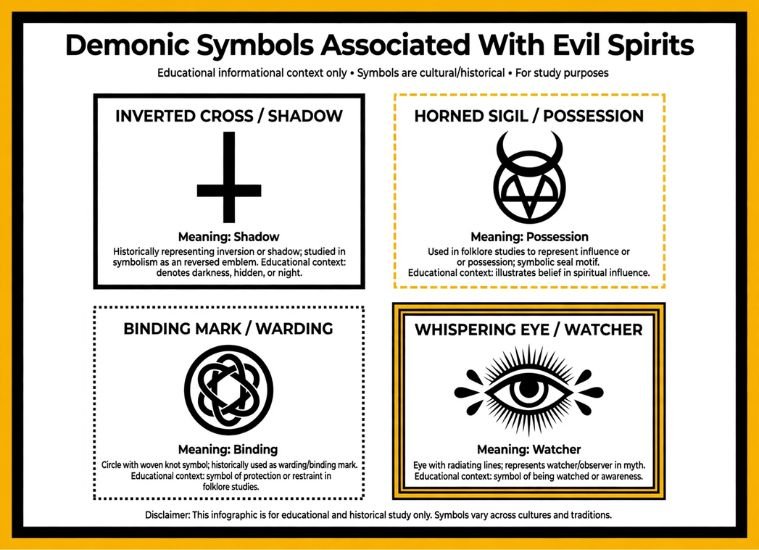
Symbols tied to evil spirits usually show up in folklore, warnings, and protective customs. People drew marks on doors, wore charms, or used certain shapes to keep harmful spirits away.
In that sense, the symbol often stands for the fear of the spirit and the wish to be safe from it. This makes the same sign both a threat and a shield, depending on the story.
Many villages had their own signs, passed down from one generation to the next. Salt, knots, and carved marks were common ways to guard a home. These customs show how everyday people dealt with fear in daily life. They also remind us that most of these symbols were about safety more than harm.
| Icon | Symbol | Meaning | Origin | Description |
| 👁️ | Evil Eye | Envy and curses | Mediterranean, Middle Eastern, and South Asian cultures | A glare believed to bring misfortune, repelled by eye-shaped charms |
| 🕯️ | Black Candle | Malevolent presence and banishing | European folk magic | Used in rituals to attract or drive away hostile spirits |
| 🪞 | Haunted Mirror | Portal for spirits | Folklore across Europe and Asia | A mirror said to trap or show restless entities, often covered after a death |
| 🕸️ | Spirit Knot | Binding or trapping spirits | Folk charms in Europe, Asia, and Africa | Knotted cords used to tie up harmful spirits or curses |
| 🧂 | Salt Circle | Barrier against spirits | Global folk practice, including European and Japanese traditions | A ring of salt believed to keep evil entities out |
Demonic Symbols And Their Connection To Satanism
Modern Satanism uses some of these symbols, mostly as signs of rebellion, independence, or personal freedom. Many groups treat them as symbolic, not as a literal worship of demons.
Common examples include the inverted pentagram and the goat-headed figure. It helps to remember that how a group uses a symbol can be very different from how outsiders read it. Some modern groups see Satan as a symbol of questioning authority. Others use the imagery mainly for art, philosophy, or shock value.
The public often confuses these groups with older folklore about devil worship. Checking what a group says about its own symbols is the fairest way to understand them.
| Icon | Symbol | Meaning | Origin | Description |
| ⛧ | Inverted Pentagram | Rejection of spiritual order, material focus | 19th-century occultism (Éliphas Lévi), adopted by modern Satanism | A five-pointed star pointing down, often enclosed in a circle |
| ✝️ | Inverted Cross | Defiance of Christianity | Originally linked to St. Peter’s crucifixion, later reinterpreted | A cross turned upside down, used as an anti-Christian statement |
| 🔥 | Sigil of Baphomet (Church of Satan) | Individualism and rebellion | Church of Satan, founded in 1966 | A pentagram with a goat’s head and Hebrew letters spelling Leviathan |
| 🔢 | 666 | The “Number of the Beast” | Book of Revelation | A number tied to the Antichrist, widely used in Satanic imagery |
| 🖤 | Black Mass Chalice | Inversion of Christian rites | Alleged in 17th-century France, dramatized in later centuries | A cup used in mock rituals that parody the Catholic Mass |
Demonic Symbols In Occult Traditions
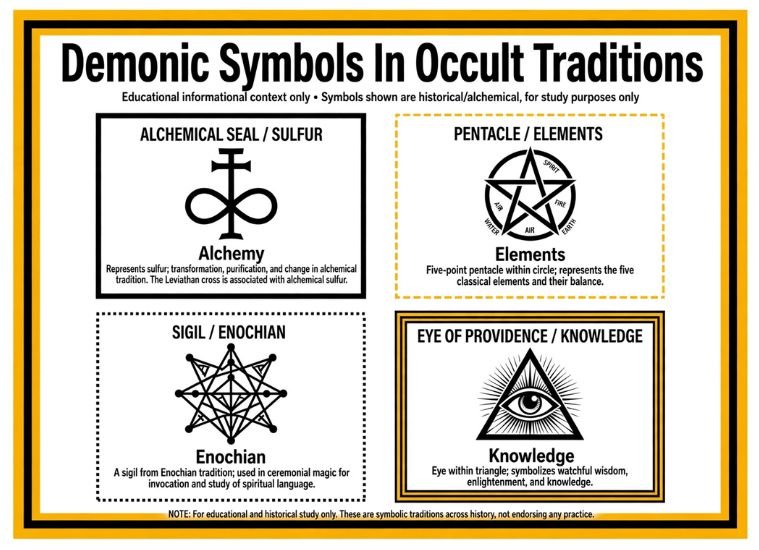
Occult traditions use symbols as tools for study, ritual, and meditation. Seals, circles, and geometric shapes are often drawn from old grimoires and ceremonial magic texts. Practitioners see them as ways to focus the mind or represent a spiritual idea. Reading them in context is the best way to understand what they were meant to do.
Many designs follow strict rules about shape, direction, and the placement of letters. Some come from Hermetic, Kabbalistic, or alchemical teachings that blend several traditions.
Writers and historians study them today as part of the history of ideas. Treat them as cultural and historical material, and they become much easier to understand.
| Icon | Symbol | Meaning | Origin | Description |
| 🔯 | Sigil of Lucifer | Light-bringer, knowledge | Grimoire tradition (Grimorium Verum) | A sigil with intersecting lines, used to invoke or represent Lucifer |
| 🜏 | Alchemical Sulfur Cross | Fire, corruption, transformation | Medieval alchemy | A triangle atop a cross, tied to brimstone and Hell |
| 🌙 | Sigil of Lilith | Rebellion and feminine power | Jewish mysticism, later occult revival | A crescent-based design representing the first wife of Adam in legend |
| 🐲 | Ouroboros | Eternal cycle, self-consumption | Ancient Egypt and Gnosticism, adopted by occultists | A serpent eating its own tail, sometimes tied to dark forces |
| 🕎 | Goetic Circle | Protection during summoning | Goetic grimoires | A ritual circle with divine names, meant to shield the magician from summoned spirits |
How To Identify Demonic Symbols Accurately
Identifying a symbol requires more than matching an image to a name found online. Similar designs may have different origins, and modern websites sometimes repeat claims without checking their historical basis.
- Check the source: Look for the manuscript, religious tradition, historical record, or publication where the symbol appears.
- Compare versions: Different drawings may be attributed to the same supernatural figure.
- Separate history from fiction: A symbol popular in a film may not have an established ancient origin.
- Consider cultural context: Religious communities can interpret the same image in different ways.
- Avoid assumptions: A symbol alone cannot reliably reveal a person’s beliefs, intentions, or behavior.
These steps make research more reliable and reduce the chance of repeating myths as established facts.
Are Demonic Symbols Dangerous?
The use of a symbol, just by being displayed or viewed, does not have any scientific evidence of a supernatural power that can harm a person. Symbols can also be emotional, cultural or religious.
What may appear harmless to one person could be disturbing or offensive to another who believe that this design is a spiritual danger.
It’s not inappropriate to view something respectfully when you don’t know what it is, especially for religious or cultural reasons. If uncomfortable, readers may opt not to display or ask about meaning of symbol. Even when there are differences in belief when it comes to spirituality, personal boundaries and cultural sensitivity are important.
Conclusion
The reason demonic symbols should be studied is that the history and meaning of them to people over time. These images are seen in religious practices, folklore, Occult writings and even in our modern entertainment but they are not each created with the same intention or source.
The inverted pentagram, Sigil of Baphomet, and other popular shapes have varied explanations and origins. Some are associated with certain contemporary movements and others have developed over a thousand years of storytelling and artistic evolution. Reliable historical evidence and the cultural context explains what is true and what is myths or common misinformation.
Also, do not make assumptions about a person’s beliefs or personality by their symbols. The way these images emerged, and the meanings that shift within them, can provide readers with a better understanding of religion, mythology, history, and popular culture in which they are embedded.
Frequently Asked Questions About Demonic Symbols
What is the most recognized demonic symbol?
The inverted pentagram and the Sigil of Baphomet are among the most recognizable designs associated with modern Satanic or demonic imagery. Their meanings depend on the context in which they are used.
Are all inverted pentagrams demonic?
No. The meaning of a five-pointed star depends on its orientation, cultural background, and use. An inverted pentagram is associated with certain modern occult and Satanic traditions, but not every appearance carries the same message.
What is the difference between demonic symbols and occult symbols?
Demonic symbols are specifically associated with demons or related supernatural figures in a particular tradition. Occult symbols form a broader category that can include astrology, alchemy, divination, ceremonial practices, and other systems of esoteric knowledge.
Do demonic symbols have the same meaning in every culture?
No. Meanings change across religious traditions, historical periods, and communities. A design viewed as threatening in one setting may have a different interpretation elsewhere.