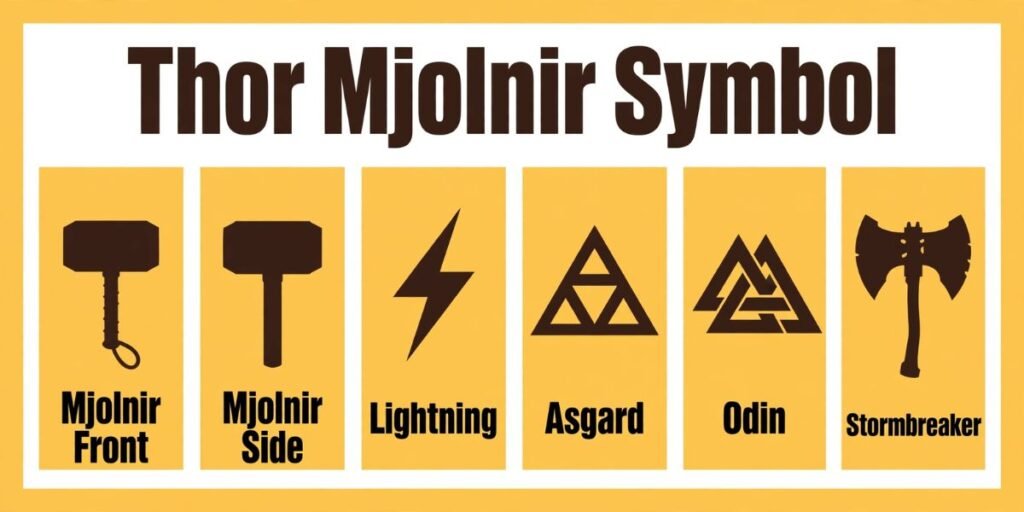
We’ve all been curious about why Thor’s Hammer is one of the most popular symbols in Norse mythology? Thor is the god of thunder, this is called Mjölnir, a powerful weapon. It is not just a battle axe that is used in the fight against the giants.
It is also a symbol of strength, courage, protection and against danger to many. In the Viking Ages, the pendants were small hammers used as symbols associated with Thor and the Norse religion.
The symbol is now used in jewelry, tattoos, books, games and movies about Marvel. Depending on the context, it could refer to ancient stories from the Nordic tradition or to an entertainment today.
Here you will discover the history of Mjölnir, its traditional meaning, its role in Viking culture and how it is used today. You will also learn why this simple hammer design is still relevant today to people worldwide.
What Does The Mjolnir Symbol Mean?

The meaning of Mjölnir comes from its connection with Thor, his powers, and the beliefs of people who honored him. Its common interpretations include:
- Strength: Thor’s hammer represents great physical power and the ability to face difficult challenges.
- Protection: Thor was known as a defender against giants and other threats, so the hammer became linked with safety.
- Courage: The symbol can represent bravery when facing danger or hardship.
- Thunder and storms: Mjölnir is closely connected with Thor’s role as the god of thunder.
- Faith and tradition: Hammer pendants were connected with Norse religious identity and cultural practices.
Explore the symbolism behind Tony Stark’s powerful chest device and its distinctive appearance in this Iron Man Arc Reactor Symbol design.
Different Mjolnir Symbol Designs And Their Uses
Historical Thor’s hammer pendants do not all look the same. Some have broad heads and short handles, while others have curved, rounded, or decorated shapes. Their appearance can vary based on the maker, material, and period.
Modern designs also include personal and artistic changes. Common examples include:
- Simple silver or steel hammer pendants
- Viking-inspired designs with carved patterns
- Mjölnir symbols combined with runes
- Modern necklaces with polished metal finishes
- Hammer designs used in tattoos and artwork
Not every decorative pattern on a modern pendant has an established ancient meaning. It is useful to check the history of a design before treating it as a traditional Viking symbol.
Explore the mystical power, protection, and connection to time represented by the Eye of Agamotto in this Doctor Strange Eye of Agamotto Symbol symbolism.
Thor Mjolnir Symbol Tattoo
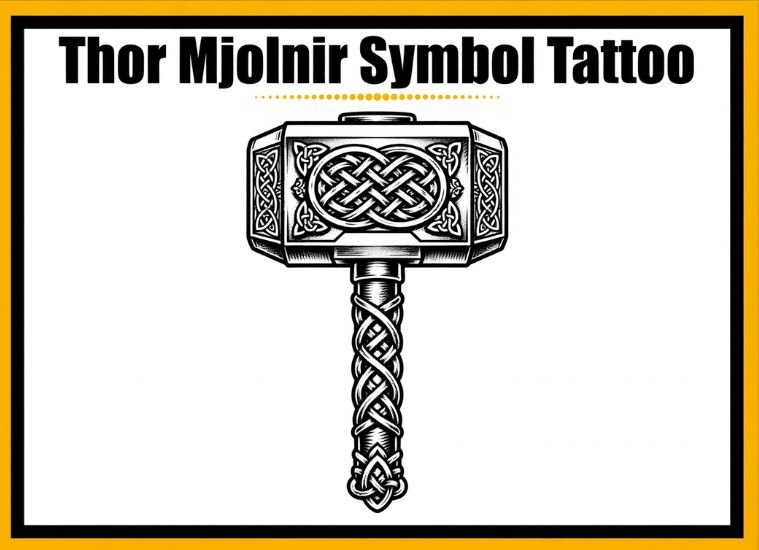
A Mjolnir tattoo is a popular pick for people who want a symbol of strength, protection, and courage. The hammer looks great as a small design on the wrist or collarbone, or as a bold piece on the arm or chest. Many people add Norse knotwork, runes, or lightning to give it more character.
Before you book your session, look into the history of the design, since some versions are tied to modern movements you may not want to be linked with. A good artist can help you pick a style that fits your story and your body.
| Icon | Symbol | Meaning | Origin | Description |
| 🔨 | Classic Pendant Mjolnir | Protection and strength | Viking Age amulets (c. 900 to 1000 CE) | A small hammer with a short handle, copied from the pendants found in Scandinavian graves. |
| 🪢 | Knotwork Mjolnir | Unbroken fate and craftsmanship | Viking Age art styles such as Borre and Urnes | A hammer filled with interlaced Norse knotwork, one of the most popular tattoo designs. |
| ⚡ | Lightning Mjolnir | Thunder and raw power | Norse myth and modern tattoo art | A hammer struck by or giving off lightning bolts, usually done in bold black work. |
| 🍂 | Oak Leaf Mjolnir | Thor’s link to the oak tree | Germanic tradition (the oak sacred to the thunder god) | A hammer framed by oak leaves and acorns, often chosen for a nature theme. |
| 🐍 | Mjolnir and the World Serpent | Courage against overwhelming odds | Norse myth (Thor and Jormungandr) | A hammer paired with a coiled serpent, a scene taken from Thor’s famous fight. |
Learn about the cultural roots and message of unity, pride, and remembrance behind the Wakanda Forever Salute Symbol history.
Thor Mjolnir Symbol Vikings
Vikings wore small Mjolnir pendants around their necks, and archaeologists have found many of them across Scandinavia. They were likely worn for protection and as a sign of faith in Thor.
A mold found in Denmark could cast both Christian crosses and Thor’s hammers, which suggests people lived between two belief systems for a time. Some pendants were simple, while others had detailed patterns in silver or bronze. Today they remain some of the best-known objects from the Viking Age.
| Icon | Symbol | Meaning | Origin | Description |
| ⚰️ | Hammer Amulets in Graves | Protection in life and the afterlife | Viking Age burials in Scandinavia and the British Isles | Small iron or silver hammers buried with the dead, worn as charms in life. |
| 🪨 | Thor Vigi Inscription | “May Thor hallow” | Læborg runestone, Denmark (10th century) | A runic blessing, sometimes paired with a carved hammer, asking Thor to consecrate a memorial. |
| 💍 | Hammer in the Bride’s Lap | Blessing of marriage and fertility | Thrymskvida (Poetic Edda) | A ritual in which the hammer was laid on the bride to bless the union. |
| ✝️ | Casting Mold for Hammers and Crosses | Faith in a time of change | Trendgarden, Jutland (Denmark), around 1000 CE | A stone mold that could make both a Mjolnir and a Christian cross, showing the religious mix of the era. |
| 🗿 | Eyrarland Thor Figure | Thor holding his hammer | Bronze figurine found in Iceland (c. 1000 CE) | A small seated figure that appears to grip a hammer, one of the few likenesses of Thor from the period. |
Mjolnir Symbol In Modern Culture

Mjolnir has moved far beyond old myths and now shows up in comics, films, video games, and jewelry. Marvel made the hammer famous with a whole new audience, and its look is now recognized almost everywhere.
Fans wear it as a pendant, hang it as wall art, and use it in cosplay. Metal bands and fantasy writers also use the hammer as a sign of power and rebellion. Each version shifts the meaning a little, but the core idea of strength stays the same.
| Icon | Symbol | Meaning | Origin | Description |
| 📚 | Marvel Comics Mjolnir | A weapon only the worthy can lift | Journey into Mystery #83 (1962) | The comic version of the hammer, with the famous inscription about those worthy of its power. |
| 🎬 | Marvel Cinematic Universe Mjolnir | Worthiness and heroism | Thor (2011) and later films | The film hammer, which became a symbol of the franchise and a favorite cosplay prop. |
| 🪖 | Halo MJOLNIR Armor | Powerful protective gear | Halo video game series (Bungie, 2001) | The name of the Master Chief’s armor, borrowed from Thor’s hammer. |
| 🎮 | God of War Mjolnir | Legacy and burden | God of War Ragnarok (2022) | A game version of the hammer, tied to Thor’s family and the story’s themes. |
| 📅 | Thursday (Thor’s Day) | The god lives on in the calendar | Old English Thunresdaeg, a translation of the Latin dies Iovis | The day of the week named after Thor, a quiet reminder of his place in language. |
Mjolnir Symbol In Norse Mythology
In Norse myth, Mjolnir is Thor’s hammer, made by the dwarf brothers Brokkr and Sindri. Loki interfered while it was being forged, which is why the handle came out short.
Even so, the gods considered it the most valuable gift they received. Thor used it to defend gods and humans from giants and other threats. The Prose Edda and the poem Thrymskvida are two of the best places to read about it.
| Icon | Symbol | Meaning | Origin | Description |
| ⚒️ | Forged by Sindri and Brokkr | Master craftsmanship | Skaldskaparmal (Prose Edda) | The dwarf brothers who made the hammer while Loki tried to ruin the work. |
| 📏 | The Short Handle | A flaw that never weakened it | Skaldskaparmal (Prose Edda) | A fly bit the smith during the forging, which left the handle shorter than planned. |
| 🥊 | Belt of Strength and Iron Gloves | Doubled might | Gylfaginning (Prose Edda) | Items Thor needs to wield the hammer, described alongside it. |
| 🕵️ | Theft by Thrym | Even gods can be tricked | Thrymskvida (Poetic Edda) | The giant who stole the hammer and demanded Freyja as his bride. |
| 👨👦 | Inheritance by Magni and Modi | Strength passed to the next generation | Vafthrudnismal (Poetic Edda) | Thor’s sons, who are said to take the hammer after Ragnarok. |
Mjolnir Symbol and Its Connection To Thunder

Thor was the god of thunder, so the hammer became closely tied to storms. When he swung or threw Mjolnir, the myths describe the sound as rolling thunder and the flashes as lightning.
People in the Viking Age may have linked storms to Thor’s work as a protector of the land. Some also saw thunder as a sign that the god was driving away dangerous forces. That link is why lightning is still a common detail in modern Mjolnir art.
| Icon | Symbol | Meaning | Origin | Description |
| 🐐 | Goat-Drawn Chariot | The sound of thunder | Gylfaginning (Prose Edda) | Thor rides a chariot pulled by the goats Tanngrisnir and Tanngnjostr, and its rumble was said to be thunder. |
| 🌳 | Donar’s Oak | Sacred tree of the thunder god | Germanic tradition, felled by Boniface at Geismar (c. 723 CE) | A famous sacred oak tied to Thor’s continental name, Donar. |
| 🪨 | Thunderstones | Fallen lightning | European folk belief | Prehistoric axe heads and fossils once thought to be bolts from the sky and used as charms against storms. |
| 🔤 | Thunraz Word Root | Thor’s name means thunder | Proto-Germanic Thunraz | The linguistic link between the god, the English word “thunder” and the German Donner. |
| 🌧️ | Rain and Harvest Blessing | Storms that feed the fields | Scandinavian folk tradition | Thor’s thunder was welcomed as a sign of rain and good crops. |
Mjolnir Symbol and the Power Of Thor
Mjolnir was more than a weapon, because it also stood for Thor’s role as protector. In the myths, the hammer always returned to his hand after being thrown.
It could also bless, as shown when it was placed in a bride’s lap during a wedding in the poem Thrymskvida. That mix of destruction and blessing gave the symbol a wide meaning. For many people, it still stands for strength used to guard others.
| Icon | Symbol | Meaning | Origin | Description |
| 🎣 | Fishing for the Midgard Serpent | Fearless challenge | Hymiskvida (Poetic Edda) | Thor hooks Jormungandr using an ox head as bait. |
| 🪓 | Duel with Hrungnir | Victory over the strongest giant | Skaldskaparmal (Prose Edda) | A fight in which Thor’s hammer shatters the giant’s stone weapon. |
| 🍺 | Trials at Utgard-Loki | Strength tested by illusion | Gylfaginning (Prose Edda) | Thor tries to drink the sea, lift a cat and wrestle an old woman, and each turns out to be a trick. |
| 🏰 | Protector of Midgard | Defender of humankind | Norse mythology | His main role as the god who keeps giants away from the human world. |
| ☠️ | Death at Ragnarok | A hero’s last battle | Voluspa (Poetic Edda) | Thor kills the serpent and then dies from its venom after nine steps. |
Mjolnir Symbol With Runes And Their Meanings

Mjolnir designs often include runes from the Elder Futhark or the Younger Futhark alphabets. Many people pick runes that match the idea of strength, protection, or the name of Thor.
The rune Thurisaz, for example, is often linked to the sound of Th, and it appears in many modern designs. Always check a rune’s real meaning with a reliable source before you use it. Placing runes carefully makes the design more accurate and more personal.
| Icon | Symbol | Meaning | Origin | Description |
| ᚦ | Thurisaz | Thorn, giant, raw force | Elder Futhark (Germanic) | A rune often tied to Thor because of its force, though its name refers to giants. |
| ᛉ | Algiz | Protection | Elder Futhark (Germanic) | A rune with branching arms, often paired with the hammer on protective jewelry. |
| ᚺ | Hagalaz | Hail, disruption, storm | Elder Futhark (Germanic) | A rune of sudden weather and change, which suits Thor’s storm side. |
| ᚾ | Nauthiz | Need, endurance | Elder Futhark (Germanic) | A rune of hardship and resilience, often chosen for strength themes. |
| ᚦᚢᚱ | Thor Spelled in Runes | His name written out | Younger Futhark inscriptions | The three runes for Thur, used on pendants and tattoos next to the hammer. |
Mjolnir Symbol As A Modern Religious Emblem
Followers of Asatru and other modern Heathen paths wear the hammer much like some Christians wear a cross. It marks their faith in the old Norse gods and their respect for ancestral tradition. In 2013, the US Department of Veterans Affairs approved Thor’s hammer as an emblem for military headstones.
That decision showed how the symbol has gained official recognition as a religious sign. Most people who wear it do so for faith or heritage, though it’s wise to know how some groups misuse it.
| Icon | Symbol | Meaning | Origin | Description |
| 📿 | Asatru Faith Emblem | Identity in modern Norse paganism | Heathen and Asatru revival (20th century) | The hammer pendant worn by many modern followers as a sign of their faith. |
| 🙌 | Hammer Hallowing Rite | Blessing a ritual or drink | Modern Heathen practice | A gesture of drawing the hammer sign over an object or space to make it sacred. |
| 🇮🇸 | Icelandic State Recognition | Official status as a religion | Asatruarfelagid, recognized in Iceland in 1973 | A landmark moment that gave the movement legal standing. |
| 🪦 | Veteran Headstone Emblem | Honoring a Heathen service member | U.S. Department of Veterans Affairs list of emblems of belief | Allows the hammer to be carved on government-supplied headstones. |
| 🕯️ | Eclectic Pagan Use | Personal connection to Thor | Modern Neopaganism | The hammer worn by Pagans outside strict Asatru groups as a protective charm. |
Conclusion
What is the reason for Thor’s symbol, Mjölnir, being so popular, even after all these years? It tells of strength, protection, courage and faith. The hammer is a symbol of Thor, the god of thunder, in the mythology of the Nordic people, who use it to ward off dangers in the world. Hammer pendants were worn by the people of the Viking Age as a part of their beliefs and traditions.
It’s now found in jewelry, tattoos, books and Marvel movies. It can have different meanings for different individuals. Some believe it is a symbol of Norse history, others associate it with personal strength or their love for Thor. This gives us an insight into its historical significance and the reasons for its popularity in culture.
Though you may have heard of it in old tales or current movies, the name Mjölnir is still a potent symbol with a rich and fascinating history.
Frequently Asked Questions About Thor Mjolnir Symbol
What does the Mjolnir symbol stand for?
Mjölnir is commonly associated with Thor, strength, thunder, and protection. Its meaning can also include courage, religious identity, and connection with Norse tradition.
Is Mjolnir a real Viking symbol?
Yes. Archaeologists have found hammer-shaped pendants from the Viking Age that are identified with Thor’s hammer. These finds provide evidence that Mjölnir was used as a symbol in historical Norse culture.
Why did Vikings wear Thor’s hammer pendants?
People may have worn them to show their connection with Thor and Norse beliefs. The pendants may also have served as protective or religious objects, although their exact purpose could vary.
What does a Mjolnir tattoo mean?
A Mjölnir tattoo can represent strength, courage, protection, or an interest in Norse mythology. Its personal meaning depends on the person who chooses the design.